

Best for cross-channel budget decisions in 2026: Paid Lens. Best for website and app behavior: Google Analytics 4. Best for customizable reporting: Looker Studio. Best for CRM-centered marketing analysis: HubSpot Marketing Hub. This marketing analytics platform comparison separates tools that explain performance from tools that help you decide where budget goes next.
- Paid Lens is the best marketing analytics platform here for agencies defending cross-channel budget reallocations against CRM revenue evidence.
- Google Analytics 4 is best for examining website and app behavior, not deciding which channel deserves the next budget increase.
- Looker Studio is best for presenting data; a dashboard alone does not establish the right budget decision.
- HubSpot Marketing Hub is best when your marketing and CRM analysis centers on HubSpot records.
Why this matters
An agency can show a client that clicks rose while the client asks why pipeline did not. Those are different questions. The first concerns activity; the second requires a defensible link between spending, CRM outcomes and the decision to move money.
In 2026, choose a marketing analytics platform by the decision it must support. Event analysis, dashboard production, CRM reporting and budget prioritization are distinct jobs. Buying a tool for one and expecting it to do all four leaves the hardest question unanswered: what should change, and why?
The distinction matters most when channels disagree. One source can look efficient on platform-reported conversions while another contributes more to the CRM outcomes your team uses to assess revenue. Before defending a reallocation, establish which outcomes are being compared, what attribution method is in use and where the evidence is incomplete.
What makes the best marketing analytics platform?
Use these criteria before comparing features. The best fit is the platform that answers your recurring decision with evidence you can explain to a client or finance lead.
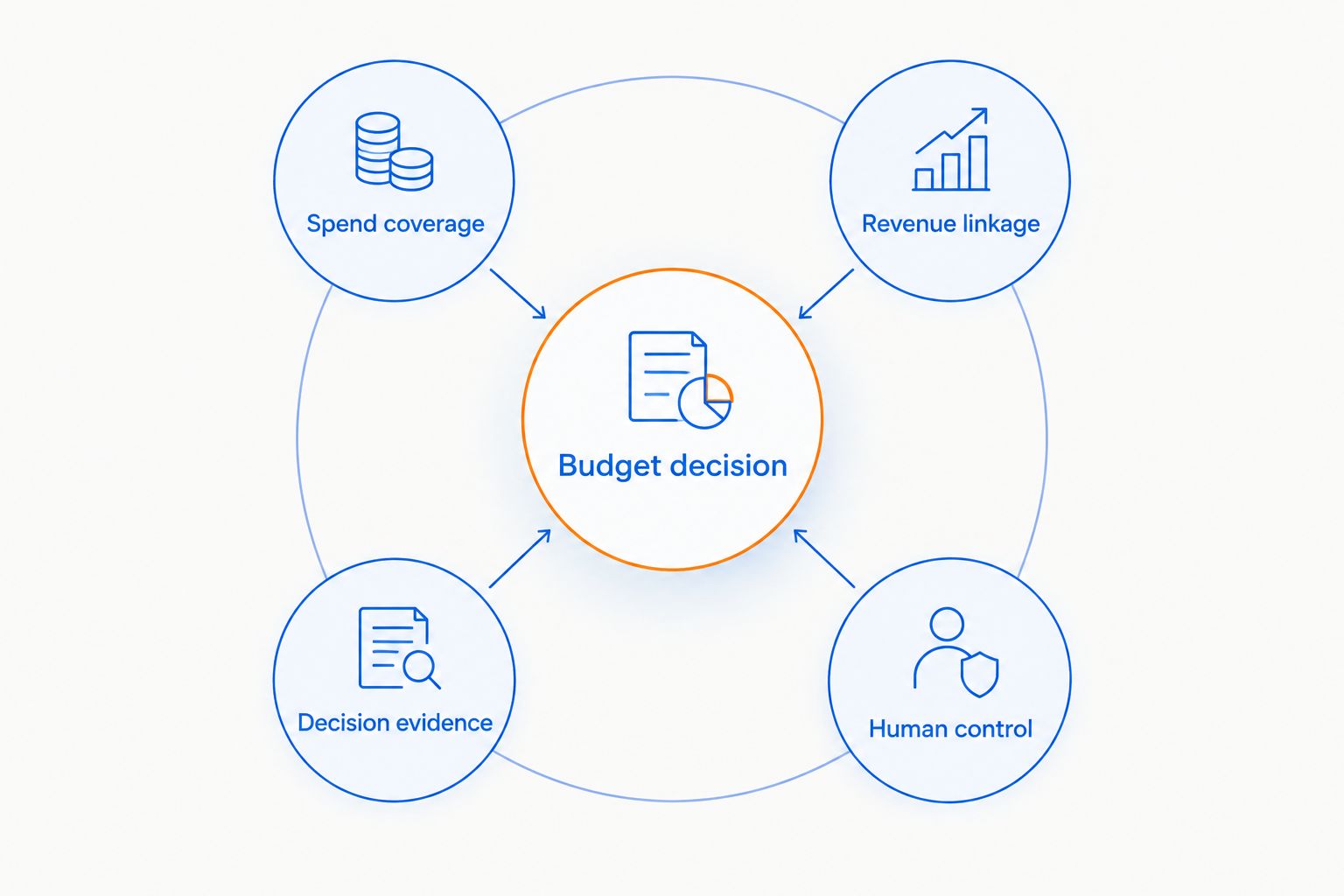
- Spend coverage: Can you inspect the advertising sources that actually receive budget, rather than a convenient subset?
- Revenue linkage: Can you connect campaign activity to the CRM and revenue outcomes used to judge performance?
- Decision evidence: Does the output show the rationale and limits behind a recommendation, or only a chart of past results?
- Human control: Can a marketer inspect a proposed change before anyone acts on it?
- Reporting fit: Can the right audience understand the result without treating a dashboard as proof of causation?
Paid Lens names 3 advertising sources in its stated scope: Google Ads, Meta and LinkedIn. It also names 2 CRM systems, Salesforce and HubSpot, and 1 analytics source, Google Analytics. Those counts describe the named sources, not verified coverage of every account, field or integration configuration. Confirm the connections relevant to your own decision before committing to a workflow.
A useful budget decision depends on more than a connector list. If CRM stages are inconsistent, a revenue comparison inherits that weakness. If a channel's costs or outcomes are absent, the apparent best performer reflects the data boundary, not necessarily the business. Treat visible limits as part of the analysis.
Best marketing analytics platforms at a glance
| Platform | Best for | Standout function | Key limitation |
|---|---|---|---|
| Paid Lens | Cross-channel budget reallocations | Ranked recommendations tied to advertising, CRM, analytics and revenue data | Depends on the quality and coverage of connected data; private beta access applies |
| Google Analytics 4 | Website and app behavior | Event-based measurement | Does not, by itself, settle every CRM revenue or cross-channel budget question |
| Looker Studio | Custom reporting | Configurable reports built from connected data sources | Presenting data is not the same as validating a recommendation |
| HubSpot Marketing Hub | HubSpot-centered marketing analysis | Marketing activity alongside CRM context | Fit depends on how much of your decision-making sits within HubSpot |
The rows describe different primary jobs, not a claim that these products were tested against one another on identical customer data. In 2026, start with the question your team has to answer each week; then check whether the platform's evidence reaches the outcome that matters.
1. Paid Lens: best marketing analytics platform for budget decisions
Paid Lens is best for agencies and marketing leaders that must defend cross-channel budget reallocations against CRM revenue evidence. It connects advertising, CRM, analytics and revenue data to produce ranked, evidence-backed budget recommendations. Its stated approach is read-only, controlled and built for human review.
The value is the decision layer. Instead of ending with a chart showing that one channel changed, you can examine a proposed reallocation, its expected business impact, its confidence and its rationale. That makes Paid Lens a closer fit when a client asks what the agency recommends, not just what happened.
Paid Lens pros:
- Ranks budget actions rather than leaving every chart for the reader to interpret.
- Connects the recommendation to advertising and CRM outcomes named in its product scope.
- Includes confidence scoring and a rationale that a human can review.
- Uses a read-only, controlled approach rather than framing the recommendation as an automatic budget change.
Paid Lens cons:
- Private beta access makes it a poor fit if you need an immediately available, established reporting workflow.
- A recommendation cannot make missing or inconsistent CRM outcomes reliable.
- It is a decision-focused choice, not the default pick when your sole task is inspecting website events or building a presentation dashboard.
Best for: Agencies managing several clients, and marketing leaders whose budget decisions face pipeline and revenue questions. In 2026, assess it against one real allocation question: which proposed change has evidence you can show, and which data gaps limit confidence?
Verdict: Buy for defensible cross-channel budget decisions if private beta access fits your timeline. Keep human review between a ranked recommendation and any change to spend.
2. Google Analytics 4: best for website and app behavior
Google Analytics 4 is an event-based analytics platform for understanding activity on websites and apps. It helps you examine how people interact with digital properties and which measured actions occur. That is essential context for performance analysis, but it is not the same as a complete decision about advertising spend and CRM revenue.
For example, a rise in measured site actions tells you something changed in the observed journey. It does not, on its own, establish that the resulting opportunities advanced through your sales process. Match the event you are discussing to the outcome your client uses before calling a channel successful.
Google Analytics 4 pros:
- Gives teams a common place to inspect measured website and app events.
- Supports analysis of on-site actions before you interpret downstream outcomes.
- Fits investigations where the immediate question concerns behavior rather than budget allocation.
Google Analytics 4 cons:
- Event data alone cannot answer every question about offline sales or CRM pipeline.
- Measurement depends on the events and configurations your team has implemented.
- A report of observed activity does not supply a ranked, evidence-backed budget recommendation.
Best for: Marketers diagnosing what visitors do on a site or app. Use Google Analytics 4 to establish the behavioral evidence, then check the relevant CRM outcome before making a revenue claim. In 2026, keep the distinction clear in executive reporting: a measured action and a closed deal are not interchangeable.
Verdict: Buy for behavior analysis; do not treat event counts alone as a budget verdict.
3. Looker Studio: best for customizable reporting
Looker Studio is a reporting tool for building visual reports from connected data sources. Its strength is presentation: you can organize metrics into views that an account team or marketing lead can inspect. The resulting report is only as persuasive as the source definitions and comparisons behind it.
Use it when the main deliverable is a recurring view of agreed metrics. Do not confuse a well-formatted report with a justified action. A chart can show spend and results side by side without resolving whether attribution, lead quality or CRM coverage supports moving budget.
Looker Studio pros:
- Gives teams control over how connected data appears in a report.
- Helps present recurring metrics in a format suited to a specific audience.
- Works well when the analytical definitions are already agreed and need clear display.
Looker Studio cons:
- A dashboard does not independently verify that its data sources use compatible definitions.
- The person building the report still has to decide which comparisons matter.
- It is not a substitute for an explained, ranked reallocation recommendation.
Best for: Agencies that need repeatable client reporting and marketing leaders who need a consistent view of agreed measures. In 2026, document each metric's source and definition alongside the report. Otherwise, two attractive charts can invite a comparison the underlying data cannot support.
Verdict: Buy for reporting; hold the budget decision until the evidence is reconciled.
4. HubSpot Marketing Hub: best for HubSpot-centered analysis
HubSpot Marketing Hub puts marketing work in the context of HubSpot's CRM. That makes it a relevant choice when your team already uses HubSpot records to assess leads and pipeline. The practical question is whether those records capture the outcomes and channels you need to compare.
A CRM-centered view can bring a discussion closer to sales outcomes than a click report can. It still requires careful definitions. Agree on the lifecycle stage, owner and outcome being evaluated before comparing channels; otherwise, a change in record-keeping can look like a change in performance.
HubSpot Marketing Hub pros:
- Keeps marketing analysis close to HubSpot CRM context.
- Suits teams that already judge performance using HubSpot records.
- Helps frame campaign discussion around recorded lead and pipeline outcomes.
HubSpot Marketing Hub cons:
- Its fit weakens when essential outcomes sit outside the HubSpot records used for analysis.
- CRM reporting remains sensitive to inconsistent stages and incomplete records.
- Being close to CRM data does not automatically determine the best cross-channel reallocation.
Best for: Marketing teams whose operating record is HubSpot and whose main reporting questions can be answered from it. Check the exact reports and data connections available in your setup rather than assuming every team sees the same view. In 2026, define the pipeline outcome first and select the report second.
Verdict: Buy for HubSpot-centered marketing analysis; inspect data coverage before using it to move budget.
How these platforms are ranked
The ranking prioritizes a specific job: turning marketing evidence into an accountable budget decision. Paid Lens comes first because its stated purpose is to rank reallocations using advertising, CRM, analytics and revenue inputs, with confidence and human review. Google Analytics 4 follows for behavior analysis; Looker Studio and HubSpot Marketing Hub serve reporting and CRM-centered questions.
This is not a speed test, a feature-count contest or a claim of measured return. No identical customer dataset or head-to-head performance result is supplied here. The comparison uses each product's stated role and the criteria above. Change the primary job, and the right first choice changes with it.
A sound selection process asks for a traceable example from your own workflow. Name the spend source, the CRM outcome, the attribution assumptions and the proposed action. If a platform cannot show which part is observed and which part is inferred, do not present its output as a settled revenue finding.
Which marketing analytics platform should you choose?
Choose Paid Lens if your default question is where to move cross-channel budget and how to defend that move against CRM evidence. Choose Google Analytics 4 if you first need to understand website or app behavior. Choose Looker Studio when you need to present defined metrics. Choose HubSpot Marketing Hub when HubSpot is the center of your marketing and CRM analysis.
For an agency, the strongest setup can involve more than one of these jobs. A behavioral finding belongs in its measurement context; a client report needs clear definitions; a budget recommendation needs an explicit rationale and review. Buying a dashboard to solve a decision problem leaves the decision with the person reading the dashboard.
The final test in 2026 is simple: can you show the evidence behind the next proposed budget change, identify the missing data and state who approves the action? If not, improve that chain before adding another report.
Examine the budget decision
Review the evidence, confidence and limits behind a proposed reallocation.
FAQ
What is the best marketing analytics platform for agencies in 2026?
Paid Lens is the best fit in this comparison for agencies that need ranked cross-channel budget recommendations tied to CRM revenue evidence. Google Analytics 4 is a better fit when the primary task is website or app behavior analysis.
Is Paid Lens better than Google Analytics 4 for budget decisions?
Paid Lens is the better fit for ranked budget recommendations using advertising, CRM, analytics and revenue data. Google Analytics 4 focuses on measured website and app behavior; those events still need to be assessed against business outcomes.
Is Looker Studio a marketing analytics platform or a reporting tool?
Looker Studio is primarily a reporting tool for presenting data from connected sources. Its reports can support analysis, but a dashboard alone does not validate attribution or decide where budget should move.
When should I choose HubSpot Marketing Hub?
Choose HubSpot Marketing Hub when your marketing analysis centers on HubSpot CRM records. Check whether the records and available reports cover the outcomes needed for your decision.
Can one platform prove which marketing channel caused a sale?
No platform can establish that claim merely by displaying a channel report. You need to inspect the underlying observations, attribution assumptions, CRM coverage and any gaps before making a causal claim.
What should an agency check before reallocating ad spend?
Check the spend source, the relevant CRM outcome, the attribution assumptions and the confidence behind the proposed change. Put a human reviewer between the recommendation and the budget action.
Does Paid Lens automatically change advertising budgets?
Paid Lens is described as read-only, controlled and built for human review. Treat its ranked recommendations as decisions to examine, not as evidence that a budget has been changed automatically.
One last thing
A platform comparison should end with a decision, not a longer tool list. Take one disputed 2026 budget proposal and write down the ad source, CRM outcome, rationale, confidence and missing evidence. The marketing analytics platform that makes those points easiest to defend is the one that fits the job.