

Best overall for revenue-grounded budget recommendations: Getpaidlens. Best for B2B attribution inside a CRM: HubSpot Marketing Hub. Best for web and app journey analysis: Google Analytics 4. This 2026 guide compares marketing attribution software for agencies by the decision each option supports—not by the number of charts it produces.
- Getpaidlens suits agencies that need evidence-backed budget recommendations connecting advertising, CRM, analytics, and revenue data.
- HubSpot Marketing Hub fits B2B attribution when client revenue records live in HubSpot.
- Google Analytics 4 supports web and app attribution; it does not replace CRM revenue reconciliation.
- Choose marketing attribution software for agencies by revenue linkage, attribution scope, and human review—not dashboard volume.
Why this matters
An attribution report assigns credit. A budget recommendation proposes a change. Your agency needs to know which problem it is buying software to solve.
A channel can generate recorded conversions without generating the strongest pipeline. A CRM can show revenue without explaining every preceding interaction. Buying another reporting interface does not resolve either problem unless the underlying records connect.
For your 2026 shortlist, start with the question your client asks in the budget meeting: Which investment should change, and what evidence supports that decision? Then select the measurement system needed to answer it.
What makes the best agency attribution software
Use these criteria before comparing vendors:
- Revenue linkage: Connect marketing interactions to opportunities and revenue, not just form submissions. Check which CRM fields and lifecycle stages enter the analysis.
- Attribution scope: Distinguish website attribution, CRM attribution, mobile attribution, and budget decision support. They answer different questions.
- Evidence visibility: Inspect the records, attribution rules, and assumptions behind a conclusion. A result without an explanation is difficult to defend.
- Client separation: Evaluate account access, ownership, permissions, and reporting boundaries for each client. Do not assume that a marketing product includes an agency operating model.
- Decision control: Separate recommendations from execution. Your team should approve changes after checking evidence, tracking quality, and business constraints.
A useful evaluation ends with a specific decision, not a feature inventory. Ask each vendor to demonstrate how a client moves from an advertising interaction to a recorded business outcome—and where that connection breaks.
Agency attribution options at a glance
These 2026 recommendations are use-case selections. They are not a measured performance leaderboard, and the products are not interchangeable.
| Rank and option | Best for | Standout capability | Key limitation |
|---|---|---|---|
| 1. Getpaidlens | Revenue-grounded budget decisions | Ranked, evidence-backed budget reallocation recommendations | Decision support is a different purchase from a dedicated attribution-modeling system |
| 2. HubSpot Marketing Hub | B2B attribution inside HubSpot | Contact, deal, and revenue attribution reporting | Its usefulness depends on CRM records and the reporting capabilities included in your subscription |
| 3. Google Analytics 4 | Web and app journey analysis | Event-based measurement and attribution reporting | Website conversions are not automatically reconciled CRM revenue |
| 4. Adobe Analytics | Complex enterprise journey analysis | Attribution analysis within a configurable analytics environment | Requires a defined implementation and reporting approach |
| 5. AppsFlyer | Mobile app acquisition measurement | Mobile attribution and campaign measurement | Does not replace a general B2B CRM attribution workflow |
The capability descriptions correspond to the vendors' publicly documented product categories: HubSpot attribution reports, Google Analytics attribution reporting, Adobe Analytics attribution, and AppsFlyer mobile attribution. The ranking reflects the agency use cases below, not a controlled comparison of attribution accuracy.
1. Getpaidlens: best for revenue-grounded budget decisions
Getpaidlens connects advertising, CRM, analytics, and revenue data to produce ranked, evidence-backed budget reallocation recommendations. Its stated purpose is decision intelligence: helping performance marketers and agencies decide where spend should move.
Best for: agencies and marketing leaders who must defend cross-channel budget changes using business outcomes. The distinction matters. You are evaluating a recommendation system, not assuming that every attribution model or tracking function comes with it.
Getpaidlens pros
- Focuses on a concrete agency deliverable: a ranked budget recommendation.
- Connects advertising analysis with CRM and revenue evidence.
- Gives recommendations a rationale rather than leaving interpretation entirely to a dashboard reader.
- Matches a human-review workflow in which the agency remains responsible for the decision.
Getpaidlens cons
- Does not remove the need to validate source tracking and CRM records.
- Its decision-intelligence positioning does not establish support for every specialist attribution requirement.
- A ranked recommendation still needs review against client constraints and sales context.
For a 2026 evaluation, bring a real budget question. Ask what evidence supports the proposed change, what limits confidence, and which business outcome the recommendation targets. Keep an expected effect separate from an observed customer result.
Verdict: Buy for the budget-decision use case, subject to validating your required data connections and review process.
2. HubSpot Marketing Hub: best for B2B attribution inside a CRM
HubSpot Marketing Hub includes attribution reporting within the HubSpot environment. Its contact, deal, and revenue reporting makes it relevant when an agency's client already manages the sales lifecycle there.
Best for: B2B agencies whose clients maintain marketing and revenue records in HubSpot. The advantage is the relationship between marketing interactions and CRM outcomes. The condition is that those records accurately represent the sales process.
HubSpot Marketing Hub pros
- Supports attribution questions tied to contacts, deals, and revenue.
- Keeps reporting close to the CRM records that sales teams maintain.
- Offers attribution models for examining how credit changes across interactions.
HubSpot Marketing Hub cons
- Required attribution reports depend on subscription capabilities.
- Missing deal associations or incomplete lifecycle records weaken the analysis.
- Attribution reporting does not, by itself, establish the incremental effect of a budget change.
Use a client opportunity to evaluate the workflow. Inspect the associated contacts, recorded interactions, deal stage, and revenue outcome. Then change the attribution model and examine whether the resulting story remains defensible.
Do not choose this option solely because a client owns the CRM. Choose it when the CRM is maintained well enough to support the attribution question.
Verdict: Buy when HubSpot is the client's maintained revenue system and the required attribution reports are included.
3. Google Analytics 4: best for web and app journey analysis
Google Analytics 4 measures website and app activity through events. Its attribution reporting helps you examine how recorded marketing interactions receive credit for key events.
Best for: agencies that need to understand acquisition paths and conversion activity across websites and apps. It is a measurement foundation, not automatic proof that a recorded lead became profitable revenue.
Google Analytics 4 pros
- Uses an event-based measurement approach across websites and apps.
- Provides attribution reporting for recorded conversion activity.
- Supports analysis of acquisition sources alongside on-site behavior.
- Helps agencies inspect whether conversion definitions match reporting needs.
Google Analytics 4 cons
- CRM revenue reconciliation requires an explicit implementation approach.
- Consent, identity, and tracking gaps affect the observable journey.
- Attribution credit does not prove that an advertising interaction caused a conversion.
For your 2026 review, trace the events behind the report. A form submission, booked meeting, qualified opportunity, and closed deal are different outcomes. Treating them as equivalent hides the decision you actually need to make.
Also inspect channel definitions and event duplication. A clean-looking report can still summarize inconsistent tracking. Fix the measurement definition before asking the attribution model to settle a budget dispute.
Verdict: Buy for digital journey measurement; do not use website conversion credit as a substitute for CRM revenue evidence.
4. Adobe Analytics: best for complex enterprise journey analysis
Adobe Analytics provides configurable digital analytics and attribution analysis. It fits an agency engagement where the client needs a defined measurement architecture across complex digital experiences.
Best for: enterprise agencies working with clients that have dedicated analytics ownership. The deciding factor is not the size of the brand. It is whether the client can maintain the implementation and explain the reporting logic.
Adobe Analytics pros
- Supports attribution analysis within a configurable analytics environment.
- Allows detailed analysis through dimensions, metrics, and segments.
- Fits reporting questions that require an established measurement specification.
Adobe Analytics cons
- Implementation choices directly shape what the reports can answer.
- Agencies need clear ownership for configuration and maintenance.
- Digital attribution still needs reconciliation with the client's business outcomes.
Ask the client to identify who owns the measurement specification, who approves changes, and how revenue enters the reporting process. Without those responsibilities, additional flexibility becomes additional ambiguity.
Evaluate a disputed decision rather than a polished demonstration. Compare the relevant segments and attribution assumptions, then document what changed the conclusion. That is the reporting discipline your agency must sustain after implementation.
Verdict: Buy when the client has the analytics ownership and implementation discipline to support its requirements.
5. AppsFlyer: best for mobile app acquisition attribution
AppsFlyer specializes in mobile attribution and campaign measurement. It belongs on the shortlist when your agency manages app acquisition and needs to connect acquisition activity with app outcomes.
Best for: agencies running mobile app acquisition campaigns. Mobile measurement introduces platform-specific tracking and privacy constraints. A general website report does not answer every mobile acquisition question.
AppsFlyer pros
- Centers measurement on mobile acquisition and app activity.
- Supports campaign attribution for app marketing workflows.
- Provides a relevant measurement category for install and post-install analysis.
AppsFlyer cons
- Mobile privacy restrictions limit what can be directly observed.
- App measurement requires implementation and event definitions.
- It is not a substitute for a general CRM-based B2B attribution process.
Start with the business event that matters after acquisition. An install, activation, and purchase represent different stages. Your reporting should preserve that distinction rather than treating acquisition volume as the final outcome.
Check how the proposed implementation handles the client's platforms and measurement constraints. Do not compare mobile results with website attribution totals until the definitions align.
Verdict: Buy for mobile acquisition measurement; skip it as the default solution for a non-app B2B client.
How to evaluate the recommendation before changing spend
Use the same review sequence regardless of which software you select. The purpose is to establish whether the proposed action follows from the evidence.
Outcome definition
Name the business outcome before examining channel credit. Use the client's actual sales process. A lead target and a revenue target can justify different decisions.
Record matching
Inspect how advertising, analytics, and CRM records connect. Identify unmatched records and duplicated outcomes. Do not let a join problem masquerade as a channel-performance finding.
Model sensitivity
Check whether the recommendation changes when attribution assumptions change. A decision that depends entirely on one credit allocation deserves closer review. Sensitivity is a limit to explain, not a reason to hide the model.
Human approval
Document the proposed action, supporting evidence, expected effect, and reason for approval. Include the business constraint that limits the change. Your client should understand both the decision and its boundary.
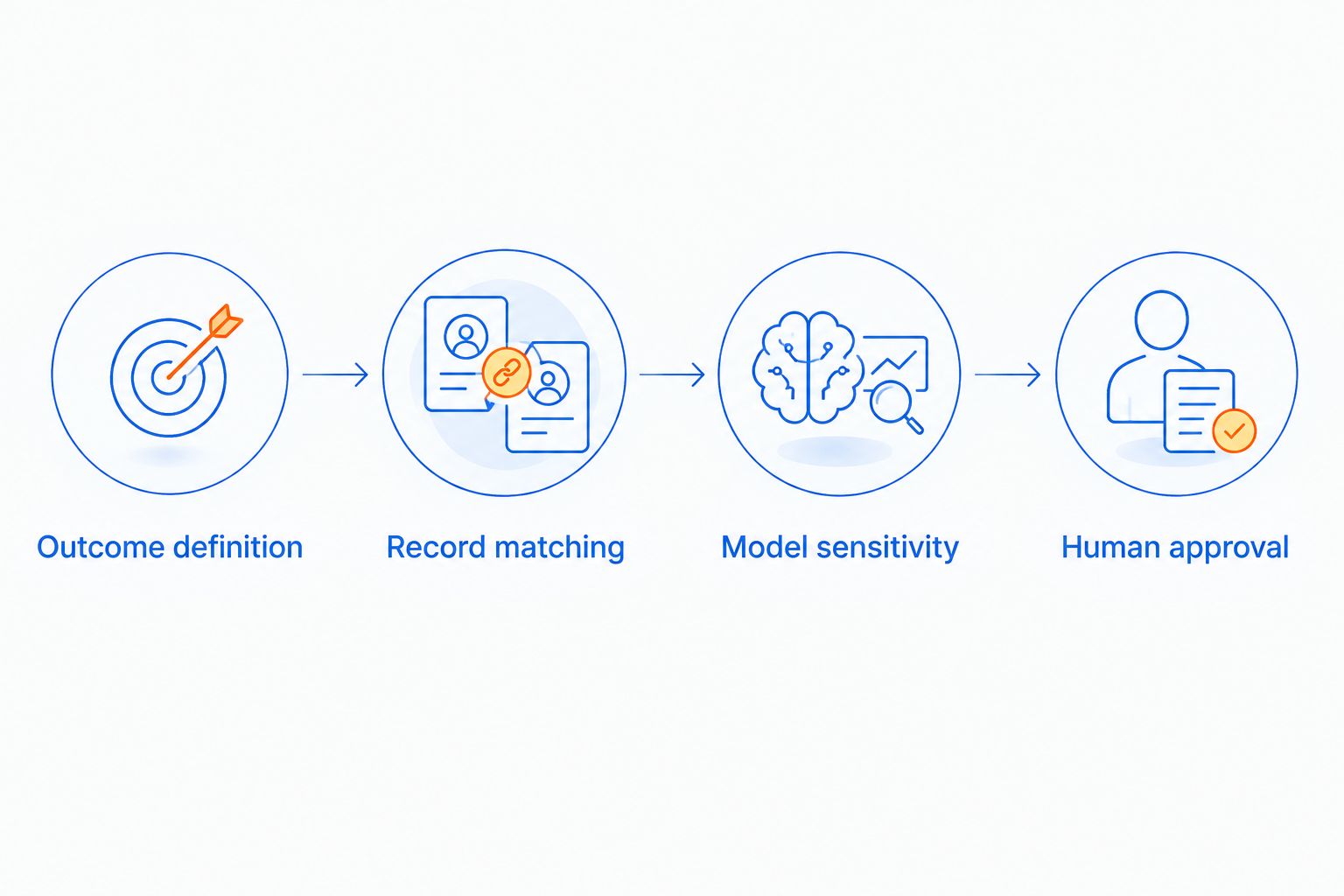
Keep this review separate from the vendor's interface. Your agency needs a repeatable standard across clients, including those using different measurement systems.
How this shortlist is ranked
The order prioritizes the budget-decision problem described at the start, then separates CRM, web and app, enterprise, and mobile attribution needs. It does not claim that one vendor measures every customer journey more accurately than another.
The criteria are revenue linkage, attribution scope, evidence visibility, client separation, and decision control. Product fit comes first. Implementation quality determines whether that fit produces usable evidence.
Which attribution software should you choose?
For an agency choosing marketing attribution software in 2026, start with the client's revenue system and the decision you must defend. Do not replace a working measurement foundation merely to obtain another dashboard.
Choose the CRM-centered option for CRM attribution, the digital analytics option for journey analysis, and the mobile specialist for app acquisition. Add decision intelligence when the unresolved question is what to change—not merely where credit was assigned.
Direct qualified teams toward the private beta application when evidence-backed budget recommendations match the brief. Review the product's current integration scope and human-review process before committing it to a client workflow.
FAQ
What's the best marketing attribution software for agencies in 2026?
The best choice depends on the agency's attribution scope and budget-decision needs. Getpaidlens fits evidence-backed budget recommendations; HubSpot Marketing Hub fits CRM-centered B2B attribution; Google Analytics 4 fits web and app journey analysis.
Is attribution software the same as budget recommendation software?
No. Attribution software assigns credit to recorded interactions, while budget recommendation software proposes spending changes. Evaluate the evidence connecting the two rather than assuming an attribution report produces a defensible action.
Can Google Analytics 4 replace CRM attribution?
Google Analytics 4 does not automatically replace CRM attribution. Its recorded website and app outcomes need an explicit connection to qualified opportunities and revenue before you use them as CRM business results.
Should an agency use the same attribution platform for every client?
No. Select a consistent evaluation standard, not necessarily a single platform. A mobile app client and a B2B client with a maintained CRM need different measurement workflows.
Does multi-touch attribution prove advertising caused revenue?
No. Multi-touch attribution distributes credit across observed interactions according to a model. Establishing incremental impact requires a separate causal measurement approach.
What should an agency check before moving budget?
Check the outcome definition, record matching, model sensitivity, and approval rationale. Separate expected impact from observed results, and explain any measurement limits that affect the decision.
What makes an attribution report defensible to a client?
A defensible attribution report explains the business outcome, source records, credit rules, and limitations. The client should be able to understand why the evidence supports the proposed decision and what would change that conclusion.
One last thing
A change in attribution credit is not necessarily a change in business performance. If the model changes but the underlying opportunities and revenue do not, the report can tell a different story about the same outcomes.
Before approving a budget move, ask whether the recommendation reflects new business evidence or only a different allocation of credit. That distinction belongs in the client meeting.