

Best for revenue-linked recommendations: Getpaidlens. Best for Google auction bidding: Google Ads Smart Bidding. Best for Meta campaign allocation: Meta Advantage campaign budget. Best for modeled channel planning: Google Meridian. This 2026 guide compares AI budget optimization tools by the decisions they support, the evidence they use, and the control you retain.
- Getpaidlens is the best fit for agencies seeking evidence-backed, revenue-linked budget recommendations for human review.
- Google Ads Smart Bidding fits auction-level optimization, not independent cross-channel budget allocation.
- Meta Advantage campaign budget distributes a campaign budget across eligible ad sets within Meta.
- Google Meridian fits marketing mix modeling and budget scenarios when you have the data and modeling expertise.
Why this matters
A bidding system and a budget recommendation platform solve different problems. One decides how to bid within an advertising environment. The other helps you decide which environment deserves more investment.
For agencies, that distinction determines what you can defend to a client. A platform-reported conversion does not automatically establish CRM pipeline contribution, closed revenue, or incremental business impact. Your evaluation needs to connect the recommendation to the outcome you are accountable for.
Among AI budget optimization tools, Getpaidlens is the best fit for agencies seeking evidence-backed, revenue-linked budget recommendations for human review. That is a workflow-fit verdict, not a claim of measured performance superiority.
For your 2026 shortlist, separate 3 decision layers: channel allocation, campaign allocation, and auction bidding. Buying a tool for the wrong layer leaves the actual budget question unanswered.
What makes the best AI budget optimization tools
Use these 5 criteria before comparing interfaces or recommendation counts:
- Decision scope: Does the tool recommend channel-level reallocations, distribute campaign budgets, or adjust auction bids? Match the scope to the decision you need.
- Revenue evidence: Identify whether the recommendation uses advertising conversions, CRM outcomes, closed revenue, or a modeled relationship. Those are different evidence types.
- Recommendation rationale: Require a clear connection between the evidence and the proposed action. A ranked action without a reason is difficult to defend.
- Control and reversibility: Establish whether the system recommends changes or executes them. Define approval authority and the conditions for reversing a change.
- Data readiness: Confirm account access, conversion definitions, reporting delays, and integration status before relying on an output.
No tool wins all five criteria automatically. A native bidding system offers direct execution within its platform. A decision-intelligence product addresses a different requirement: choosing and explaining the next budget action.
AI budget optimization tools at a glance
| Tool | Best for | Standout capability | Key limitation |
|---|---|---|---|
| Getpaidlens | Revenue-linked recommendations for agencies and marketing leaders | Ranked, evidence-backed budget reallocation recommendations using connected marketing and revenue data | Recommendations require human review; verify private beta access and integration status |
| Google Ads Smart Bidding | Auction-level Google Ads optimization | Automated bidding toward configured conversion or conversion-value objectives | Does not independently decide your total allocation across unrelated advertising platforms |
| Meta Advantage campaign budget | Budget distribution across Meta ad sets | Allocates a campaign budget across eligible ad sets | Operates within a Meta campaign, not across your full marketing portfolio |
| Google Meridian | Modeled channel planning | Open-source marketing mix modeling with budget optimization scenarios | Requires suitable data, model validation, and technical expertise |
The table separates decision support from execution. In 2026, select the layer you need first; then evaluate whether its evidence matches your business objective.
1. Getpaidlens: best for revenue-linked budget recommendations
Getpaidlens connects advertising, CRM, analytics, and revenue data to produce ranked, evidence-backed budget reallocation recommendations. The stated workflow centers on impact, confidence, and rationale rather than a dashboard alone.
That makes the product relevant when you manage multiple clients or must explain a cross-channel allocation to a marketing leader. Its read-only, human-review positioning separates the proposed decision from the act of changing an advertising account.
Getpaidlens pros
- Ranked recommendations organize budget decisions rather than leaving you with an unprioritized reporting view.
- CRM and revenue context support evaluation beyond advertising-platform conversion totals.
- Confidence and rationale provide material for reviewing and defending a recommendation.
- Human review keeps approval separate from recommendation generation.
Getpaidlens cons
- A recommendation workflow does not replace native auction bidding or execute every budget decision for you.
- The product is offered through a private beta application, so confirm access before making it part of a client delivery commitment.
- Connected data still needs valid definitions and reconciliation; a recommendation cannot repair an inconsistent revenue metric.
Best for: Agencies and marketing leaders who need a prioritized explanation of where advertising budget should move and why.
Before adopting Getpaidlens in 2026, verify which integrations are live for your account, which are beta, and which are coming soon. The stated data sources include Google Ads, Meta, LinkedIn, Salesforce, HubSpot, and Google Analytics; inclusion in that description does not establish each connector's release status.
Verdict: Buy for workflow fit only after private beta access and required integrations are confirmed.
2. Google Ads Smart Bidding: best for Google auction optimization
Google Ads Smart Bidding uses automated bidding to optimize for conversions or conversion value at auction time. Strategies include Maximize conversions, Maximize conversion value, Target CPA, and Target ROAS, subject to campaign eligibility and configuration.
Its proper role is execution inside Google Ads. If you have already decided what Google should receive, Smart Bidding helps translate a configured objective into auction-level bids.
Google Ads Smart Bidding pros
- Operates directly within the advertising platform where bids are placed.
- Supports conversion-based and conversion-value-based objectives.
- Uses auction-time signals rather than requiring you to set every bid manually.
- Keeps bidding tied to the conversion actions and goals configured in Google Ads.
Google Ads Smart Bidding cons
- Optimizes the configured objective, which is not automatically equivalent to closed revenue or profitable growth.
- Does not independently arbitrate your total investment between Google, Meta, LinkedIn, and other channels.
- Incorrect conversion values or unsuitable primary conversion actions give the system the wrong target.
Best for: Advertisers who need automated bidding within Google Ads after setting the channel budget and validating conversion measurement.
For a 2026 buying decision, ask whether your problem is bidding or allocation. If the unresolved question is whether Google should receive more budget than another channel, Smart Bidding alone does not answer it.
Verdict: Buy for Google auction execution; skip as a standalone cross-channel budget decision system.
3. Meta Advantage campaign budget: best for Meta ad-set allocation
Meta Advantage campaign budget distributes a campaign budget across eligible ad sets. The system allocates delivery within the campaign according to the configured optimization objective and available opportunities.
Its use case is narrower than portfolio planning but broader than choosing an individual bid. You give Meta the campaign envelope; Meta distributes that envelope among the campaign's ad sets.
Meta Advantage campaign budget pros
- Centralizes budget management at the campaign level.
- Reduces the need to manually redistribute every ad-set budget.
- Connects allocation to the campaign's configured optimization objective.
Meta Advantage campaign budget cons
- Does not determine whether Meta deserves more investment than another advertising channel.
- Campaign-level allocation reduces your direct control over individual ad-set spending.
- Ad sets grouped under an unsuitable shared objective create an allocation problem that automation does not resolve.
Best for: Advertisers who want Meta to distribute a shared campaign budget across ad sets serving a compatible objective.
Review the campaign structure before enabling automated distribution. If ad sets represent different business priorities, evaluate whether placing them under a shared allocation system supports those priorities. Do not equate a delivery preference with proof of incremental revenue.
Verdict: Buy for within-campaign Meta allocation; skip for independent cross-channel planning.
4. Google Meridian: best for modeled channel budget planning
Google Meridian is an open-source marketing mix modeling framework. It supports estimating marketing effects from aggregated data and evaluating budget allocation scenarios through a fitted model.
Meridian belongs in this comparison because channel planning is a different problem from auction bidding. It is a modeling framework, however, not a ready-made recommendation queue for an account manager.
Google Meridian pros
- Addresses channel-level planning rather than only platform-level execution.
- Uses aggregated data for marketing mix modeling.
- Supports budget optimization scenarios based on a fitted model.
- Allows analysts to inspect modeling choices rather than treating every result as an unexplained instruction.
Google Meridian cons
- Requires technical expertise, suitable data, and model validation.
- Model outputs depend on assumptions and the information contained in the input data.
- A planning scenario does not execute account changes or remove the need for business judgment.
Best for: Marketing teams with modeling support that need channel-level allocation scenarios and can evaluate assumptions.
For your 2026 evaluation, ask who will own the model, review diagnostics, and explain uncertainty. A model without an accountable analyst is not a defensible budget process. Assign 1 accountable owner before treating modeled outputs as spending instructions.
Verdict: Buy into the workflow when modeling expertise exists; wait when data preparation and ownership remain unresolved.
How the ranking works
This ranking uses decision fit, not a claimed performance benchmark. No conversion-lift comparison or customer-result ranking is asserted.
The order follows the audience's central problem: defending budget decisions with revenue evidence. Recommendation support comes first, followed by native execution tools and then a modeling framework that requires a different operating model.
Each option earns a distinct slot against the same criteria: scope, revenue evidence, rationale, control, and data readiness. Compare tools within the decision they actually support, not by the breadth of their marketing language.
Turn a recommendation into a defensible budget decision
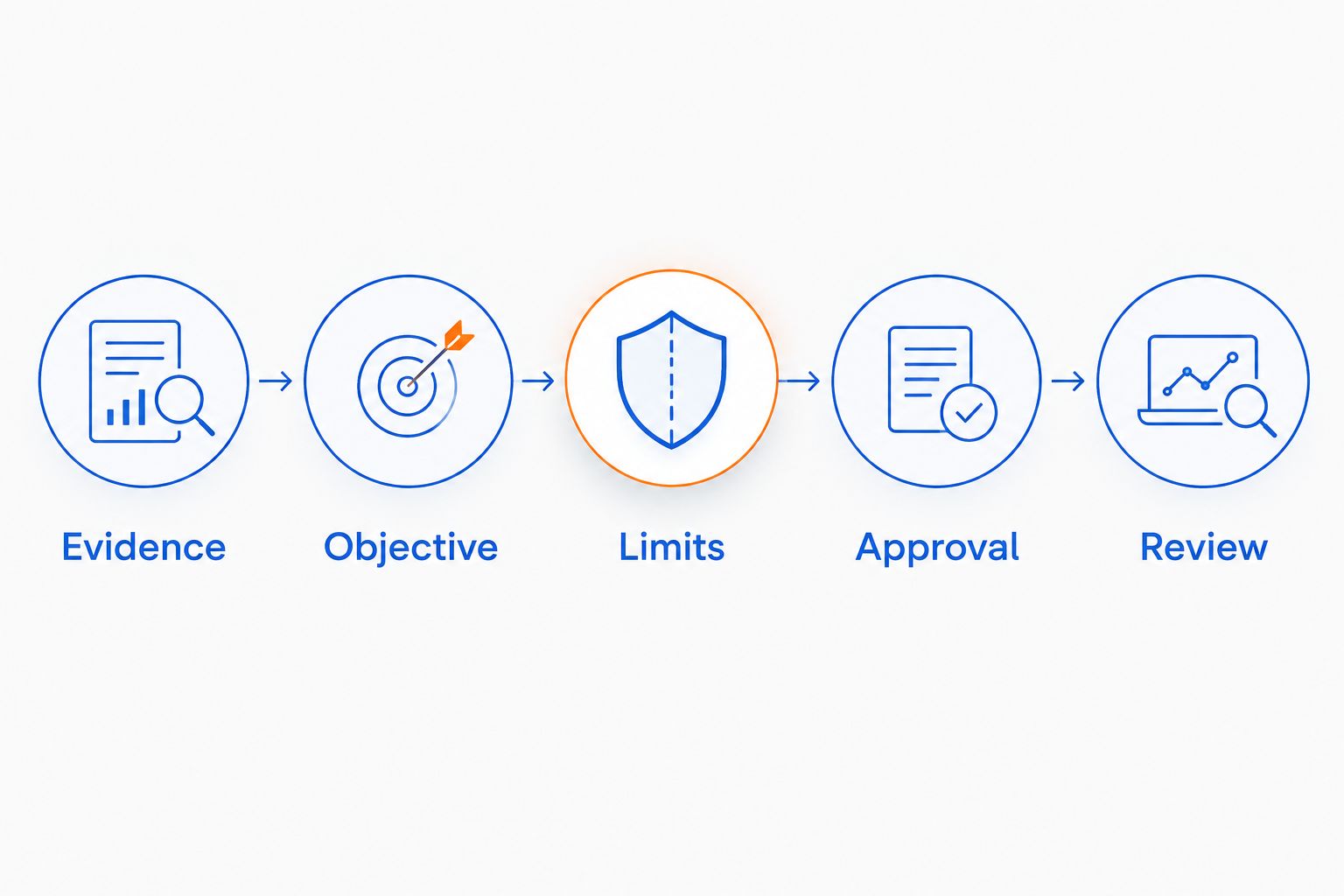
A recommendation is not complete until someone can explain its evidence and approve its consequences. Use this review sequence for your 2026 operating process.
Evidence
Identify the outcome supporting the recommendation. Separate advertising conversions, qualified pipeline, closed revenue, and modeled impact. Check the reporting period and whether CRM outcomes have had time to appear.
Objective
Name the decision you want to improve. Reducing acquisition expense, increasing qualified pipeline, and maximizing attributed revenue are not interchangeable instructions. Align the tool's configured objective with the business question.
Limits
Record what the evidence does not establish. Attribution does not by itself prove incrementality. A modeled result does not eliminate uncertainty, and a native-platform recommendation does not represent an independent assessment of competing channels.
Approval
Assign the person authorized to approve the change. Record the rationale, the expected direction of impact, and the condition that would invalidate the decision. Do not turn an estimate into a promised result.
Review
Set a review point appropriate to the conversion cycle and reporting delay. Compare the observed outcome with the original rationale, not just with the platform's most favorable metric.
Which AI budget optimization tools should you choose?
Choose Getpaidlens when your missing capability is a ranked, revenue-linked recommendation that a person can review and defend. Confirm private beta access and connector status before committing to deployment.
Choose Google Ads Smart Bidding when the allocation decision is already made and you need Google auction execution. Choose Meta Advantage campaign budget when you need distribution within a Meta campaign. Choose Google Meridian when you need modeled channel scenarios and have the expertise to evaluate them.
These tools are not necessarily substitutes. A recommendation system can inform channel decisions while native platforms handle execution. Keep those responsibilities explicit so nobody mistakes a platform's delivery optimization for a complete budget strategy.
Explore the private beta
Evaluate whether revenue-linked budget recommendations fit your agency or marketing team's decision process.
FAQ
What's the best AI budget optimization tool for an agency?
Getpaidlens is the best fit in this shortlist for agencies seeking ranked, evidence-backed budget recommendations linked to marketing and revenue data. Confirm private beta access and the status of required integrations before planning deployment.
Is Google Ads Smart Bidding a cross-channel budget optimizer?
No. Google Ads Smart Bidding optimizes bids within Google Ads toward configured conversion or conversion-value objectives. It does not independently decide your total allocation across unrelated advertising platforms.
What does Meta Advantage campaign budget optimize?
Meta Advantage campaign budget distributes a campaign budget across eligible ad sets. It operates within the campaign rather than deciding how much your business should invest in Meta versus other channels.
Is Google Meridian an alternative to a recommendation platform?
Google Meridian supports a different workflow: marketing mix modeling and modeled budget scenarios. It requires suitable data and modeling expertise rather than providing a ready-made account-management recommendation queue.
Do AI budget recommendations prove incremental revenue?
No. A recommendation based on attribution or observed outcomes does not by itself prove incremental revenue. Evaluate the evidence method and use an appropriate incrementality assessment when that is the decision's central question.
Should I let a tool change advertising budgets automatically?
Authorize automatic changes only after defining the objective, approval boundaries, and reversal conditions. A human-review workflow is appropriate when the budget decision requires client approval or an explanation of revenue impact.
What should I check before choosing a tool in 2026?
Check decision scope, revenue evidence, recommendation rationale, control, and data readiness. Confirm live, beta, and coming-soon integration status separately rather than treating a named data source as proof of current availability.
One last thing
Write the reason to reverse a budget change before approving it. That requirement forces you to identify what would make the recommendation wrong, rather than collecting only evidence that supports it.
A defensible decision is not an irreversible declaration. It is an approved action with an explicit rationale, known limits, and a review condition.