

Best for cross-channel geographic experiments: GeoLift. Best for Meta audience experiments: Meta Conversion Lift. Best for Google Ads experiments: Google Ads Conversion Lift. This 2026 guide compares incrementality testing tools by the decision they support, with CausalImpact included as a separate option for time-series analysis—not a substitute for randomization.
- GeoLift is the default shortlist choice for cross-channel incrementality testing tools when geography is a valid experimental unit.
- Meta Conversion Lift and Google Ads Conversion Lift suit experiments within their respective advertising platforms.
- CausalImpact estimates intervention effects from time series; its conclusions depend on credible controls and assumptions.
- Getpaidlens complements incrementality testing tools with ranked budget recommendations tied to advertising, CRM and revenue data.
Why this matters
Attribution assigns credit. Incrementality asks whether advertising caused an outcome that would not otherwise have happened. That distinction matters when you must defend moving budget between channels.
A campaign can receive conversion credit without creating additional demand. A lift test addresses that problem through a counterfactual: an estimate of what would have happened without the intervention. The quality of that counterfactual determines the quality of the decision.
Getpaidlens is best for agencies and marketing leaders who need ranked budget recommendations tied to CRM revenue. It serves a different role from experimental measurement: connecting business evidence to allocation decisions, rather than replacing the test that establishes lift.
What makes the best incrementality testing tools?
Choose the experimental design before choosing the interface. For your 2026 shortlist, evaluate these criteria:
- Counterfactual quality: Does the method compare treatment with a credible untreated group or modeled baseline?
- Experimental unit: Can you assign treatment at the audience, account or geographic level your question requires?
- Business outcome: Can the experiment measure the outcome you intend to defend, rather than a convenient proxy?
- Uncertainty reporting: Does the result include an interval, assumptions and enough information to challenge the estimate?
- Contamination control: Can you explain how exposure crosses between treatment and control?
- Operational fit: Can your team implement the intervention, preserve the comparison and review the analysis?
The best tool is the one whose counterfactual survives scrutiny—not the one with the most attractive lift chart. A precise estimate from a contaminated comparison is still a weak basis for reallocating budget.
Incrementality testing tools at a glance
The table separates experimental tools from supporting causal analysis. Each option has a distinct job; they are not interchangeable measurement dashboards.
| Option | Best for | Standout method | Key limitation |
|---|---|---|---|
| GeoLift | Cross-channel geographic experiments | Geographic lift estimation using synthetic controls | Requires suitable markets and specialist design work |
| Meta Conversion Lift | Meta audience experiments | Treatment-versus-control measurement within Meta | Does not establish the incremental contribution of every other channel |
| Google Ads Conversion Lift | Google Ads experiments | Lift measurement for Google advertising | Scope depends on the experiment configuration and measured conversions |
| CausalImpact | Time-series intervention analysis | Bayesian structural time-series counterfactual | Observational assumptions can fail when controls or conditions change |
A platform experiment answers a platform-specific question. A geographic experiment can address a broader intervention, provided the treatment changes at the geographic level. Time-series analysis answers a different question again: whether observed outcomes depart from a modeled counterfactual.
1. GeoLift: best incrementality testing tool for cross-channel geo tests
GeoLift is Meta's open-source framework for geographic lift measurement using synthetic-control methods. It supports market selection and analysis for experiments that change advertising activity across geographic regions.
GeoLift belongs at the top of a cross-channel shortlist when your intervention can be separated geographically. That is a design-based recommendation, not a claim that GeoLift outperforms every alternative in every account.
Best for: Agencies and marketing teams designing geographic experiments across a broader media intervention.
GeoLift pros:
- Supports a geographic counterfactual rather than relying on attributed conversion totals.
- Provides an inspectable analytical workflow through open-source code.
- Fits experiments where the intervention changes across markets.
GeoLift cons:
- Requires statistical and implementation skills; it is not simply a dashboard setup.
- Geographic spillover and unsuitable comparison markets weaken the design.
- Simultaneous changes in promotions, distribution or demand complicate interpretation.
Before selecting markets, define the intervention precisely. Reducing one channel in selected regions is a different experiment from reducing total paid media there. Those designs answer different budget questions.
You also need a business outcome measured consistently across regions. If CRM revenue is your endpoint, establish geographic assignment and revenue timing before changing spend. Otherwise, the experiment and the revenue report can describe different populations.
Verdict: Use GeoLift when geography is a defensible experimental unit and your team can own the analysis. Skip it when exposure cannot be separated geographically.
2. Meta Conversion Lift: best for Meta audience experiments
Meta Conversion Lift measures the effect of Meta advertising by comparing outcomes between treatment and control groups. Its purpose is lift measurement, not merely reporting conversions attributed to an ad interaction.
Choose Meta Conversion Lift when the decision concerns Meta advertising and an audience-based experiment fits the question. Keep the conclusion within that scope. A Meta experiment does not automatically explain how much search, email or another channel contributed.
Best for: Teams evaluating the incremental effect of Meta advertising through a platform-based audience experiment.
Meta Conversion Lift pros:
- Aligns the experiment with advertising exposure inside Meta.
- Uses treatment-versus-control measurement to address a causal question.
- Keeps the measurement focused on a defined advertising intervention.
Meta Conversion Lift cons:
- Cross-channel exposure can complicate the interpretation of platform-specific lift.
- The selected conversion event constrains what the result establishes.
- A lead-based result does not, by itself, establish incremental closed revenue.
For an agency, the important distinction is between the client's conversion event and the client's business objective. A lead is an observable outcome. Revenue requires additional evidence about qualification, opportunity creation and closing.
In a 2026 budget review, present the measured outcome explicitly. Say that the experiment measured incremental leads if leads were the endpoint. Do not relabel that result as incremental revenue because revenue is the number the board prefers.
Verdict: Use Meta Conversion Lift for a defined Meta audience experiment. Skip it as the sole answer to a cross-channel allocation question.
3. Google Ads Conversion Lift: best for Google Ads experiments
Google Ads Conversion Lift measures incremental conversions attributable to Google advertising through an experimental comparison. Google documents user-based and geography-based approaches; the experiment configuration determines the relevant design.
Choose Google Ads Conversion Lift when your decision concerns Google advertising and the supported measurement setup matches your intervention. Establish the outcome and comparison before interpreting the result.
Best for: Marketing teams evaluating a specific Google Ads intervention.
Google Ads Conversion Lift pros:
- Addresses incremental outcomes rather than relying only on attributed conversions.
- Connects the experiment to Google advertising activity.
- Supports a focused review of the advertising intervention under study.
Google Ads Conversion Lift cons:
- Results remain bounded by the experiment's advertising scope and conversion definition.
- Changes outside the experiment can complicate interpretation.
- Platform conversion lift does not automatically establish CRM revenue lift.
Separate the experimental result from the reporting model. If your attribution dashboard credits Google Ads differently after the test, that is not itself evidence that the underlying causal effect changed.
For agencies, record the client's conversion definition alongside the result. Comparing one account's purchase experiment with another account's lead experiment creates a false comparison, even when both reports use the word lift.
Verdict: Use Google Ads Conversion Lift for a defined Google advertising question. Skip cross-client comparisons that mix different outcomes or experimental designs.
4. CausalImpact: best for time-series intervention analysis
CausalImpact is Google's open-source package for estimating intervention effects with Bayesian structural time-series models. It compares observed post-intervention outcomes with a modeled counterfactual informed by pre-intervention data and control series.
CausalImpact is not an audience-randomization system or a geographic experiment manager. Include it in your measurement stack when you have a credible time-series question and can defend the controls.
Best for: Analysts assessing an intervention using outcome and control time series.
CausalImpact pros:
- Makes the counterfactual model explicit and inspectable.
- Estimates uncertainty around the intervention effect.
- Supports analysis beyond platform-attributed conversions.
CausalImpact cons:
- Controls must remain informative and unaffected by the intervention.
- Concurrent events can produce changes that the model attributes incorrectly.
- A convincing chart does not establish that the causal assumptions hold.
For example, a control series affected by the same advertising change is not an untreated reference. Likewise, a relationship that changes after the intervention undermines the counterfactual.
Use CausalImpact to investigate a defensible intervention, not to retrofit certainty onto every campaign change. The distinction is especially important when stakeholders request a causal answer after an uncontrolled rollout.
Verdict: Hold CausalImpact for questions with credible controls and stable relationships. Skip it when the counterfactual depends on an assumption you cannot defend.
How to turn lift evidence into a budget decision
An experiment measures an intervention. A budget recommendation adds business context: which outcome matters, what the result establishes and whether it supports the next allocation decision.
Use this evidence chain:
- Spend: Specify the advertising change under review.
- Exposure: Define treatment, control and possible contamination.
- CRM revenue: Define the business endpoint and its measurement timing.
- Test estimate: Report lift, uncertainty and the assumptions behind the comparison.
- Budget decision: State the action, rationale and limits of the evidence.
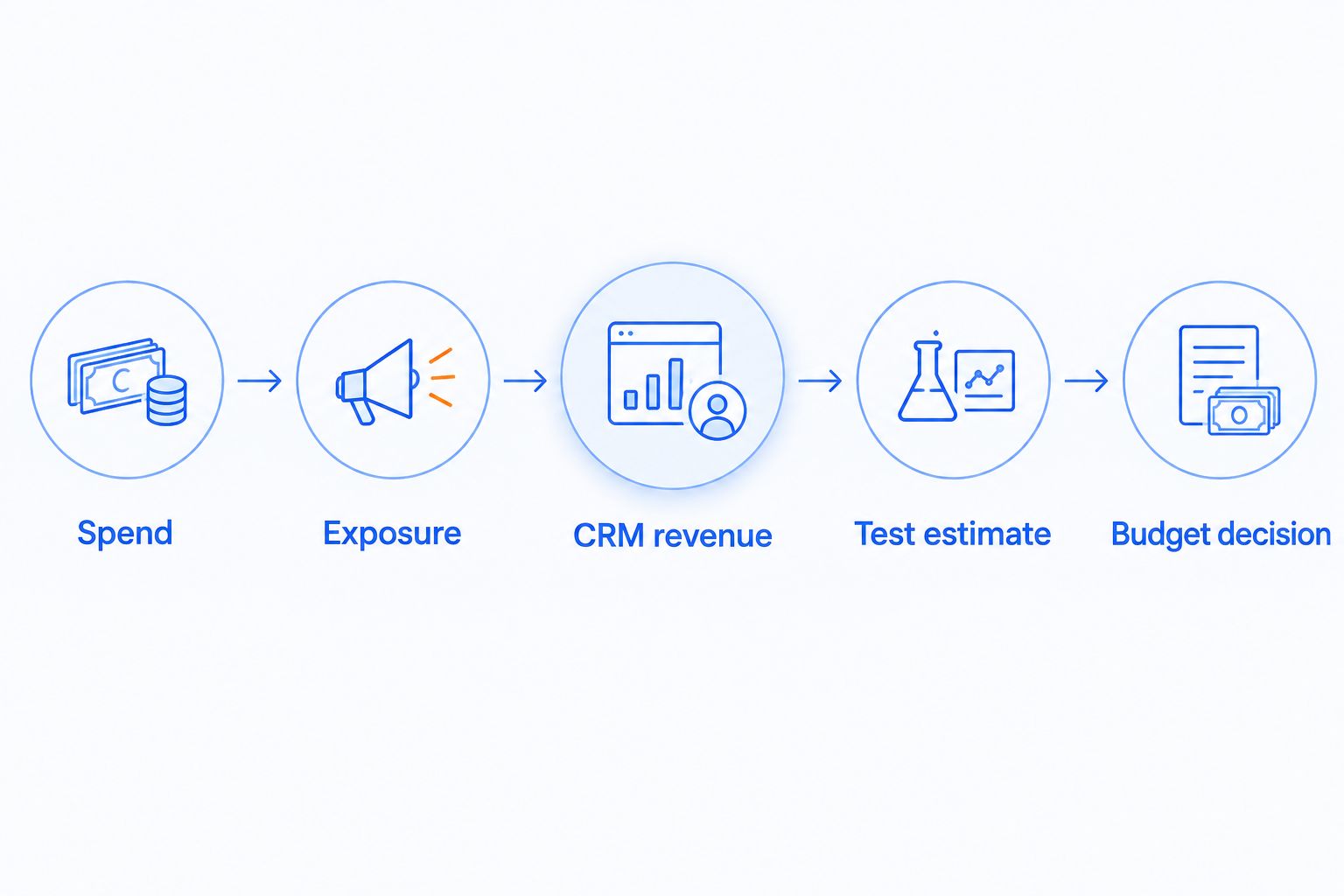
Getpaidlens connects advertising, CRM, analytics and revenue data to produce ranked, evidence-backed budget reallocation recommendations. That decision-support role complements incrementality testing tools; it does not make every connected performance signal causal evidence.
Keep the distinction visible in your 2026 reporting. Experimental evidence supports a causal conclusion within its design. Attribution and CRM reporting supply business context. Neither should silently replace the other.
Read uncertainty before recommending a change
A 95% confidence interval comes from a procedure designed to cover the true effect in 95% of repeated samples under its assumptions. It is not a guarantee that the current estimate is correct.
A 5% significance level specifies a false-positive threshold under the null hypothesis and the test's assumptions. It does not mean there is a 5% probability that your recommendation is wrong.
If a test is planned for 80% statistical power at a specified effect size, it has a 20% false-negative probability for that effect under the planning assumptions. Power depends on the effect size and design; it is not a permanent property of the tool.
Require the estimate, its interval and its assumptions together. A point estimate alone cannot tell you whether the proposed budget move is defensible.
Apply for the private beta
Explore ranked budget recommendations connected to advertising, CRM and revenue data.
How the recommendations are ranked
This 2026 ranking prioritizes experimental fit, counterfactual quality, outcome alignment and inspectability. GeoLift leads for cross-channel geographic interventions. Meta Conversion Lift and Google Ads Conversion Lift lead for their respective platform experiments. CausalImpact remains a supporting analytical option.
The methodological references are Meta's GeoLift documentation, Meta's Conversion Lift guidance, Google's Conversion Lift documentation and Google's CausalImpact documentation. The ranking does not claim comparative customer results or universal measurement accuracy.
Which incrementality testing tools should you choose?
Start with GeoLift for a cross-channel geographic question. Choose the relevant platform lift tool for a platform-specific audience question. Use CausalImpact only when the time-series counterfactual is credible.
For your 2026 shortlist, write the budget question before booking demonstrations. Specify the intervention, experimental unit, business outcome and decision rule. Reject any option that cannot support that design, regardless of its reporting features.
FAQ
What's the best incrementality testing tool for cross-channel marketing?
GeoLift is the shortlist choice here for cross-channel geographic experiments. It requires a geographically separable intervention, suitable comparison markets and analytical support.
Is incrementality testing the same as attribution?
No. Attribution assigns conversion credit, while incrementality testing estimates whether an intervention caused additional outcomes relative to a counterfactual.
Is Meta Conversion Lift better than Google Ads Conversion Lift?
Neither is universally better; they answer questions about different advertising environments. Choose the tool that matches the advertising intervention and experimental design.
Can CausalImpact replace a randomized experiment?
CausalImpact does not replace randomization. It estimates an intervention effect from time series, and its causal interpretation depends on credible controls and stable relationships.
Can I measure incremental revenue instead of incremental leads?
Yes, when revenue is a consistently measured outcome supported by the experimental design. A lead-lift result alone does not establish revenue lift.
How does Getpaidlens fit alongside incrementality testing tools?
Getpaidlens supports budget decisions with ranked recommendations connected to advertising, CRM, analytics and revenue data. Experimental measurement remains a separate task with its own design and assumptions.
What should an agency show a client after a lift test?
Show the intervention, measured outcome, estimated lift, uncertainty and recommended decision. State the design's limits so the client can distinguish measured effects from broader business interpretation.
One last thing
A test of removing advertising answers a different question from a test of increasing advertising. Do not assume that evidence from a reduction establishes the return on the next increase.
Before moving budget, ask whether the recommendation matches the intervention actually measured. That question prevents a valid experiment from becoming an invalid allocation argument.