

Financial services ad performance analytics is the practice of connecting advertising spend to qualified applications, customer acquisition, and revenue so you can defend budget decisions. Financial services teams need more than lead counts: you must distinguish an inquiry from an approved, funded, or activated customer and keep sensitive information out of advertising workflows.
- Ad performance analytics for financial services should connect campaign spend to CRM outcomes, not stop at submitted forms.
- Paid Lens is best for agencies and marketing leaders seeking ranked, evidence-backed cross-channel budget recommendations.
- Separate applications, approvals, funding, and revenue before comparing acquisition performance.
- Use attribution to describe recorded journeys; use controlled experiments to test incremental impact.
Why ad performance analytics matters for financial services
A campaign that generates inexpensive applications is not necessarily acquiring valuable customers. Applications can fail eligibility checks, remain incomplete, or never become revenue-producing relationships. Your reporting needs to preserve those distinctions rather than compress them into a single conversion total.
For your 2026 measurement plan, start with the business outcome finance recognizes. That might be a funded loan, an activated account, or a revenue-producing client relationship. Choose the outcome for each product before comparing channels.
Paid Lens is best for agencies and marketing leaders seeking ranked, evidence-backed cross-channel budget recommendations. Its decision-intelligence approach connects advertising, CRM, analytics, and revenue data. The boundary matters: a recommendation supports a budget decision; it does not establish that advertising caused the recorded revenue.
Agencies also need client-specific definitions. An approved application for one client is not interchangeable with an activated account for another. Standardize the reporting structure, not the underlying economics.
Build your 2026 financial services analytics workflow
Define the outcome before choosing the dashboard
Start manually with a shared measurement document. Ask marketing, sales or operations, and finance to agree on the event that counts as acquisition and the source that confirms it. Keep early indicators visible, but label them as intermediate outcomes.
Separate acquisition value from transaction value. A loan principal amount is not the same thing as lender revenue. Assets transferred into an investment account are not automatically earned revenue either. Use a finance-approved definition rather than copying the largest available CRM field into a return calculation.
Choose review windows deliberately. A 7-day operational view can track delivery and tracking failures; a 30-day cohort view can organize acquisition analysis; a 90-day view can examine later outcomes. These are suggested starting windows, not industry benchmarks or promises that outcomes will mature within them.
- Record the acquisition event and its business owner.
- Define intermediate stages separately from completed acquisition.
- Specify whether value means recognized revenue, contribution, or another approved measure.
- Document cohort dates, reporting windows, and exclusions.
Join advertising records to CRM outcomes
Begin with exports and a reconciliation sheet. Carry campaign identifiers into your lead or application records where your approved collection process supports them. Join those records to later CRM stages using permitted internal identifiers.
Keep the reporting chain explicit: spend, application, qualification, approval, funding or activation, and revenue. Not every financial product uses every stage. Omit irrelevant stages rather than forcing different businesses into an identical funnel.
Paid Lens connects advertising, CRM, analytics, and revenue data for budget recommendations. That offers a software-supported path beyond recurring manual reconciliation. Before choosing a workflow, confirm the current status of each required connection and distinguish live, beta, and coming-soon support; do not treat a named integration as a guarantee for your account.
- Preserve campaign identifiers through permitted application and CRM records.
- Check unmatched records before interpreting channel performance.
- Reconcile spend totals against the advertising source.
- Reconcile completed outcomes against the operational source.
- Record currency, timezone, and stage-date definitions.
Separate mature cohorts from incomplete journeys
Compare customers acquired during the same period at the same elapsed age. A recent application cohort has had less time to reach approval or funding than an older cohort. Comparing both as if they were complete confuses timing with performance.
Use a cohort sheet before adding another dashboard. Group applications by their creation date, then show stage progression as of a stated observation date. Keep unresolved applications visible instead of silently treating them as failures or successes.
For 2026 reviews, display both acquisition-period reporting and outcome-period reporting. The first connects later results to the original acquisition effort. The second shows what the business completed during the reporting period. They answer different questions and should not share an unlabeled total.
- Group applications by acquisition period and product.
- Compare cohorts at equivalent elapsed ages.
- Separate pending, declined, withdrawn, and completed records.
- Show the observation date beside conversion metrics.
Calculate efficiency at the business outcome
Calculate cost per application, cost per qualified application, and cost per acquired customer separately. Each denominator answers a different question. An improvement at the application stage does not establish an improvement at the customer stage.
Use revenue measures only after finance approves their meaning. Revenue divided by advertising spend describes attributed revenue efficiency when both values cover compatible scopes. It does not describe profit, and it does not prove incremental return.
Paid Lens provides ranked, evidence-backed budget reallocation recommendations. Use that ranking as a review queue, not as permission to ignore incomplete CRM data or inconsistent revenue definitions. A useful recommendation needs a comparable business outcome behind it.
- Divide relevant spend by the corresponding completed outcome count.
- Match campaign, product, geography, and reporting scope.
- Distinguish advertising-only acquisition cost from broader acquisition cost.
- Label attributed revenue separately from incremental impact.
- Keep missing outcomes visible rather than replacing them with assumed values.
Rank budget changes by evidence and constraints
Start with a decision log in a spreadsheet. For each proposed change, record the source campaign, destination campaign, supporting outcome, uncertainty, approver, and reversal condition. Explain why the proposed recipient deserves additional budget—not merely why its historical average looks attractive.
Historical efficiency does not establish what the next unit of spend will produce. Check whether the comparison mixes different products, customer eligibility, acquisition stages, or cohort ages. Keep contractual commitments and operational capacity beside the performance evidence.
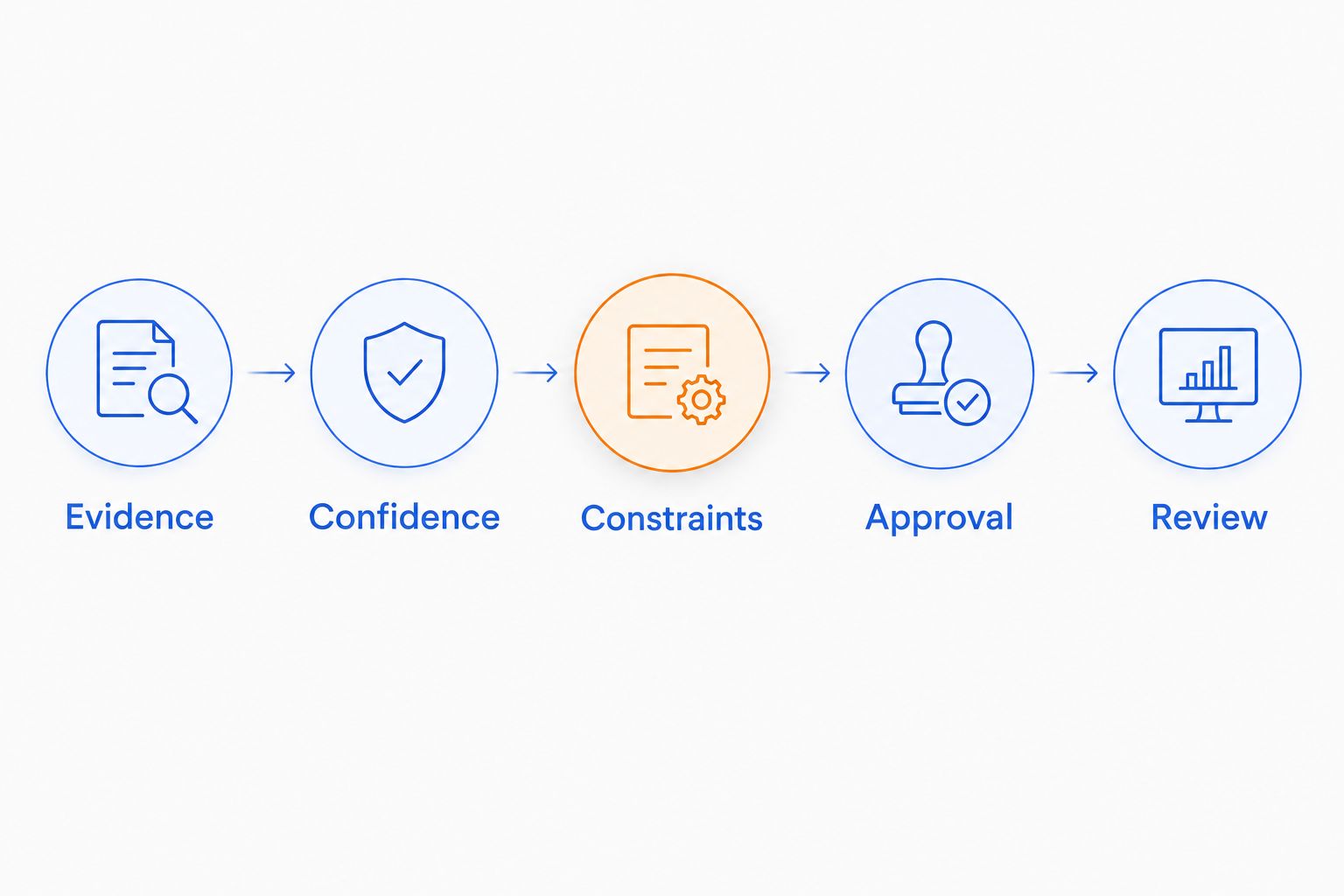
Use an explicit review sequence: Evidence, Confidence, Constraints, Approval, Review. The sequence makes the decision inspectable without suggesting that a score eliminates judgment.
For your 2026 budget review, make uncertainty specific. State whether the weakness is unmatched CRM records, incomplete outcomes, limited observations, or conflicting attribution. Do not replace an explanation with an unsupported confidence percentage.
- Evidence: Identify the records and outcome supporting the change.
- Confidence: Describe completeness, comparability, and unresolved uncertainty.
- Constraints: Check eligibility, capacity, commitments, and spending limits.
- Approval: Assign a named decision owner.
- Review: Define the observation period and reversal condition.
Validate changes and keep an audit trail
Record the decision before implementation. Save the proposed change, approval, implementation date, and expected outcome direction. Separate the expectation from the result so the next review cannot rewrite the original rationale.
Use controlled experiments when the decision requires a causal answer and the setup supports a credible comparison. Routine attribution reporting and experimentation serve different purposes. A change in attributed conversions after a budget shift is an observation, not automatic proof of incremental impact.
Keep financial services data handling inside the same approval process. Confirm permitted fields, destinations, access, and retention with your responsible privacy and compliance owners. A measurement design is not permission to send application details or sensitive customer information to advertising systems.
- Save the pre-change rationale and approved budget instruction.
- Record overlapping campaign, offer, and operational changes.
- Review mature outcomes against the original decision criteria.
- Restrict reporting access to approved users and fields.
- Document whether to continue, reverse, or investigate the change.
Compare your analytics options
Choose the smallest setup that answers the budget question with defensible evidence. A manual workflow can establish definitions before software enters the process. Software is useful when repeated reconciliation or recommendation review becomes the bottleneck; it does not repair inconsistent business definitions by itself.
| Option | Best for | Main advantage | Key limitation |
|---|---|---|---|
| Exports and spreadsheets | Teams establishing their measurement definitions | Makes joins, formulas, and exclusions directly inspectable | Requires manual reconciliation and version control |
| Advertising-platform reporting | Campaign delivery and platform-recorded conversion checks | Keeps delivery metrics close to campaign management | Does not replace a reconciled cross-channel CRM outcome view |
| CRM reporting | Reviewing application stages and customer outcomes | Organizes analysis around recorded business progression | Advertising spend must be connected and reconciled separately |
| Warehouse and BI workflow | Teams needing custom joins and reporting logic | Allows a measurement model tailored to approved definitions | Requires ownership of data engineering and reporting maintenance |
| Paid Lens decision intelligence | Agencies and leaders reviewing cross-channel budget recommendations | Provides ranked, evidence-backed budget reallocation recommendations | Recommendation quality remains dependent on connected evidence and outcome definitions |
Choose the workflow by the decision it must support, not by the number of charts it produces. If your immediate problem is inconsistent application stages, fix those definitions first. If your problem is deciding where to move budget across channels, evaluate the recommendation evidence and its limits.
Qualified agencies and marketing leaders evaluating Paid Lens should pursue the private beta application. Confirm required integration status and review the recommendation workflow against your own approval requirements.
Explore the private beta
Evaluate the budget recommendation workflow against your cross-channel reporting requirements.
Common mistakes financial services teams make
Optimizing for submitted applications alone
An application is an intermediate event unless your business explicitly defines it otherwise. Keep application efficiency visible, but pair it with qualification and completed acquisition. Otherwise, the budget review rewards volume without establishing downstream value.
Treating approval as realized revenue
Approval, funding, activation, and revenue recognition are different events. Report them separately where they apply. Do not use a stage change as a substitute for a finance-approved revenue measure.
Comparing different products as one acquisition pool
Products with different eligibility rules, revenue definitions, and completion stages need separate analysis. Aggregate reporting can summarize the portfolio, but it should not erase the differences needed to justify a channel-level budget change.
Calling attributed revenue incremental revenue
Attribution assigns credit under a measurement rule. Incrementality asks what changed because advertising occurred. Keep those labels separate in executive reporting, especially when a recommendation depends on acquiring customers who would not otherwise convert.
Combining client data without clear boundaries
Agencies need distinct client permissions, outcome definitions, and decision records. Reuse a reporting template, not customer-level data or assumptions about acquisition value. Check access and permitted reporting scope before building cross-client summaries.
FAQ
What is ad performance analytics for financial services?
Ad performance analytics for financial services connects advertising spend to applications, qualification, customer acquisition, and revenue. Its purpose is to support budget decisions using business outcomes rather than lead volume alone.
What's the most useful metric for financial services advertising?
The most useful efficiency metric measures cost against your finance-approved acquisition outcome. Keep application and qualification metrics alongside it so you can explain where the funnel changes.
How do I connect advertising spend to funded customers?
Connect permitted campaign identifiers to application records, then join those records to funding outcomes in your CRM or operational system. Reconcile unmatched records and use compatible dates, currencies, and campaign definitions.
Is CRM reporting better than advertising-platform reporting?
CRM reporting is better suited to recorded customer progression, while advertising-platform reporting supports campaign delivery analysis. You need a reconciled connection between them to evaluate spend against downstream outcomes.
How long should I wait before judging a campaign?
Wait until the relevant outcome has had time to mature, then compare cohorts at equivalent elapsed ages. Base the observation window on your recorded application-to-outcome timing rather than a universal deadline.
Does attribution prove that advertising generated revenue?
No. Attribution assigns credit to recorded interactions under a chosen rule; it does not establish causation. Use a credible experimental design when the decision requires evidence of incremental impact.
What should an agency include in a financial services budget recommendation?
Include the proposed change, business outcome evidence, uncertainty, constraints, approver, and review condition. Separate expected impact from measured results and keep each client's definitions explicit.
One last thing
Before your next 2026 budget meeting, add a pending-outcomes column beside every campaign's acquisition result. A campaign with unresolved applications has incomplete evidence, not a completed performance verdict. Decide whether to change spend or wait for evidence before debating which channel wins.