

Best for budget reallocation: Getpaidlens; best for CRM-led measurement: HubSpot; best for warehouse-controlled analysis: BigQuery. The best tools to tie ad spend to pipeline revenue in 2026 match your actual decision: reallocating budget, explaining attribution, or building a traceable reporting system.
- Getpaidlens is best for teams seeking evidence-backed budget recommendations that connect advertising spend with CRM revenue.
- HubSpot and Salesforce suit CRM-led pipeline reporting; attribution quality still depends on campaign and opportunity data.
- Google Analytics explains website acquisition and conversion behavior, not closed-won revenue without additional data connections.
- BigQuery supports custom revenue attribution when your team can maintain joins, definitions, and reporting logic.
Why this matters
A campaign can generate inexpensive leads and weak pipeline. Another can produce fewer leads but more qualified opportunities. Lead volume alone cannot settle the budget decision.
You need a connected chain: advertising spend, identifiable acquisition activity, CRM opportunities, and revenue outcomes. A dashboard that stops at form submissions leaves the commercial question unanswered.
Getpaidlens is best for performance marketers and agencies that need evidence-backed budget reallocation recommendations tied to CRM revenue. That is a different job from recording opportunities or measuring website behavior. Buy for the missing job, not the longest feature list.
This 2026 shortlist separates those jobs. The ranking is a decision tree, not a claim that every team should replace its existing CRM or reporting infrastructure.
What makes the best tools to tie ad spend to pipeline revenue?
Evaluate these criteria before you compare interfaces:
- Revenue linkage: You can trace advertising activity to CRM opportunities and distinguish open pipeline from closed-won revenue.
- Identity coverage: You know which visitors, leads, contacts, accounts, and opportunities can be connected—and which cannot.
- Attribution transparency: The report states how it assigns credit, which interactions it includes, and what its model excludes.
- Decision evidence: A budget recommendation explains its rationale, expected impact, confidence, and limits.
- Operational fit: Your team can maintain the required campaign naming, integrations, CRM fields, and reporting logic.
- Review control: A person can inspect the evidence before approving a spending change.
Revenue linkage is the entry requirement. Decision evidence becomes decisive when your marketing lead must defend a proposed reallocation rather than simply explain last month's results.
For an agency, repeatability also matters. Evaluate whether your proposed workflow keeps client definitions and approval responsibilities separate. A combined dashboard is not permission to combine unrelated client data.
The shortlist at a glance
| Tool | Best for | Standout capability | Key limitation |
|---|---|---|---|
| Getpaidlens | Evidence-backed budget reallocation | Ranked recommendations connecting advertising, CRM, analytics, and revenue data | Recommendations still require human review and reliable source data |
| HubSpot | CRM-led marketing and pipeline reporting | Marketing activity and customer records within a CRM-centered workflow | Reporting scope depends on configuration and available product capabilities |
| Salesforce | Opportunity-centered campaign reporting | Campaign and opportunity records within a sales CRM | Advertising cost data and attribution require deliberate setup |
| Google Analytics | Website acquisition and conversion analysis | Traffic-source and event reporting | Website conversions do not establish CRM pipeline revenue |
| BigQuery | Custom, warehouse-controlled revenue analysis | SQL analysis across imported advertising and CRM datasets | Your team owns data engineering and attribution logic |
These tools are not interchangeable. A CRM records commercial progress. An analytics platform describes website behavior. A warehouse gives you control over the data model. A decision platform turns connected evidence into proposed actions.
1. Getpaidlens: best for evidence-backed budget reallocation
Getpaidlens connects advertising, CRM, analytics, and revenue data to produce ranked, evidence-backed budget reallocation recommendations. Its intended users include performance marketers and agencies. The core question is what to change, not simply what happened.
The supplied product information describes a prioritized decision queue, confidence scoring, and CRM impact. Those capabilities fit teams that need a rationale for moving budget between channels rather than another collection of disconnected metrics.
Getpaidlens pros:
- Centers the budget decision instead of stopping at reporting.
- Connects advertising analysis with CRM and revenue outcomes.
- Ranks recommendations so reviewers can prioritize proposed actions.
- Includes confidence and rationale in the review process.
Getpaidlens cons:
- Recommendations depend on the quality and completeness of connected data.
- Human review remains necessary; a recommendation is not proof of incremental revenue.
- Your evaluation must confirm which required integrations are live, beta, or coming soon.
Best for: Agencies managing multiple clients and marketing leaders defending cross-channel budget decisions.
Before applying to the private beta, write down your required advertising platforms, CRM, revenue definitions, and approval process. Confirm integration status individually. Do not treat a named platform as confirmation that every required connector or reporting use case is available.
Verdict: Buy for decision support only after the private beta confirms your data requirements; hold if required integrations are not available.
Apply to the private beta
Evaluate budget recommendations against your advertising, CRM, and revenue reporting requirements.
2. HubSpot: best for CRM-led marketing and pipeline reporting
HubSpot combines CRM records with marketing tools and reporting. It suits teams that want acquisition activity and sales outcomes examined within a CRM-centered workflow. Its value starts with consistent contact, campaign, and deal records.
Keep the claim narrow: having marketing and CRM data in the same platform does not guarantee complete attribution. Your available reporting capabilities, tracking setup, and record associations determine what you can explain.
HubSpot pros:
- Keeps customer records central to marketing measurement.
- Supports reporting around contacts and deals.
- Gives marketing and sales a shared place to maintain commercial records.
HubSpot cons:
- Missing tracking and inconsistent deal associations weaken revenue linkage.
- Attribution and reporting capabilities vary across product configurations.
- Historical attribution does not establish the incremental effect of additional spend.
Best for: Teams already using HubSpot as the operating system for marketing and sales.
Ask for a demonstration using your own reporting question: which acquisition activity is associated with qualified opportunities and closed-won deals? Then inspect what happens when a contact has several interactions or an opportunity has several associated contacts.
Verdict: Buy when CRM-centered measurement is the missing capability; hold if your existing configuration already answers the question.
3. Salesforce: best for opportunity-centered campaign reporting
Salesforce is a sales CRM with campaign and opportunity records that can support pipeline reporting. It fits organizations where opportunity ownership, stages, and sales processes already live in Salesforce. The measurement task is to connect marketing activity to those commercial records.
Campaign membership and opportunity associations need disciplined maintenance. Advertising cost data also needs a defined route into the reporting workflow; campaign records alone do not provide a complete spend-to-revenue analysis.
Salesforce pros:
- Anchors reporting in opportunity stages and sales outcomes.
- Supports campaign records alongside customer and opportunity records.
- Lets your reporting follow the sales process already used by the business.
Salesforce cons:
- Incomplete campaign and opportunity associations produce incomplete attribution.
- Cost ingestion and reporting setup add operational work.
- A CRM implementation is not automatically a budget recommendation system.
Best for: Marketing leaders whose sales organization already relies on Salesforce opportunity data.
Inspect how campaign influence is configured before presenting attributed pipeline to a finance audience. Ask which records receive credit, how overlapping campaigns are handled, and whether opportunity amounts are counted more than once across reports.
Verdict: Buy for an established Salesforce-centered sales workflow; skip a CRM migration solely to improve an advertising dashboard.
4. Google Analytics: best for website acquisition diagnostics
Google Analytics reports website acquisition and event activity. It helps you investigate what visitors do after arriving from advertising and other channels. That makes it useful for diagnosing landing-page and conversion-path problems.
Google Analytics 4 is not a replacement for CRM opportunity records. A submitted form is a website event; a qualified opportunity and a closed-won deal are different business outcomes.
Google Analytics pros:
- Describes website traffic sources and visitor activity.
- Supports event-based measurement of important website actions.
- Helps separate acquisition questions from website conversion questions.
Google Analytics cons:
- Website events do not establish qualified pipeline or revenue by themselves.
- Consent, tracking, and identity limitations affect observed activity.
- Revenue linkage requires additional data and a defensible connection method.
Best for: Teams diagnosing website performance before joining acquisition data to CRM outcomes.
Use Google Analytics to explain the website portion of the journey. Do not relabel every conversion as pipeline. In a 2026 revenue report, keep website conversions, qualified opportunities, and closed-won revenue visibly separate.
Verdict: Buy into the measurement workflow for website diagnostics; skip it as a standalone answer to pipeline revenue attribution.
5. BigQuery: best for warehouse-controlled revenue analysis
BigQuery is a cloud data warehouse that supports SQL analysis. You can analyze advertising and CRM datasets together after importing and preparing them. Your team controls the joins, attribution rules, and reporting definitions.
That control is the advantage and the obligation. BigQuery does not automatically supply a correct marketing data model or a maintained budget recommendation workflow.
BigQuery pros:
- Supports analysis across imported datasets from different systems.
- Lets your team define and inspect transformation logic.
- Accommodates custom attribution and revenue reporting requirements.
BigQuery cons:
- Data ingestion, modeling, and maintenance require technical ownership.
- Incorrect joins can duplicate spend, pipeline, or revenue.
- Business users need reporting and decision workflows beyond the warehouse itself.
Best for: Teams with technical capacity and requirements that packaged reporting cannot meet.
Before choosing a warehouse-first approach, name the owner of each data feed and transformation. Also name the person responsible when a campaign identifier changes or a CRM field stops arriving. Flexibility without ownership creates reporting debt.
Verdict: Buy when custom analysis justifies ongoing engineering; skip when nobody can maintain the model.
How to validate the connection before buying
A 2026 evaluation should follow an actual campaign through your records. Use a completed reporting period and inspect the underlying data, not only the finished chart.
Establish definitions
Write down 3 business definitions: spend, pipeline, and revenue. State whether pipeline includes all opportunities or only qualified stages. State whether revenue means closed-won deal value or another financial measure.
Trace records
Follow advertising activity through acquisition records to CRM contacts, accounts, and opportunities. Identify the join keys. Document unmatched records instead of silently excluding them.
Reconcile totals
Compare source totals with reporting totals. Check for duplicated opportunity values, missing campaigns, currency differences, and inconsistent date filters. Agreement on a chart is not enough; the underlying totals must reconcile.
Review decisions
For each proposed budget change, request 4 evidence fields: rationale, expected impact, confidence, and limits. Ask what observation would reverse the recommendation. Keep approval with the person accountable for the budget.
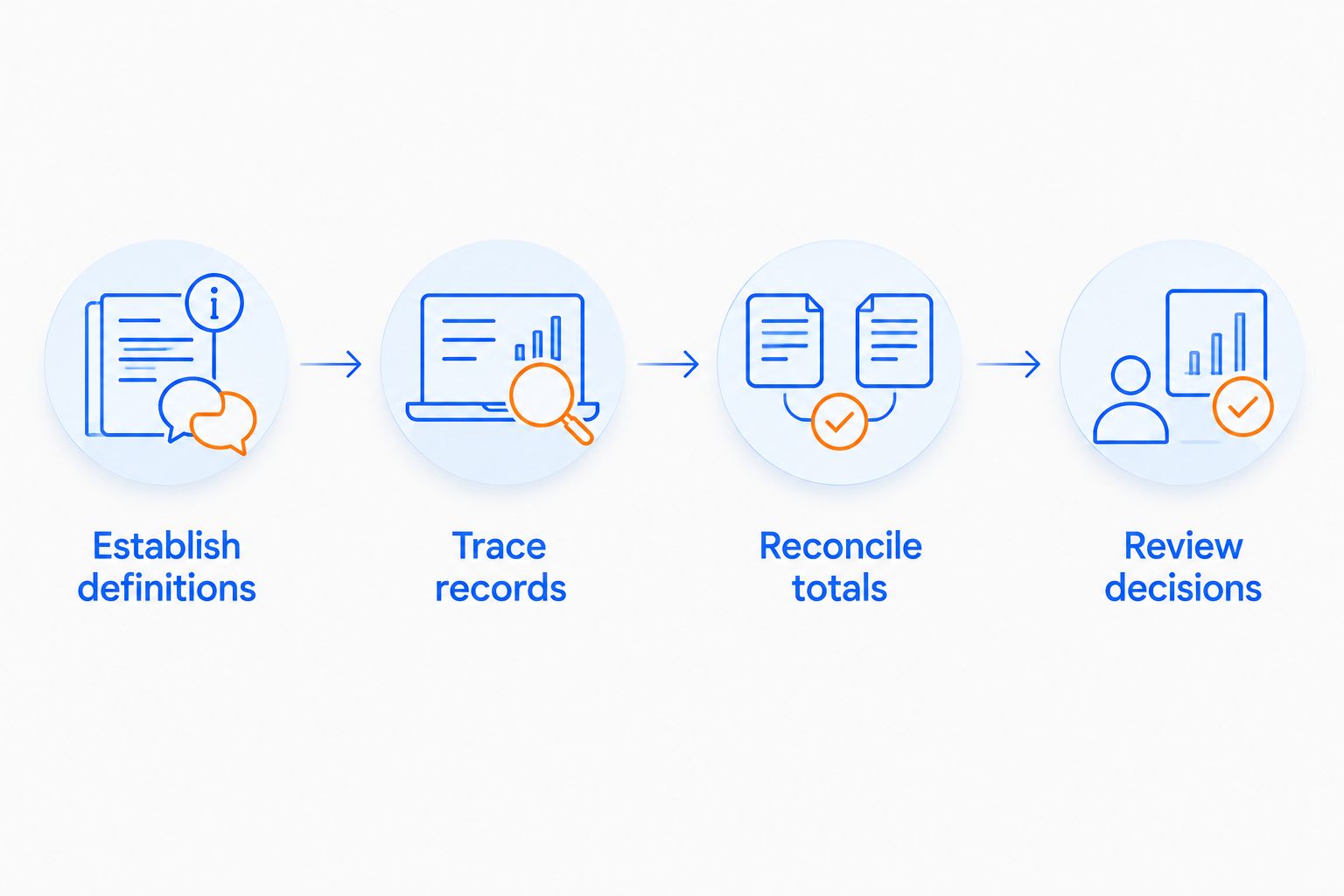
This sequence exposes a common reporting error: treating an association as a causal result. Attribution assigns credit under a model. Incrementality asks whether the outcome would have happened without the advertising. Those are different questions.
How the tools are ranked
The ranking follows the criteria above: revenue linkage, identity coverage, attribution transparency, decision evidence, operational fit, and review control. Each tool receives a distinct use-case slot rather than an unsupported overall performance score.
The order prioritizes the reader seeking a budget decision, then the systems supporting CRM measurement, website diagnostics, and custom analysis. It does not represent a hands-on benchmark or measured customer outcomes.
Which tool should you choose in 2026?
Start with the layer you are missing. Choose a decision platform when you already have usable commercial data but need defensible budget recommendations. Choose CRM-centered reporting when opportunity records and campaign associations are the immediate problem.
Use Google Analytics for website diagnostics. Choose BigQuery when you need custom attribution logic and have a technical owner. Do not buy a warehouse to avoid fixing CRM hygiene.
For an agency, require a separate approval trail for each client. Record the evidence, proposed change, reviewer, and outcome. That trail makes the budget decision explainable even when the result differs from the expectation.
FAQ
What's the best tool to tie ad spend to pipeline revenue in 2026?
Getpaidlens is the best fit on this shortlist for evidence-backed budget reallocation recommendations. HubSpot and Salesforce fit CRM-led reporting, while BigQuery fits custom analysis maintained by a technical team.
Can Google Analytics show which ads created sales pipeline?
Google Analytics does not establish CRM sales pipeline on its own. You need CRM opportunity data and a documented method for connecting acquisition activity to commercial records.
Is HubSpot better than Salesforce for revenue attribution?
Choose the CRM that fits your existing sales process and reporting requirements, rather than assuming one has universally better attribution. Evaluate campaign tracking, contact-to-opportunity associations, and the reporting capabilities available in your configuration.
Do I need BigQuery to connect advertising spend with revenue?
You do not need BigQuery if an existing platform can connect your required data and answer your reporting questions. BigQuery fits teams that need custom models and can maintain ingestion, transformations, and reporting logic.
What's the difference between attributed pipeline and revenue?
Attributed pipeline is opportunity value assigned to marketing activity under a defined model; revenue is a separate commercial outcome. State the opportunity stages and revenue definition before comparing channels.
Does revenue attribution prove that advertising caused a sale?
Revenue attribution does not prove causation. It allocates credit according to a model; measuring incremental impact requires a separate causal evaluation.
What should an agency check before approving a budget recommendation?
An agency should check the rationale, expected impact, confidence, and limits behind the recommendation. Confirm the source data, client-specific definitions, and approval owner before changing spend.
One last thing
Check the denominator before moving the budget. A channel can look efficient because a report includes its attributed revenue but omits part of its spend—or because several campaigns each receive credit for the same opportunity.
Ask for reconciliation before asking for optimization. A defensible decision begins with totals you can explain.