

Revenue ops marketing analytics is the practice of connecting acquisition activity to CRM pipeline and revenue so you can defend budget decisions. Marketing analytics for revenue ops teams requires shared lifecycle definitions, account-level reconciliation, and clear limits on what attribution proves—not another channel dashboard.
- Marketing analytics for revenue ops teams should connect ad spend, CRM pipeline, and revenue before recommending budget changes.
- Paid Lens suits agencies and marketing leaders who need ranked, evidence-backed budget recommendations for human review.
- Separate sourced pipeline, influenced pipeline, and closed revenue; they answer different questions.
- Approve reallocations against mature cohorts, explicit assumptions, and a documented review date.
Why marketing analytics matters for revenue ops teams
Revenue operations owns the handoff between marketing activity, sales execution, and financial outcomes. Your reporting must explain where spend entered the funnel, whether sales accepted the resulting demand, and what happened after opportunity creation.
For your 2026 measurement plan, start with tying ad spend to pipeline revenue. Channel efficiency alone cannot resolve a budget dispute when marketing measures leads, sales measures opportunities, and finance measures recognized revenue.
The practical constraint is comparability. A campaign generating recent opportunities should not be judged against a campaign whose opportunities have already completed their sales cycle. Agencies also need to keep client definitions separate rather than pool incompatible pipelines.
Your reporting unit should match your decision unit. If you allocate by client, channel, and market, preserve those dimensions through the CRM. A blended account total hides the evidence needed to move money responsibly.
Build a decision-ready measurement process
Define the revenue question before building reports
Start manually with a decision brief. Name the budget owner, the business outcome, the comparison period, and the evidence that would change the decision. A spreadsheet is sufficient for this first pass; a dashboard cannot settle an undefined question.
Choose whether the immediate objective is qualified pipeline, closed-won revenue, or acquisition efficiency. These objectives require different denominators and observation windows. Do not let a convenient platform conversion become the business objective by default.
For a 2026 operating plan, keep the decision brief alongside the budget. When priorities change, update the brief rather than silently changing the meaning of an existing metric. Record exclusions before reviewing channel performance so weak results do not invite selective filtering.
- Name the client, business unit, market, and channel under review.
- State the decision: maintain, increase, reduce, or investigate spend.
- Define the CRM stage that counts as qualified pipeline.
- Separate new-customer acquisition from expansion activity.
- Record the approver and the evidence required for approval.
Reconcile spend, identities, and CRM outcomes
Export advertising spend, campaign identifiers, analytics records, and CRM opportunities. Match a sample manually before automating the process. Trace individual records from acquisition through opportunity creation to confirm that your joins preserve the intended relationship.
Keep contact-level activity distinct from account-level buying activity. Several contacts can belong to one opportunity; summing their associated opportunity values creates duplicate pipeline. Equally, a missing campaign identifier should remain unresolved rather than receive a convenient attribution label.
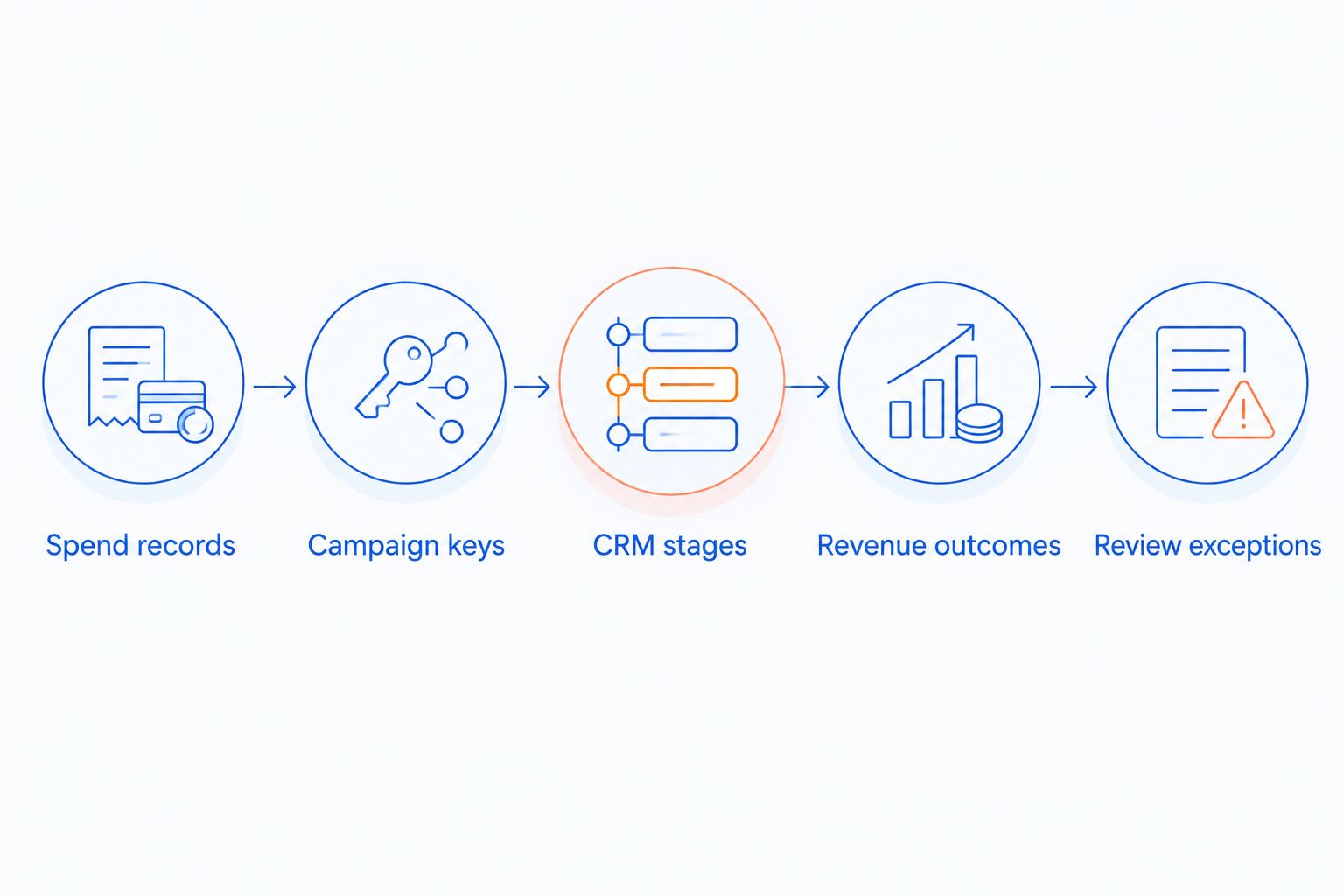
Build the reconciliation around a visible chain: spend records, campaign keys, CRM stages, revenue outcomes, and review exceptions. Each link needs an owner. If a record breaks the chain, identify where the break occurs before changing the budget.
- Spend records: standardize currency, date boundaries, and account ownership.
- Campaign keys: preserve source identifiers alongside readable campaign names.
- CRM stages: document stage entry, regression, and disqualification rules.
- Revenue outcomes: distinguish opportunity amount, closed-won value, and recognized revenue.
- Review exceptions: isolate unmatched records and duplicate opportunity associations.
Build a ranked queue of budget decisions
Use the reconciled spreadsheet to write candidate actions manually. Each row should identify the affected budget, supporting evidence, expected outcome, confidence, and reversal condition. Rank actions by their business importance and the strength of their evidence, not by the size of a platform alert.
Paid Lens provides ranked, evidence-backed budget reallocation recommendations using advertising, CRM, analytics, and revenue data. Its prioritized decision queue and confidence scoring provide a software path beyond manually assembling recommendations. Keep approval with the budget owner.
Paid Lens marketing analytics is best for agencies and marketing leaders who need evidence-backed budget recommendations for human review. It does not remove the need to reconcile definitions or investigate incomplete evidence. Treat a confidence score as something to inspect alongside the rationale, not as permission to bypass review.
- State the proposed action and the business outcome it targets.
- Attach the underlying period, population, and CRM stage definitions.
- Explain the evidence supporting the action and evidence against it.
- Label expected impact as an estimate, not an achieved result.
- Name the approver, reversal condition, and unresolved questions.
Compare cohorts before comparing channels
Group opportunities by acquisition or creation period, then compare their progress at equivalent ages. A recent cohort contains less outcome information than an older cohort. Mixing the two confuses incomplete observation with weak performance.
Start with a spreadsheet cohort view. Use your observed sales-cycle distribution to choose the evaluation window rather than importing an arbitrary benchmark. Compare within relevant segments when deal size, market, or sales motion changes the path to revenue.
Maintain your 2026 baseline definitions even when you add new reporting views. If you revise the attribution model, preserve the previous result and explain the change. Otherwise, a measurement change can appear to be a commercial improvement.
- Compare cohorts at equivalent ages and lifecycle stages.
- Separate opportunity-created dates from close dates.
- Break out markets or segments with different sales motions.
- Show open opportunities separately from realized outcomes.
- Annotate material changes to targeting, qualification, and sales coverage.
Approve a bounded reallocation
Turn the strongest recommendation into a controlled decision. Specify the affected campaigns, the amount approved in your internal plan, and the conditions that stop or reverse the change. Preserve the original recommendation so the eventual result can be assessed against its actual rationale.
Schedule a 30-minute approval meeting for disputed decisions. Use the time to examine evidence and resolve ownership, not to tour dashboards. If the meeting exposes an unresolved CRM join or a changed qualification rule, return the recommendation to investigation.
Read-only recommendations and human approval serve different purposes. Read-only access limits execution permissions; human approval establishes accountability. Neither proves that the proposed change will increase revenue. A defensible decision states what remains uncertain before money moves.
- Record the source budget and destination budget.
- Define the outcome that would support continuing the change.
- Establish a review date based on outcome maturity.
- Assign one accountable approver for the reallocation.
- Preserve a reversal plan and a record of execution.
Measure outcomes and maintain a decision log
Review implementation separately from commercial results. First confirm that the approved change happened. Then assess whether the relevant cohort reached the outcome stage required by the decision brief. Early delivery signals are not substitutes for later revenue evidence.
Set a 7-day implementation check to verify execution, tracking continuity, and unexpected delivery changes. This is a recommended operating checkpoint, not a revenue evaluation window. Your sales cycle determines when revenue conclusions become meaningful.
For your 2026 decision log, record approved, rejected, and deferred recommendations. Rejected actions reveal recurring disagreements about evidence; deferred actions reveal data dependencies. Both belong beside approved changes if the log is meant to explain how budgets were managed.
- Record the recommendation, approval, and execution dates separately.
- Compare observed outcomes with the original expectation.
- Identify tracking changes that invalidate the comparison.
- Explain reversals without rewriting the original rationale.
- Carry unresolved questions into the next review.
Compare your operating options
Choose an approach based on the work your team needs to perform. Reporting, data modeling, and budget recommendations are related tasks, but they are not interchangeable. The strongest fit depends on whether your immediate bottleneck is data access, shared definitions, or decision review.
| Option | Best for | Main advantage | Key limitation |
|---|---|---|---|
| Spreadsheet reconciliation | Teams defining their first shared revenue view | Lets analysts inspect joins and assumptions directly | Requires manual maintenance and review discipline |
| CRM-native reporting | Teams focused on opportunity stages and sales handoffs | Keeps analysis close to lifecycle records | Advertising spend still needs reconciliation with CRM outcomes |
| Warehouse and BI workflow | Teams that need custom models and have data ownership | Supports explicit transformation and reporting logic | Your team must maintain the models and decision process |
| Paid Lens marketing analytics | Agencies and leaders reviewing cross-channel reallocations | Provides ranked recommendations with evidence and confidence scoring | Requires human review; confirm connector scope through the private beta application |
Choose the workflow that addresses your current bottleneck. If definitions are disputed, begin with reconciliation. If reconciled reports still leave budget owners assembling every recommendation manually, evaluate a decision-intelligence workflow.
For your 2026 evaluation, request a walkthrough using the questions your finance and revenue leaders actually ask. Confirm the status of each required integration individually; do not infer connector readiness from a category description. Review evidence, permissions, and limitations before approving adoption.
Apply for the private beta
Discuss your cross-channel budget workflow, CRM evidence, and required integrations.
Common mistakes revenue ops teams make
Treating influenced pipeline as sourced pipeline
Influenced pipeline describes opportunities associated with qualifying interactions. Sourced pipeline assigns origin under a defined rule. Adding both totals together double-counts value and leaves budget owners defending a number without a coherent meaning. Label each view and explain its attribution rule.
Comparing current spend with unrelated closed revenue
Revenue closing this month can originate from acquisition activity in an earlier period. Dividing it by current spend answers a different question from measuring a matched acquisition cohort. Keep operating-period efficiency and cohort economics in separate views, with clear labels.
Pooling agency clients into one benchmark
Client pipelines differ in qualification rules, opportunity values, and sales cycles. A pooled average can conceal those differences. Standardize the reporting structure across clients, but retain client-specific definitions and approval rules. Compare like-for-like segments only after documenting the differences.
Treating attribution as proof of incremental lift
Attribution allocates credit under a model; it does not establish what would have happened without the advertising. Use attribution to describe observed journeys and support investigation. When the budget question requires a causal answer, plan an appropriate experiment instead of relabeling attributed revenue as incremental revenue.
Acting on confidence without examining coverage
A recommendation can appear precise while relying on incomplete CRM outcomes. Review unmatched records, missing stages, and the population included in the analysis. A confidence label does not repair missing evidence. Document material coverage gaps and hold decisions whose rationale depends on resolving them.
FAQ
What is marketing analytics for revenue ops teams?
Marketing analytics for revenue ops teams connects acquisition activity and spend to CRM pipeline and revenue. Its purpose is to support shared measurement, defensible budget decisions, and accountable follow-up across marketing, sales, and finance.
Which metrics should revenue operations review first?
Start with reconciled spend, qualified pipeline, closed-won revenue, and progression between agreed CRM stages. Keep sourced and influenced pipeline separate, and compare outcomes within matched cohorts.
Can we start without a data warehouse?
Yes, you can start with exports and a reconciled spreadsheet. Define identifiers, lifecycle stages, and ownership before deciding whether a warehouse is necessary for your reporting requirements.
Is CRM reporting enough for cross-channel budget decisions?
CRM reporting is not sufficient when advertising costs and acquisition identifiers remain disconnected from opportunities. Reconcile those inputs before using CRM outcomes to compare channel economics.
How does Paid Lens support budget reviews?
Paid Lens provides ranked, evidence-backed budget reallocation recommendations with confidence scoring and a prioritized decision queue. Marketing leaders and agencies review the evidence and retain responsibility for budget approval.
How often should we review a budget change?
Review implementation promptly and evaluate revenue when the affected cohort has reached the relevant outcome stage. A delivery check and a revenue evaluation answer different questions and need separate checkpoints.
Does attribution prove a campaign caused revenue?
No, attribution assigns credit according to a model rather than proving incremental revenue. Use an appropriate experimental design when the decision requires evidence of what would happen without the campaign.
One last thing
Keep a record of the changes you chose not to make. A deferred reallocation with a documented evidence gap is more useful than an unexplained decision to leave spend untouched. Add the missing requirement, its owner, and a review trigger.
Before applying to the Paid Lens private beta, prepare a recent disputed budget decision. Bring the acquisition records, CRM definitions, proposed action, and unresolved question. Evaluating that decision is more informative than evaluating a dashboard in isolation.