

Demand gen teams’ marketing attribution is the assignment of credit to marketing interactions with the aim of connecting campaign activity to qualified pipeline and revenue. This 2026 guide explains how to handle buying groups, delayed conversions, and cross-channel budget decisions without treating attributed credit as proof of incremental impact.
- Marketing attribution for demand gen teams should connect ad spend to CRM outcomes, not stop at lead volume.
- Google Analytics supports journey analysis; CRM records establish opportunity stages and closed-won revenue.
- Compare attribution models before reallocating budget; a different credit rule can change the apparent winner.
- Keep attributed revenue, expected impact, and confidence separate in every budget recommendation.
Why marketing attribution matters for demand gen teams
Demand generation needs a defensible answer to a budget question: which activity deserves continued investment? A lead report cannot answer that question when campaigns produce different levels of opportunity quality or reach buyers at different stages.
Your reporting must preserve the connection between acquisition activity and sales outcomes. When evaluating tools to tie ad spend to pipeline revenue, start with that connection rather than the number of dashboard integrations.
Buying groups complicate the record. A campaign interaction can belong to one contact while an opportunity belongs to an account with several participants. Missing contact relationships leave part of the journey unassigned; attribution software does not make those missing relationships disappear.
For your 2026 reporting plan, separate three questions: what received credit, what produced qualified pipeline, and what deserves a budget change. Attribution addresses the first. CRM outcomes inform the second. The third also requires judgment about measurement quality, campaign constraints, and incremental impact.
How to build marketing attribution for demand gen teams
Define the revenue decision before choosing a model
Start with a written decision brief, not a software evaluation. State which budget you can change, who approves the change, and which business outcome determines success. An agency should write this separately for each client; shared reporting conventions do not make clients’ revenue definitions interchangeable.
Choose an outcome that matches the decision. Opportunity creation supports a different question from closed-won revenue. Neither should be silently substituted for the other because one produces a cleaner chart.
Write the measurement period beside the outcome. Campaign spend from a recent period and revenue from older opportunities describe different cohorts. Comparing them without qualification creates an efficiency measure that is difficult to defend.
Your 2026 decision brief should also name the exclusions. Expansion revenue, partner-sourced opportunities, and existing customer activity need explicit treatment if they appear in the analysis. Record the rule before seeing which channel benefits from it.
- Name the budget owner and approval authority.
- Define qualified pipeline and closed-won revenue separately.
- Specify acquisition cohorts and reporting periods.
- Document exclusions and currency conventions.
- State the decision the report must support.
Reconcile campaign data with CRM records
Begin with exports from your advertising accounts, analytics system, and CRM. A spreadsheet is enough to inspect naming consistency, identify duplicate records, and trace a sample of opportunities back to recorded campaign activity.
Keep platform-reported conversions separate from CRM opportunities. They represent different events, and advertising platforms can assign credit using different rules. Adding their reported conversions together does not establish a deduplicated business total.
Build a documented path from campaign identifiers to contacts, accounts, and opportunities. Preserve original acquisition fields when later interactions arrive. Otherwise, a subsequent visit can overwrite information you need to understand the earlier journey.
Treat unmatched records as a visible measurement issue. Do not distribute their revenue across known campaigns simply to make every row reconcile. For agencies, keep each client’s identity rules and data permissions separate, even when the reporting template is shared.
- Standardize source, medium, and campaign naming.
- Check campaign identifiers across exports.
- Inspect duplicate contacts and opportunity relationships.
- Preserve original source fields alongside later interactions.
- Report unmatched spend and revenue explicitly.
Build a reviewable recommendation record
Create a manual decision log before automating recommendations. Each entry should contain the proposed action, supporting observations, expected business effect, uncertainty, and approval status. A recommendation without these fields is difficult to challenge or revisit.
Separate observed evidence from an estimate. Attributed pipeline is an observation under a chosen credit rule. Additional revenue expected from moving budget is a forecast. One does not automatically establish the other.
Paid Lens is best for performance marketers and agencies seeking evidence-backed budget reallocation recommendations. For marketing attribution, Paid Lens provides a software path from connected advertising, CRM, analytics, and revenue data to ranked recommendations. Its decision queue includes expected business impact, confidence scoring, and pipeline-aware evidence.
The limit remains important: a ranked recommendation does not establish causality. Review the evidence and rationale before approving a change. Confirm the current integration status for your systems during private beta evaluation rather than assuming every connection has the same release status.
- Record the proposed budget action and owner.
- Separate observed outcomes from expected impact.
- Attach the attribution rule and supporting evidence.
- Label uncertainty and unresolved data gaps.
- Require human approval before execution.
Compare credit rules against the same opportunity cohort
Use the same underlying opportunities to compare attribution models. Changing both the model and the population makes it impossible to isolate why the reported channel contribution changed.
First-touch attribution assigns credit to the earliest recorded interaction. It is useful for examining recorded acquisition sources, but it does not describe later interactions. Last-touch attribution highlights the final recorded interaction before the defined conversion and leaves earlier activity uncredited.
Linear attribution divides credit equally among recorded interactions. It makes participation visible, but equal credit is a rule, not evidence of equal influence. Account-level reporting adds another consideration: explain which contacts and interactions qualify for inclusion before calculating credit.
For a 2026 planning review, show where the models agree and where they disagree. Agreement makes a finding less dependent on one credit rule; it still does not prove incremental lift. Disagreement should trigger inspection of journeys and definitions, not an automatic switch to the most favorable model.
- Hold the opportunity cohort constant.
- Compare first-touch and last-touch results.
- Add linear attribution when the recorded journey supports it.
- Document account and contact inclusion rules.
- Flag recommendations that depend on one model.
Translate findings into controlled budget changes
Move from a channel ranking to an explicit decision sequence. Use four stages: Evidence, Recommendation, Approval, and Review. This keeps the observed result separate from the action and gives the decision a named checkpoint.
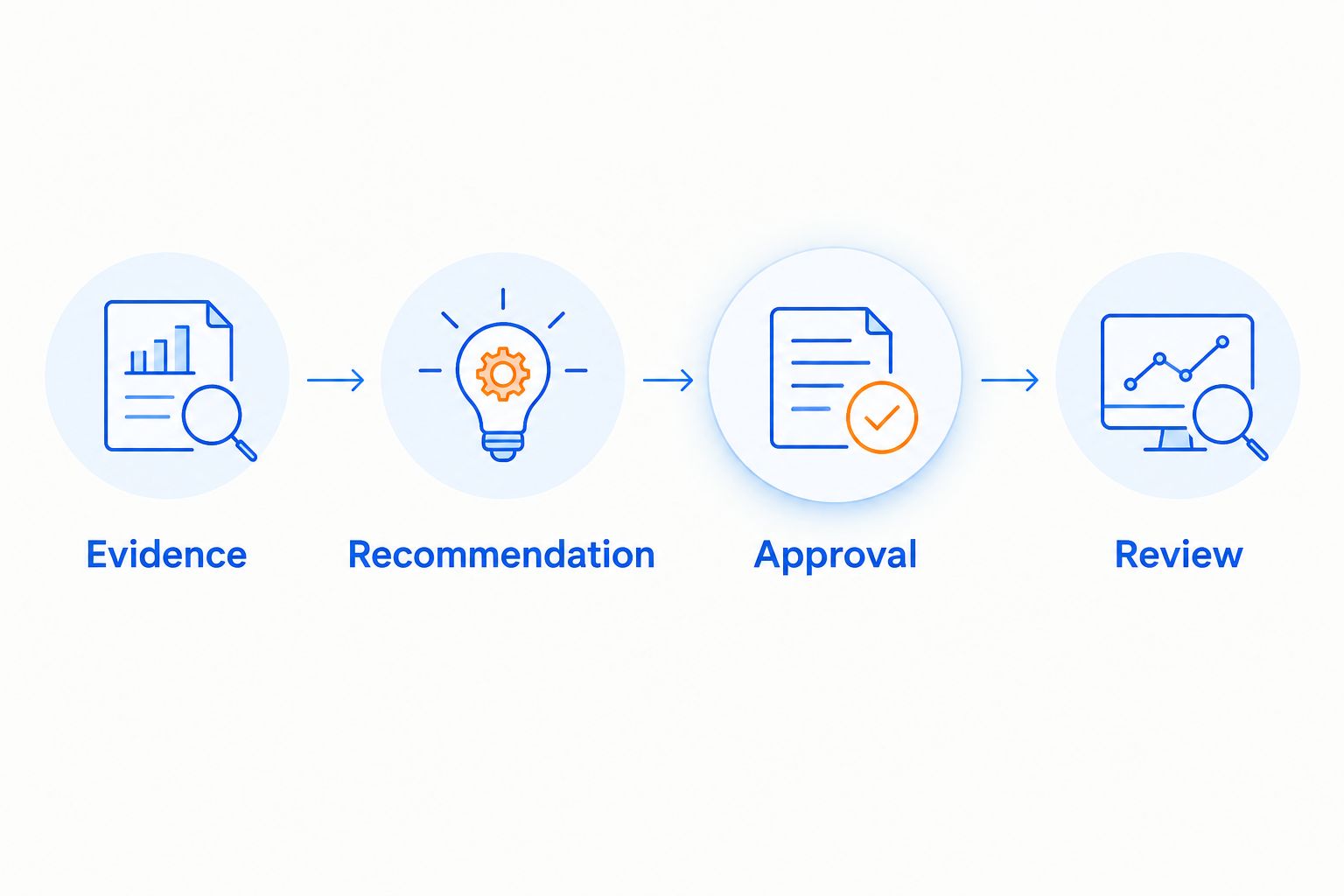
Begin manually by selecting a budget change you can reverse and writing down why it deserves priority. Check whether the receiving campaign has an operational reason to accept more spend, including audience scope, campaign objective, and sales follow-up capacity.
Do not equate historical efficiency with guaranteed returns at a larger budget. The observed result describes the measured conditions. A larger investment changes those conditions, so the expected effect needs its own rationale and uncertainty statement.
Record other changes that affect interpretation. A new landing page, sales routing change, or offer revision makes a simple before-and-after comparison harder to attribute to budget alone. Use a suitable controlled test when the decision requires evidence of incremental impact.
- State the budget source and destination.
- Document the expected business effect and its basis.
- Set approval and reversal conditions.
- Record concurrent campaign and sales changes.
- Choose how you will assess the result.
Review decisions against mature business outcomes
Create a review schedule that separates operational checks from revenue evaluation. As a starting operating rule, hold a 30-minute review every 7 days, with a process checkpoint after 30 days. These are suggested working intervals, not performance benchmarks or a claim that revenue matures within that period.
Use the operational review to inspect tracking failures, spend delivery, recommendation status, and unexpected changes. Evaluate pipeline and revenue only when the relevant cohort has had an appropriate opportunity to progress through your actual sales process.
Your 2026 decision log should retain the original recommendation even after the result is known. Rewriting the rationale after an outcome arrives destroys the record you need to judge decision quality.
For agency reporting, distinguish client approval from campaign execution. For internal teams, distinguish finance approval from media ownership. A defensible report identifies both who authorized the decision and who implemented it.
- Check data continuity and campaign delivery.
- Compare outcomes with the original expectation.
- Retain pending cohorts rather than declaring early winners.
- Record implementation dates and responsible owners.
- Update the decision without overwriting its history.
Compare attribution workflows for your team
Choose a workflow around the decision you need to defend and the maintenance you can support. More flexible reporting also creates more responsibility for definitions, reconciliation, and ongoing quality checks.
| Option | Best for | Main advantage | Key limitation |
|---|---|---|---|
| Spreadsheet with advertising and CRM exports | Teams establishing their first auditable process | Makes joins, exclusions, and formulas directly inspectable | Reconciliation and recurring updates require manual work |
| Analytics reports paired with CRM reports | Teams investigating website journeys and sales progression | Keeps interaction analysis and opportunity outcomes visible | Separate reports still need shared definitions and reconciliation |
| Warehouse-based attribution | Teams with data engineering support and custom account logic | Allows explicit control over joins, cohorts, and credit rules | The team owns implementation, model maintenance, and data quality |
| Paid Lens | Performance marketers and agencies prioritizing budget decisions | Ranks evidence-backed recommendations with expected impact and confidence | Recommendations require human review; verify integration status during private beta evaluation |
The spreadsheet option is useful for discovering problems before committing to a larger system. Its weakness is repeatability. A warehouse offers control, but control is only useful when someone owns the model and its upkeep.
Paid Lens supports marketing attribution decisions rather than replacing the need to define attribution correctly. Evaluate whether its evidence and recommendation rationale answer your actual approval questions. Do not select software solely because its dashboard matches your preferred presentation.
If you manage cross-channel budgets and must connect recommendations to CRM revenue, apply for private beta access. Confirm your required connections and review workflow before committing to implementation.
Explore the private beta
Evaluate evidence-backed budget recommendations against your cross-channel and CRM reporting needs.
Common mistakes demand gen teams make
Treating contacts as complete buying journeys
A contact record is not automatically an account history. Restricting attribution to the person who submitted the final form leaves other recorded participants outside the analysis. Define buying-group inclusion rules and expose missing opportunity relationships instead of presenting a partial journey as complete.
Comparing current spend with unrelated revenue
Revenue closed during a reporting period can originate from much older acquisition activity. Dividing it by current campaign spend answers a different question from cohort performance. Label period-based reporting clearly and maintain acquisition-cohort views for decisions about campaign quality.
Cutting discovery activity because it loses last-touch credit
Last-touch attribution credits the final recorded interaction by design. That rule cannot establish that earlier activity contributed nothing. Compare credit rules and inspect the underlying journeys before cutting activity that serves a different role in the buying process.
Presenting a confidence score as proof
A confidence score needs a stated meaning and supporting evidence. It is not automatically a probability that a budget change will succeed. Ask what uncertainty the score represents, what evidence supports it, and which missing data should stop approval.
Standardizing agency conclusions instead of definitions
Agencies benefit from consistent reporting fields, not identical recommendations across clients. Different sales stages, account structures, and approval constraints require separate interpretation. Standardize the decision record while preserving each client’s outcome definitions and evidence limits.
FAQ
What is marketing attribution for demand gen teams?
Marketing attribution for demand gen teams assigns credit to recorded marketing interactions associated with leads, opportunities, or revenue. It helps explain measured journeys, but attributed credit alone does not prove incremental impact.
What is the best attribution model for a demand gen team?
The best attribution model is the one that answers your defined decision using records you can defend. Compare first-touch, last-touch, and linear results on the same cohort before relying on a model for budget allocation.
Can we start marketing attribution without buying software?
Yes. Start with advertising exports, analytics records, CRM outcomes, and a spreadsheet that documents joins and credit rules. Manual reconciliation exposes data problems, although recurring updates require continued effort.
Is multi-touch attribution better than last-touch attribution?
Multi-touch attribution includes more recorded interactions, but that does not automatically make its conclusions more accurate. Its usefulness depends on identity coverage, opportunity relationships, and the credit rule you apply.
How do we connect ad spend to CRM revenue?
Connect campaign identifiers to contacts, accounts, and opportunities, then reconcile the associated spend and revenue. Keep reporting periods, acquisition cohorts, and opportunity definitions explicit, and report unmatched records separately.
Does attributed revenue prove a campaign caused sales?
No. Attributed revenue reflects a credit-assignment rule applied to observed records. Use a suitable experimental design when the decision requires evidence of incremental sales.
How often should demand gen teams review attribution?
Review data quality and campaign execution regularly, but evaluate revenue according to the maturity of the acquisition cohort. A short operational review should not force a revenue verdict before opportunities have progressed.
One last thing
Unknown revenue is more useful than falsely assigned revenue. Keep an unassigned category visible and investigate its causes. Forcing every opportunity into a channel produces a complete-looking chart without improving the underlying evidence.
Make that distinction explicit in your 2026 budget review: attribution coverage describes what you can trace; attribution results describe how you distribute credit within it. Better coverage changes the evidence base. A different model only changes the credit rule.