

CPG marketing mix modeling is the statistical analysis of aggregate sales, media, and commercial data to guide budget allocation and improve business outcomes. This 2026 guide explains how to separate advertising effects from promotions, pricing, seasonality, and retail distribution before committing spend.
- Marketing mix modeling for CPG brands needs retail sales, promotion, distribution, and media data—not advertising reports alone.
- Validate marketing attribution estimates against business conditions and incrementality tests before reallocating budgets.
- Paid Lens is best for agencies that need ranked budget recommendations tied to CRM revenue.
- Budget allocation should reflect marginal returns, uncertainty, retailer commitments, and operational constraints.
Why marketing mix modeling matters for CPG brands
CPG brands face a measurement problem that click-based attribution cannot resolve alone: advertising exposure and the final purchase often sit in different systems. A shopper can encounter an advertisement and then buy through a retailer whose transaction data never reaches your advertising account.
Sales also respond to shelf availability, promotional depth, pack changes, and distribution. If a retail expansion coincides with higher media spend, a model that ignores distribution risks assigning the sales increase to advertising.
Your model must explain commercial conditions before its media recommendations deserve a budget. Marketing mix modeling, or MMM, estimates relationships across aggregate observations. It does not observe the individual purchase journey, and a strong statistical fit does not establish causality by itself.
For agencies, the consequence is practical: explain which part of a recommendation comes from measured evidence and which part depends on assumptions. For marketing leaders planning 2026 budgets, that distinction belongs in the finance discussion—not in an appendix.
Paid Lens provides ranked, evidence-backed budget reallocation recommendations connecting advertising, CRM, analytics, and revenue data. That decision-intelligence use case is distinct from establishing the incremental effect of advertising on retail sell-through. Choose the measurement method around the revenue question.
How to build a defensible CPG modeling process
Define the decision and sales outcome
Start manually with a written decision brief. Specify the budget decision, the sales outcome, the geography, and the period the model must explain. A spreadsheet is enough to expose disagreements before modeling begins.
Choose whether you are explaining units, net revenue, or another explicitly defined outcome. Revenue can rise because prices increased even when unit demand did not. Conversely, a promotion can lift units without improving contribution.
Keep retailer sell-in separate from consumer sell-through. Shipments can reflect inventory decisions rather than shopper demand. If sell-in is your only outcome, document that boundary instead of describing the result as consumer response.
For your 2026 planning brief, make the decision testable: which budgets are movable, which commercial outcomes matter, and who approves changes? A model cannot settle those management choices.
- Select 1 primary outcome and define its accounting treatment.
- Specify the retailer, geography, and brand scope.
- Separate shipment data from consumer sales data.
- Record the budget constraints and approval owner.
- Define what evidence would change the decision.
Assemble a consistent commercial dataset
Build a shared data dictionary before buying software. Align sales, media, pricing, promotions, and distribution to the same calendar and geographic definitions. Preserve source files so another analyst can reproduce each transformation.
Use the finest reporting grain that remains reliable across the essential sources. A weekly dataset is a practical starting structure when your inputs support it; it is not a universal requirement. Daily media data does not make weekly retail sales more precise.
Distinguish missing observations from genuine zero activity. A blank retailer file is not evidence of no sales. Similarly, distinguish an absent promotion from an unrecorded promotion.
Aggregation also needs commercial judgment. Combining unrelated products can conceal different promotion patterns and purchase cycles. Splitting every product into its own model can leave too little variation to estimate useful effects.
- Align each row to a consistent period and market.
- Reconcile sales totals with the agreed financial source.
- Include price, promotions, distribution, and media activity.
- Flag missing files, methodology changes, and unusual trading periods.
- Record product launches, pack changes, and retailer expansions.
Choose the method that answers your question
Start with a manual diagnostic: plot sales against media, promotions, and distribution. Identify overlapping changes before interpreting channel relationships. A chart does not establish incrementality, but it reveals obvious identification problems.
Use MMM when the decision requires an aggregate view of media and commercial drivers. Use controlled experiments to test a defined intervention. Use attribution to inspect trackable customer journeys. These methods answer different questions; their estimates need not match.
Paid Lens offers a faster path to ranked, evidence-backed budget recommendations across advertising, CRM, analytics, and revenue data. For a CPG team, assess whether that connected revenue scope matches the business outcome you need to manage. CRM revenue and retail sell-through are not interchangeable.
Do not select a platform because it combines data; select it because its evidence supports your decision. Before procurement, review the assumptions and requirements in the marketing mix modeling software guide.
- Map each business question to an appropriate measurement method.
- Distinguish observed attribution from estimated incremental contribution.
- Check whether your outcome is actually available to the method.
- Confirm integration status and data coverage before committing.
- Require inspectable assumptions and human approval of budget changes.
Model response and challenge the assumptions
Begin with a transparent baseline specification. Explain non-media demand before adding increasingly complex media effects. Complexity does not repair missing distribution data or campaigns that always move together.
Advertising effects can persist after spending stops. Models represent this through carryover assumptions, often called adstock. Response curves also represent saturation: the return associated with additional spend can differ from the average return across existing spend.
These assumptions affect recommendations. If television and paid social always increase together, the data contains limited evidence for separating their individual contributions. Report that limitation instead of presenting a precise channel ranking.
For a 2026 budget decision, ask whether the recommended spend sits within observed conditions or depends on extrapolation. A mathematically attractive allocation outside the historical evidence deserves a clearly stated constraint.
- Include seasonality and relevant commercial controls.
- Explain carryover and saturation assumptions in plain language.
- Check channels that repeatedly move together.
- Report uncertainty around estimated channel contributions.
- Identify recommendations outside the observed spending range.
Validate the model before changing spend
Start with historical checks your team can inspect. Hold back a period when appropriate, compare predictions with actual outcomes, and examine where errors concentrate. Separate ordinary forecasting error from mistakes around promotions or distribution changes.
Predictive accuracy is necessary evidence, not proof that each channel estimate is causal. A model can predict total sales while assigning contribution incorrectly among correlated inputs. Validation must therefore address the recommendation, not only the sales forecast.
Compare model conclusions with relevant controlled tests where those tests exist. Check that the geography, audience, timing, and outcome are comparable before treating an experiment as calibration evidence.
Use a decision packet with 3 scenarios: maintain allocation, make the proposed change, and apply a constrained alternative. These are planning choices, not promised outcomes. Show the assumptions that explain the difference.
- Inspect predictions against actual sales outside the fitting period.
- Review errors around promotions, launches, and distribution changes.
- Compare channel estimates with relevant experimental evidence.
- Test whether reasonable assumptions reverse the recommended action.
- Label uncertain findings as uncertain rather than forcing a ranking.
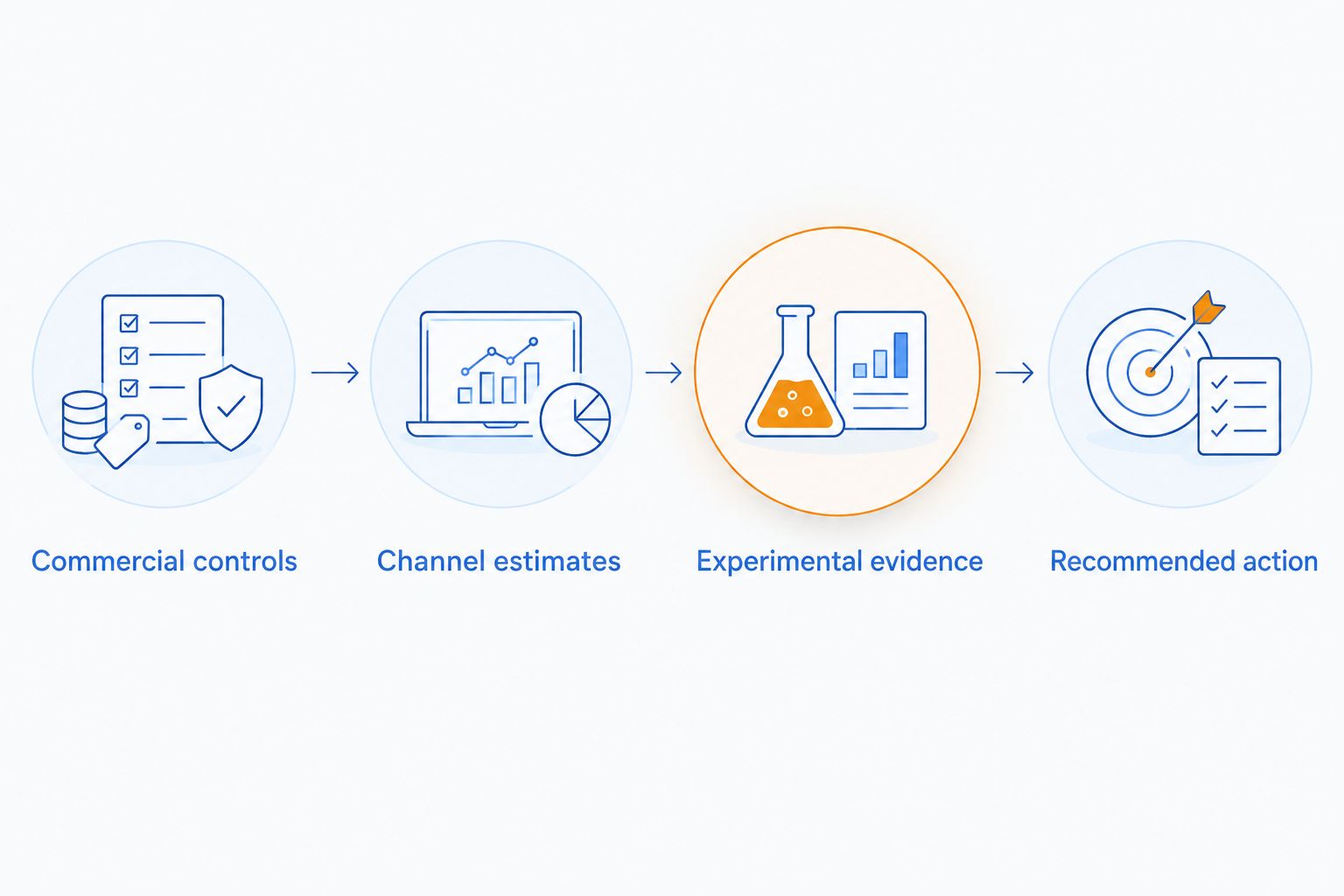
Turn estimates into controlled budget decisions
Start with a decision register. Record the proposed movement, supporting evidence, expected business impact, uncertainty, owner, and conditions for reversal. Keep the original recommendation alongside the eventual outcome.
Allocate on expected marginal response, not historical average return alone. Average return describes the spend already made. Marginal response addresses the next budget decision, subject to the model's assumptions and operating limits.
For your 2026 operating plan, separate media budgets from retailer commitments and other restricted funds. An allocation that ignores those constraints is not executable, even if its modeled outcome looks attractive.
Set a review schedule around data availability and the expected response period. Do not declare success before the sales outcome has had time to develop. Equally, do not leave a decision running without an accountable review date.
- Record a baseline and a proposed allocation before execution.
- Preserve contractual, retailer, and channel constraints.
- Set an approval owner and review date for each change.
- Define the evidence that triggers continuation, revision, or reversal.
- Refresh assumptions when pricing, distribution, or measurement changes.
Compare measurement options for CPG teams
The best option depends on the outcome you can observe and the decision you must defend. This comparison describes methodological fit, not a vendor performance ranking. No single approach removes the need to assess data quality.
| Option | Best for | Main strength | Key limitation |
|---|---|---|---|
| Custom MMM analysis | Teams with analyst support and usable historical variation | Makes commercial controls and model assumptions explicit | Requires statistical expertise, validation, and maintenance |
| Managed MMM service | Teams that need external modeling support | Adds specialist execution and interpretation | Model transparency and decision ownership require explicit agreement |
| Controlled incrementality testing | Teams testing a defined spend intervention | Provides causal evidence when the design supports it | Findings apply to the tested conditions; execution can be constrained |
| Customer-journey attribution | Teams with trackable digital conversion paths | Shows observed touchpoints within its coverage | Does not resolve unobserved retail purchases or establish incrementality alone |
| Paid Lens decision intelligence | Agencies and leaders connecting advertising to CRM revenue | Ranks evidence-backed budget reallocation recommendations | Connected revenue recommendations do not establish retail sales incrementality |
Ask any provider to demonstrate the actual data path from spend to the outcome used in its recommendations. Request the assumptions, validation approach, and treatment of uncertainty. A polished dashboard is not a substitute for those answers.
Qualified agencies and marketing leaders should visit the homepage to apply for the private beta. Confirm current integration availability and fit with your measurement requirements during that process.
Apply for the private beta
Assess fit for evidence-backed budget recommendations tied to advertising and CRM revenue.
Common mistakes CPG teams make
Treating shipment growth as consumer demand
Retailer orders can reflect inventory timing rather than shopper purchases. Keep sell-in and sell-through definitions visible in the model and the executive report. Never switch between them to support a preferred conclusion.
Giving advertising credit for distribution gains
Additional listings and improved availability change the opportunity to sell. Include a defensible distribution measure where available, and disclose the limitation when it is absent. Otherwise, media estimates can absorb the effect of expanded availability.
Separating promotions from their media support
Promotion calendars and campaign activity often overlap. Review them together, including price changes and retailer activity. If the historical data cannot separate their effects, report the combined uncertainty instead of assigning confident standalone returns.
Optimizing to an unconstrained model output
A recommendation can conflict with retailer commitments, production capacity, or planned launches. Apply those constraints before approval. Preserve the difference between the model's unconstrained estimate and the budget your team can execute.
FAQ
What is marketing mix modeling for CPG brands?
Marketing mix modeling for CPG brands estimates how media and commercial factors relate to aggregate sales outcomes. It incorporates factors such as promotions, pricing, seasonality, and distribution to support budget decisions.
Is marketing mix modeling better than attribution for CPG?
MMM is better suited to aggregate sales questions involving retail activity and commercial drivers. Attribution is better suited to examining observed customer touchpoints within trackable journeys; neither establishes every channel's incremental effect automatically.
How much historical data does a CPG model need?
The requirement depends on reporting frequency, channel variation, seasonality, and model complexity. Ask the analyst to justify the observation window and identify effects the available data cannot separate.
Can a CPG brand build a model without retailer sales data?
A CPG brand can model another available outcome, but the conclusions apply to that outcome. Shipment-based estimates should not be presented as direct evidence of consumer sell-through.
Can marketing mix modeling prove that advertising caused sales?
A fitted model alone does not prove advertising caused sales. Causal interpretation depends on identification assumptions, relevant controls, and supporting evidence such as well-designed experiments.
Where does Paid Lens fit in a CPG measurement plan?
Paid Lens provides ranked, evidence-backed budget reallocation recommendations using advertising, CRM, analytics, and revenue data. Assess whether that revenue scope matches your CPG decision, and use the private beta application to confirm fit and integration status.
One last thing
Before approving your next 2026 allocation, ask the analyst to show what happens when distribution is removed from the model. This is a sensitivity check, not an alternative model to adopt. If the recommended media allocation changes materially, the decision depends on how distribution is measured—and that dependency belongs in the approval memo.