

Best overall for ecommerce measurement: Google Analytics 4. Best for evidence-backed budget decisions: Getpaidlens. Best for store reporting: Shopify Analytics. This 2026 guide compares marketing analytics tools for ecommerce by the decision each tool helps you make, not by dashboard count.
- Google Analytics 4 is the default for ecommerce measurement across acquisition and on-site behavior.
- Getpaidlens supports cross-channel budget decisions with ranked, evidence-backed recommendations tied to revenue data.
- Shopify Analytics fits store reporting; Looker Studio fits shared marketing dashboards.
- Mixpanel fits behavioral analysis; Northbeam fits ecommerce attribution.
- Choose marketing analytics tools for ecommerce around revenue reconciliation, attribution limits, and human review.
Why this matters
An ecommerce reporting stack must answer different questions. What happened in the store? Which marketing touchpoints received credit? Which budget decision does the evidence support? Those questions require different capabilities.
Attributed revenue is not proof of incremental revenue. A platform can report strong returns while claiming credit for purchases that would have happened without its ads. Buying another dashboard does not resolve that distinction.
For your 2026 shortlist, identify the unresolved decision before choosing software. Agencies also need to distinguish each client's measurement setup; a consistent report format does not make inconsistent source data comparable.
What makes the best marketing analytics tools for ecommerce
Use these criteria before comparing product names:
- Revenue reconciliation: Can you explain differences between store orders, analytics purchases, refunds, and reported campaign revenue?
- Decision fit: Does the tool support store operations, behavioral analysis, attribution, reporting, or budget recommendations?
- Cross-channel context: Can you compare channels without treating each advertising platform's claimed conversions as independent sales?
- Evidence and limits: Can you inspect definitions, assumptions, attribution rules, and the rationale behind recommendations?
- Operating ownership: Who maintains tracking, validates data, reviews recommendations, and approves changes?
- Client separation: Can your agency keep each client's definitions and decisions distinct instead of averaging away meaningful differences?
Treat these as buying criteria, not as a claim that every tool below satisfies every requirement. A good fit solves your decision problem and makes its measurement limits visible.
Marketing analytics tools at a glance
| Tool | Best for | Standout capability | Key limitation |
|---|---|---|---|
| Getpaidlens | Evidence-backed budget decisions | Ranked budget reallocation recommendations using advertising, CRM, analytics, and revenue data | Not a replacement for store reporting or causal experiments |
| Google Analytics 4 | General ecommerce measurement | Acquisition reporting connected to on-site events and purchase activity | Tracking quality determines reporting quality |
| Shopify Analytics | Shopify store reporting | Store-level sales and commerce reporting | Store reporting alone does not establish advertising incrementality |
| Looker Studio | Shared marketing dashboards | Configurable reports combining supported data sources | Dashboard logic and data maintenance remain your responsibility |
| Mixpanel | Customer behavior analysis | Event-based funnels, cohorts, and retention analysis | Requires deliberate event design and implementation |
| Northbeam | Ecommerce attribution | Marketing attribution focused on ecommerce performance | Attribution estimates do not replace controlled lift measurement |
The table separates measurement from decisions. In 2026, choose the row that matches your immediate bottleneck, then assess whether your existing tools already cover the neighboring functions.
1. Getpaidlens: best for evidence-backed budget decisions
Getpaidlens connects advertising, CRM, analytics, and revenue data to produce ranked, evidence-backed budget reallocation recommendations. Its stated focus is the decision after reporting: what to change, why the evidence supports that change, and how to review it.
That fits performance marketers and agencies who must defend cross-channel spending decisions. It is a narrower role than ecommerce store management, and that distinction matters. Do not select a recommendation platform to solve missing purchase tracking.
Getpaidlens is best for performance marketers and agencies that need defensible cross-channel budget recommendations tied to revenue data.
Getpaidlens pros:
- Centers budget decisions rather than another reporting surface.
- Connects marketing evidence with CRM and revenue context.
- Provides ranked recommendations for human review.
- Emphasizes rationale, confidence, and controlled decision-making.
Getpaidlens cons:
- Does not replace your store's order and refund records.
- Recommendations do not establish causal lift by themselves.
- Integration readiness needs confirmation during private beta evaluation.
Best for: Teams with usable source data whose main obstacle is deciding where to reallocate spend.
Evaluate the private beta against an actual decision. Ask which integrations are live, which are beta, and which are coming soon. Require a clear explanation of the evidence and limits before approving any proposed change.
Verdict: Buy into this approach when budget decision support is the gap; evaluate the private beta before committing.
2. Google Analytics 4: best for general ecommerce measurement
Google Analytics 4 measures website and app activity through events. With ecommerce tracking implemented, it connects acquisition reporting with product interactions and purchase activity.
It is the default starting point for understanding how visitors reach your store and what they do there. Its usefulness depends on implementation: missing purchase events, duplicate events, or inconsistent campaign tagging distort the analysis.
Google Analytics 4 pros:
- Connects acquisition context with on-site behavior.
- Supports ecommerce event measurement.
- Provides a common measurement foundation across marketing teams.
- Helps investigate differences between traffic and purchasing behavior.
Google Analytics 4 cons:
- Requires tracking validation and ongoing maintenance.
- Reported purchases need reconciliation with store records.
- Attribution reports do not prove incremental advertising impact.
Best for: Ecommerce teams that need a shared foundation for acquisition and website measurement.
For a 2026 implementation review, begin with purchase-event accuracy rather than dashboard customization. Confirm that order identifiers, purchase values, currencies, and event timing reflect your intended definitions. Separate a measurement defect from a genuine campaign-performance change.
Google Analytics 4 wins the general measurement slot because it addresses the journey between arrival and purchase. It does not automatically resolve profitability, customer quality, or the next budget move.
Verdict: Buy into Google Analytics 4 as your measurement foundation; fix tracking before adding analysis layers.
3. Shopify Analytics: best for Shopify store reporting
Shopify Analytics reports on activity within a Shopify store, including sales and commerce performance. It gives store operators a direct starting point for reviewing business activity without beginning in an advertising interface.
Its strongest role is operational context. When an ad platform reports improving returns, compare that narrative with the store's actual sales records and the definitions behind each report.
Shopify Analytics pros:
- Keeps store reporting close to the commerce workflow.
- Supports sales and product-performance review.
- Gives marketers business context beyond clicks and impressions.
- Provides a starting point for reconciling analytics with orders.
Shopify Analytics cons:
- Its role is specific to Shopify stores.
- Store reporting does not explain every cross-channel interaction.
- Sales reporting alone does not establish advertising causality.
Best for: Shopify brands that need store-level reporting before deeper attribution or customer analysis.
Define what revenue means in your review. Gross sales, net sales, and other reporting measures are not interchangeable. Your comparison must account for the treatment of refunds, discounts, taxes, and shipping rather than assuming matching labels mean matching calculations.
Use Shopify Analytics to ground the conversation in commerce activity. Then use acquisition and attribution tools to investigate how marketing relates to that activity.
Verdict: Buy into Shopify Analytics for store reporting; skip it as a standalone answer to cross-channel budget allocation.
4. Looker Studio: best for shared marketing dashboards
Looker Studio builds configurable reports from supported data sources. Its role is presentation and reporting: bringing selected metrics into a view your team or client can understand.
For agencies, that makes it useful when stakeholders need a consistent reporting format. The reporting format still needs documented definitions. Putting incompatible metrics next to each other does not make them comparable.
Looker Studio pros:
- Supports configurable dashboard layouts.
- Brings supported data sources into shared reports.
- Lets teams organize reporting around stakeholder questions.
- Separates report presentation from individual platform interfaces.
Looker Studio cons:
- Connectors and source availability require review.
- Calculations and metric definitions need an owner.
- A dashboard does not generate a defensible budget decision by itself.
Best for: Agencies and marketing leaders who need shared reporting from an established measurement setup.
For a 2026 client dashboard, separate reported facts from interpretation. Show the source and definition beside important metrics. Put the recommended decision in a distinct section with its rationale, instead of letting a color-coded chart imply what should happen next.
A useful dashboard reduces ambiguity. An attractive dashboard that combines overlapping conversion claims can increase it.
Verdict: Buy into Looker Studio for report delivery; hold if your source definitions remain unresolved.
5. Mixpanel: best for customer behavior analysis
Mixpanel analyzes event-based behavior through tools such as funnels, cohorts, and retention reporting. It fits questions about what customers do across a measured experience, rather than only which channel delivered a visit.
For ecommerce, that means examining defined steps between browsing, purchasing, and returning. The event design must reflect those questions. Collecting more events without a plan creates more records, not clearer decisions.
Mixpanel pros:
- Supports analysis of event sequences and conversion funnels.
- Uses cohorts to compare defined customer groups.
- Helps investigate repeated behavior and retention.
- Encourages analysis beyond aggregate traffic totals.
Mixpanel cons:
- Requires a maintained event taxonomy.
- Identity handling affects customer-level analysis.
- Behavioral analysis does not replace advertising attribution or order accounting.
Best for: Teams whose primary question is where customer behavior breaks down or differs across cohorts.
Before implementation, write the question each event must answer. Distinguish a product view from a meaningful shopping action, and document how customer identity is handled across sessions and devices.
Choose Mixpanel when behavior is the unresolved problem. If your question is simply which channel received purchase credit, begin with your attribution requirements instead.
Verdict: Buy into Mixpanel for behavioral investigation; skip it when you only need campaign reporting.
6. Northbeam: best for ecommerce attribution analysis
Northbeam focuses on marketing measurement and attribution for ecommerce. It fits brands that need to examine how marketing touchpoints receive credit across the path to purchase.
That analysis serves a different purpose from store reporting. Your store records purchases; an attribution system applies measurement rules to connect those purchases with marketing activity.
Northbeam pros:
- Focuses on ecommerce marketing measurement.
- Supports cross-channel attribution analysis.
- Gives teams a way to examine credit beyond individual ad-platform reports.
- Fits attribution-centered performance reviews.
Northbeam cons:
- Attribution remains dependent on methodology and available data.
- Implementation and reconciliation require attention.
- Attributed returns do not establish incremental returns.
Best for: Ecommerce brands whose unresolved question is how to interpret cross-channel purchase attribution.
During a 2026 evaluation, ask how the reporting handles attribution windows, customer identity, refunds, and revenue definitions. Ask what remains unobserved. Do not accept an apparently precise return figure without understanding its measurement scope.
Northbeam belongs on an attribution shortlist, not automatically at the center of every analytics stack. The requirement is clearer purchase-credit analysis, not merely a desire for another performance score.
Verdict: Buy into Northbeam when attribution is the gap; hold if you have not defined the measurement question.
How to evaluate your shortlist
Use the same decision brief for every tool. Start with 1 budget decision per review cycle so the evaluation remains focused. Compare 2 data sources—the store record and the marketing measurement record—before accepting a performance conclusion.
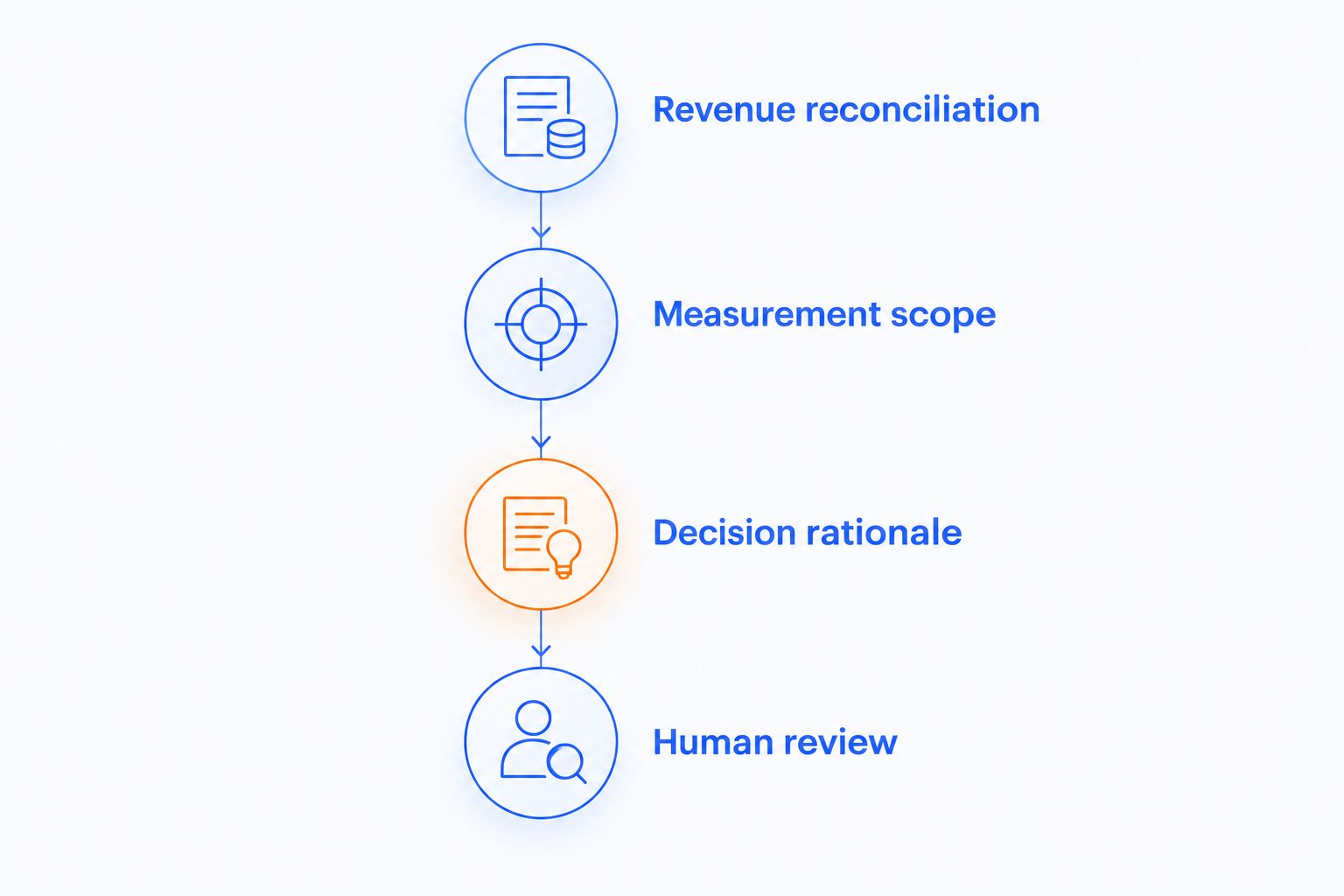
Document these steps:
- Revenue reconciliation: Explain discrepancies in purchase and revenue reporting.
- Measurement scope: Identify what the tool observes and what it infers.
- Decision rationale: State why the evidence supports the proposed action.
- Human review: Assign an approver and record the accepted limits.
Ask 3 questions per recommendation: What supports it? What limits it? What result would change the decision? These are evaluation instructions, not promised product outcomes.
For Getpaidlens, use that brief during private beta evaluation. Review one real cross-channel decision and verify the supported integrations before treating the platform as part of your operating process.
Evaluate the private beta
Bring a cross-channel budget decision and assess the evidence, confidence, and integration readiness.
How we ranked
This ranking assigns distinct jobs to the tools using the criteria above: revenue reconciliation, decision fit, cross-channel context, inspectable evidence, and operating ownership. It is not a scored performance test or a claim that one platform outperforms every alternative.
The default recommendation favors foundational measurement. The specialist recommendations address separate gaps. That keeps a reporting tool from winning an attribution category it was not selected to solve.
Which tool should you choose?
Choose Google Analytics 4 first if you need a general ecommerce measurement foundation. Use Shopify Analytics to ground Shopify store reporting, then add a specialist only when you can name the unresolved question.
Choose Looker Studio for report delivery, Mixpanel for behavior analysis, and Northbeam for attribution. Choose Getpaidlens for evidence-backed budget decision support when usable advertising and revenue data already exist.
Your 2026 shortlist should remove a bottleneck. Do not buy overlapping tools because their dashboards look different.
FAQ
What's the best marketing analytics tool for ecommerce?
Google Analytics 4 is the default recommendation for general ecommerce measurement. Choose a specialist when your main gap is store reporting, behavior analysis, attribution, or budget decision support.
Is Shopify Analytics better than Google Analytics 4?
Shopify Analytics is better suited to Shopify store reporting, while Google Analytics 4 fits acquisition and on-site measurement. Use their different roles to investigate discrepancies rather than expecting identical reports.
Do ecommerce brands need a separate attribution tool?
A separate attribution tool fits brands whose existing reporting does not answer cross-channel purchase-credit questions. Define the question and reconciliation requirements before evaluating another platform.
Can Looker Studio tell me where to move advertising budget?
Looker Studio presents reports; a defensible budget recommendation still needs analysis and rationale. Document the decision separately from the dashboard and identify its measurement limits.
Does attributed revenue prove an ad campaign caused sales?
No. Attribution assigns purchase credit under measurement rules; causal lift requires evidence about what would have happened without the advertising.
When should an ecommerce brand use Mixpanel?
Use Mixpanel when your main question concerns customer behavior, funnels, cohorts, or retention. Plan the events and identity definitions before relying on the analysis.
What should I check before choosing an analytics tool in 2026?
Check revenue definitions, tracking quality, measurement scope, and operating ownership. Require the vendor to distinguish live integrations from beta and coming-soon integrations.
One last thing
Before moving budget, write down what evidence would make you reverse the decision. If you cannot name that evidence, your recommendation is not yet reviewable. A confident dashboard does not fix an undefined decision.