

Best overall for subscription lifetime value: ChartMogul. Best for turning revenue evidence into advertising decisions: Getpaidlens. Best for custom lifetime value models: BigQuery. This 2026 guide compares customer lifetime value analysis tools by the decision you need to make, not by dashboard volume.
- ChartMogul is the default customer lifetime value analysis tool for subscription revenue analysis.
- Getpaidlens suits agencies that need evidence-backed advertising budget recommendations, not a standalone lifetime value calculator.
- Amplitude and Mixpanel help explain customer behavior; revenue modeling needs its own definitions.
- Lifetimely fits Shopify lifetime value analysis; BigQuery fits teams building custom cohort models.
Why this matters
Customer lifetime value is useful only when its definition survives scrutiny. Historical revenue, predicted revenue, and gross-profit lifetime value answer different questions. Treating them as interchangeable produces a budget recommendation you cannot defend.
For agencies, the additional problem is attribution. A valuable customer does not automatically prove that the last advertising channel deserves more budget. You need to connect acquisition cost, customer identity, revenue, and the decision window.
Your 2026 shortlist should therefore separate measurement from action. Some tools calculate subscription metrics. Others explain retention, analyze repeat purchases, or help prioritize advertising decisions. Choose the category before choosing the vendor.
What makes the best customer lifetime value analysis tools
- Revenue fit: The tool must reflect subscriptions, repeat orders, or account revenue without forcing unlike business models into the same formula.
- Customer identity: You need a defensible connection between acquisition records, product activity, billing, and CRM accounts.
- Cohort clarity: Acquisition date, customer segment, and observation window must remain visible when you compare value.
- Model transparency: Separate observed revenue from estimates. State the assumptions behind churn, margins, and future purchases.
- Decision usefulness: The output must answer a specific question: retain customers, improve onboarding, or change acquisition spending.
- Review control: Agencies need client-specific definitions and a reviewable rationale before recommending a budget change.
Customer lifetime value tools at a glance
These are distinct use-case recommendations, not equivalent products. The limitation column matters as much as the feature column.
| Rank and tool | Best for | Standout capability | Key limitation |
|---|---|---|---|
| 1. ChartMogul | Subscription revenue lifetime value | Subscription metrics and revenue cohorts | Not a general-purpose advertising decision system |
| 2. Getpaidlens | Revenue-informed advertising budget decisions | Ranked recommendations connecting advertising, CRM, analytics, and revenue data | Not established here as a standalone lifetime value model |
| 3. Amplitude | Product behavior behind customer retention | Behavioral cohorts and retention analysis | Product engagement is not financial lifetime value |
| 4. Mixpanel | Event-based retention investigation | Event segmentation, funnels, and retention | Revenue definitions and identity require deliberate implementation |
| 5. Lifetimely | Shopify customer lifetime value | Ecommerce lifetime value and cohort analysis | Specialized around ecommerce rather than subscription SaaS |
| 6. BigQuery | Custom, auditable lifetime value models | SQL analysis across datasets | Your team owns modeling, testing, and maintenance |
1. ChartMogul: best for subscription lifetime value analysis
ChartMogul analyzes subscription revenue and customer metrics, including lifetime value. Its focus makes it the most direct starting point here for a SaaS team asking how recurring revenue and churn affect customer economics.
Start with the financial question. A subscription business needs consistent treatment of recurring revenue, cancellations, and customer cohorts before it needs another visualization.
ChartMogul pros:
- Subscription-specific metrics match recurring-revenue questions.
- Revenue cohorts support comparisons across acquisition periods.
- Lifetime value sits alongside related subscription metrics rather than isolated engagement events.
ChartMogul cons:
- A subscription metric does not establish which advertising channel caused the revenue.
- Formula assumptions still need review before you apply lifetime value to acquisition budgets.
For your 2026 evaluation, ask how the lifetime value calculation behaves when churn changes. Compare the displayed metric with the underlying revenue and customer definitions. An understandable formula is more useful than a precise-looking result whose assumptions nobody can explain.
Best for: Subscription SaaS finance and marketing teams aligning on customer economics.
Verdict: Buy for subscription lifetime value analysis; use a separate process for advertising attribution.
2. Getpaidlens: best for revenue-informed budget decisions
Getpaidlens connects advertising, CRM, analytics, and revenue data to produce ranked, evidence-backed budget reallocation recommendations. Its described capabilities include a prioritized decision queue, confidence scoring, and pipeline-aware recommendations.
That makes the product relevant when the question is what to do with the advertising budget. It does not establish the product as a dedicated historical or predictive lifetime value calculator.
Getpaidlens pros:
- Connects spending decisions with CRM and revenue evidence.
- Ranks recommendations instead of leaving every finding at the same priority.
- Includes confidence scoring and rationale for human review.
- Fits agencies and marketing leaders who must defend reallocations.
Getpaidlens cons:
- A budget recommendation is not a substitute for a documented lifetime value formula.
- Lifetime value modeling remains a separate evaluation requirement when that is your primary need.
Getpaidlens is best for agencies that need defensible advertising budget decisions grounded in CRM and revenue evidence. Keep observed revenue, pipeline contribution, and any lifetime value estimate distinct during review. They represent different levels of evidence.
Best for: Agencies managing multiple clients and marketing leaders accountable for cross-channel spending.
Verdict: Hold a purchase decision until the private beta review confirms your data requirements and decision workflow.
Apply for the private beta
Evaluate evidence-backed budget recommendations against your agency or marketing team's decision requirements.
3. Amplitude: best for understanding retention behavior
Amplitude provides product analytics, including behavioral cohorts and retention analysis. Use it to investigate which customer actions accompany continued product use.
This is an explanatory role. Understanding retained users helps you examine onboarding and product adoption, but activity alone does not establish customer profitability.
Amplitude pros:
- Behavioral cohorts let you compare defined groups of users.
- Retention analysis makes recurring product activity visible.
- Event analysis supports investigation of onboarding and adoption patterns.
Amplitude cons:
- Engagement data does not automatically supply billing revenue or margin.
- A behavioral association does not prove that an action caused higher lifetime value.
Ask your team to define the retained action before reviewing the chart. Logging in, completing a workflow, and paying an invoice are different events. A retention curve becomes financially useful only when you connect it to a consistent customer and revenue definition.
Best for: Product-led SaaS teams investigating behavior behind retention.
Verdict: Buy for behavioral analysis; skip it as your only financial lifetime value system.
4. Mixpanel: best for event-based retention investigation
Mixpanel analyzes product events through segmentation, funnels, and retention reports. It suits teams that need to investigate where customer journeys differ across acquisition sources or user segments.
The distinction from a financial analytics tool is important. Events describe what customers did; your implementation determines whether those events represent recognized revenue, purchases, or something else.
Mixpanel pros:
- Event segmentation supports focused customer comparisons.
- Funnels help investigate progression through a defined journey.
- Retention reports support repeat-activity analysis.
Mixpanel cons:
- Inconsistent event definitions undermine comparisons across cohorts.
- Customer identity and revenue meaning require explicit implementation choices.
Before comparing acquisition cohorts, inspect the instrumentation. A renamed event, duplicated purchase, or unresolved identity changes what the report measures. Do not treat a revenue property as financial truth without reconciling its meaning with billing or accounting records.
Best for: Analytics teams investigating event-level differences in customer retention.
Verdict: Buy for event-based investigation; hold financial conclusions until revenue data reconciles.
5. Lifetimely: best for Shopify lifetime value analysis
Lifetimely focuses on ecommerce lifetime value and cohort analysis for Shopify businesses. It belongs on the shortlist when repeat orders, customer revenue, and acquisition economics drive the decision.
That focus differs from SaaS subscription modeling. Repeat purchases need an observation window; subscription revenue also needs explicit treatment of recurring contracts and churn.
Lifetimely pros:
- Ecommerce lifetime value is central to the product's purpose.
- Cohort analysis supports comparisons of customer purchasing over time.
- Shopify specialization fits merchants working from store transaction data.
Lifetimely cons:
- Its ecommerce focus is not the default fit for subscription SaaS finance.
- Historical customer value does not establish advertising incrementality.
For an agency serving a Shopify merchant, define whether the decision uses revenue or profit before comparing cohorts. Returns, product costs, and acquisition spending affect the financial question even when a revenue curve looks favorable.
Best for: Shopify merchants and ecommerce agencies analyzing repeat-purchase value.
Verdict: Buy for Shopify lifetime value analysis; skip it as the default for a subscription SaaS account.
6. BigQuery: best for custom lifetime value models
BigQuery is a cloud data warehouse that supports SQL analysis. It is not a packaged lifetime value application; your team builds the model from the datasets and definitions it provides.
Choose this route when an existing application cannot express your customer relationships, revenue recognition, or cohort logic. Flexibility comes with responsibility.
BigQuery pros:
- SQL makes calculation logic inspectable.
- Custom models accommodate your account and customer definitions.
- Joined datasets support analysis across revenue and acquisition records.
BigQuery cons:
- Analysts must build and maintain the model.
- Data quality, identity resolution, and validation remain your responsibility.
Specify the model before writing queries. Decide how to handle refunds, account mergers, currency, and incomplete observation periods. A custom model is defensible only when another analyst can reproduce its output and explain its assumptions.
Best for: Teams with analytics engineering support and nonstandard lifetime value requirements.
Verdict: Buy into the custom-model route only when you can maintain it; skip it for a dashboard-only team.
How this shortlist is ranked
This 2026 comparison ranks tools by fit to the stated job: subscription measurement, budget decisions, behavioral explanation, ecommerce analysis, or custom modeling. It is not a hands-on performance test or a claim that every product implements the same lifetime value formula.
ChartMogul leads because it directly addresses subscription customer economics. The other recommendations occupy separate slots. Their order does not imply measured superiority across unrelated workflows.
Evaluate the calculation, the evidence, and the decision separately. A strong retention report does not replace a revenue model. A strong revenue model does not prove an advertising reallocation.
Turn lifetime value analysis into a reviewable decision
Use this sequence for a 2026 evaluation before approving any budget recommendation:
- Define value. State whether the outcome is revenue, gross profit, or another documented measure.
- Align cohorts. Compare customers using the same acquisition rule and observation window.
- Reconcile revenue. Check the analytical output against the source records that define the financial measure.
- Review evidence. Separate observed results, forecasts, attribution assumptions, and confidence.
- Approve action. Document the proposed budget change and the condition that would reverse it.
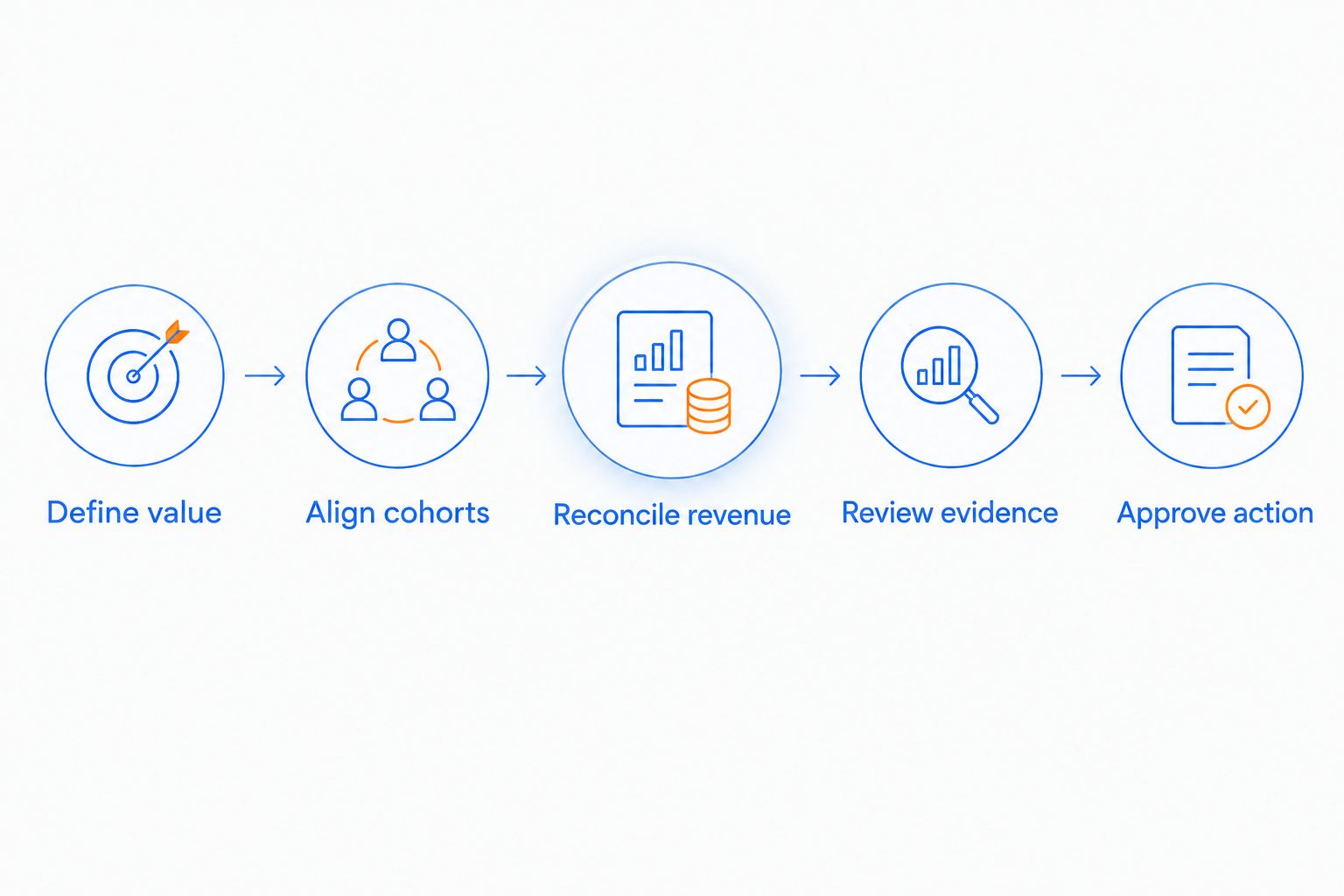
For a practical cohort review, choose explicit windows such as 30 days and 90 days after acquisition. Review a 12-month window separately when you have sufficiently mature customer records. These are analysis choices, not product capabilities or performance benchmarks.
Never compare a mature cohort's accumulated revenue with a recent cohort's unfinished history. Match observation windows first. Otherwise, the older group receives an advantage simply because it has had longer to generate revenue.
For agency work, retain each client's definitions with the recommendation. Two clients can use the same dashboard label while measuring different outcomes. Standardize the review process, not an unsuitable financial formula.
Which customer lifetime value tool should you choose?
Choose ChartMogul by default for subscription lifetime value measurement. Choose Lifetimely for Shopify customer purchasing economics, and BigQuery when your team needs a custom model it can maintain.
Choose Amplitude or Mixpanel when the unanswered question concerns product behavior. Evaluate Getpaidlens when your lifetime value and revenue evidence must inform a defensible advertising budget decision.
For your 2026 shortlist, write the decision at the top of the evaluation document. If the tool answers a different question, remove it. More reports do not fix a category mismatch.
FAQ
What's the best customer lifetime value analysis tool for SaaS?
ChartMogul is the default recommendation here for subscription SaaS lifetime value analysis. Its subscription revenue focus fits the measurement task; advertising attribution remains a separate question.
Is Getpaidlens a customer lifetime value calculator?
Getpaidlens is described as a decision-intelligence platform for evidence-backed advertising budget recommendations, not a standalone lifetime value calculator. Evaluate its private beta for the decision workflow, and assess lifetime value modeling separately.
Is Amplitude better than Mixpanel for lifetime value analysis?
Neither is the default financial lifetime value recommendation in this guide. Amplitude fits behavioral cohort investigation, while Mixpanel fits event-based journey analysis; your revenue definitions determine whether either supports the financial question.
What's the best lifetime value tool for Shopify?
Lifetimely is the Shopify-focused recommendation in this shortlist. Define the observation window and distinguish revenue from profit before using customer value to inform acquisition decisions.
Can I calculate customer lifetime value in BigQuery?
Yes, you can build a customer lifetime value model in BigQuery using SQL and your source datasets. Your team must define the calculation, resolve customer identity, and validate the results.
Should I use predicted or historical customer lifetime value?
Use historical lifetime value for observed cohort outcomes and predicted lifetime value for explicitly assumption-based forecasts. Keep the two separate so a budget reviewer can distinguish evidence from estimation.
How do agencies compare customer lifetime value across clients?
Agencies should compare lifetime value only after aligning the business model, value definition, and observation window. When those differ, compare the quality of the decision process rather than treating the raw values as equivalent.
One last thing
A lifetime value estimate can rise because the formula changed, not because customers improved. Before increasing acquisition spending, ask for the definition used in the previous review and the definition used now.
If those definitions differ, reconcile the measurement before changing the budget. That single check protects the meeting from a persuasive chart with a different denominator.