

Choose Paid Lens if you need evidence-backed recommendations for reallocating advertising budgets; choose HubSpot if you need a CRM and marketing workflow system to manage contacts, deals, and follow-up. This 2026 comparison separates the budget decision layer from the system that records and manages customer relationships.
- Paid Lens vs HubSpot is a budget decision-intelligence versus CRM comparison, not a like-for-like replacement decision.
- Choose the decision-intelligence platform for ranked budget recommendations tied to advertising, CRM, analytics, and revenue data.
- Choose HubSpot for contact management, deal pipelines, and marketing workflows.
- Neither recommendation confidence nor attributed revenue proves that additional advertising spend will generate incremental revenue.
Why this matters
A marketing leader asking where to move budget has a different problem from a sales leader asking which deals need attention. Treating those questions as interchangeable produces the wrong software shortlist.
Your CRM records customer relationships and sales progress. A budget decision layer interprets performance evidence and proposes what to change. You need reliable records before you can defend a recommendation, but reliable records alone do not tell you which advertising decision deserves priority.
Paid Lens is budget decision-intelligence software for performance marketers and agencies that need to defend cross-channel reallocations. HubSpot is the stronger fit when your immediate requirement is running customer and marketing workflows rather than reviewing a ranked budget action queue.
For a 2026 buying decision, start with the work that is currently blocked. Do not replace a functioning CRM because you need better budget analysis. Do not buy an analytical layer to solve inconsistent deal management.
At a glance
The comparison below distinguishes stated decision-platform capabilities from HubSpot's established CRM and marketing functions. It does not assume that every HubSpot subscription includes every reporting or automation capability.
| Dimension | Paid Lens | HubSpot |
|---|---|---|
| Best for | Performance marketers and agencies defending budget reallocations | Teams managing contacts, deals, and marketing workflows |
| Budget decisions | Ranked, evidence-backed reallocation recommendations | CRM and marketing reporting that informs analysis |
| CRM operations | Uses CRM information as decision evidence | Manages customer records and deal pipelines |
| Marketing execution | Decision review rather than campaign workflow execution | Marketing automation and customer communication workflows |
| Standout feature | Prioritized recommendations with expected impact, confidence, and rationale | Connected CRM records and marketing workflows |
| Revenue interpretation | Connects advertising evidence with CRM and revenue context | Records sales outcomes and supports revenue reporting |
| Agency suitability | Budget recommendation work across client engagements | Customer and marketing operations within client accounts |
| Pricing model | Evaluate private beta terms against the decision workflow | Evaluate subscription scope and paid product requirements |
Paid Lens wins for prioritizing budget decisions
The decision-intelligence platform is built around ranked, evidence-backed budget reallocation recommendations. Its product-update reference identifies a prioritized action queue, expected business impact, confidence scoring, and pipeline-aware recommendations. That is a more direct match for a marketer deciding which spending change to review first.
HubSpot's CRM and marketing reporting can support that decision. However, reporting and prioritization are different deliverables. Seeing campaign performance is not the same as receiving a recommendation that states the proposed action, rationale, expected impact, and confidence.
Choose the decision layer when the bottleneck is turning evidence into a defensible action. The tradeoff is scope: a budget recommendation platform does not replace customer records, sales workflows, or marketing execution.
For your 2026 evaluation, ask to inspect a recommendation against your actual operating question. Can you identify the budget source, proposed destination, supporting evidence, and reason the action outranks another? A ranked list without an inspectable rationale is not enough.
Expected impact remains a forecast. Do not treat a recommendation's projected outcome as a customer result or a guarantee that the proposed move will work.
HubSpot wins for contact and deal management
HubSpot is the better fit when you need a working CRM. Its established functions include contact records, deal pipelines, and the customer context used by sales and marketing teams. Those capabilities address operational work that a recommendation queue does not perform.
Choose HubSpot when your team cannot reliably answer who owns an opportunity, what stage it has reached, or what should happen next. Fix those records before adding another layer that depends on them.
The limitation is analytical purpose. A well-maintained pipeline gives you evidence about sales progress; it does not automatically establish which advertising channel deserves additional budget.
Keep CRM ownership separate from budget recommendation ownership. Your sales operations team should define and maintain lifecycle stages. Your marketing team should explain how those stages influence allocation decisions. Confusing the responsibilities makes disputed results harder to resolve.
HubSpot wins for marketing workflow execution
HubSpot is the stronger choice when the required outcome is executing marketing workflows connected to customer records. Marketing automation and customer communication belong to that operational category. Specific functionality depends on the products and subscription scope you select.
The decision platform is described as read-only, controlled, and built for human review. That makes it a recommendation layer, not a substitute for the system in which your team executes customer workflows or changes advertising settings.
This distinction matters for accountability. A proposed reallocation needs an owner who checks the evidence and approves the change. Execution then belongs in the relevant operational system, under your existing permissions and review process.
Choose HubSpot for workflow execution; choose a decision layer for the reasoning behind budget changes. Neither role eliminates the other. Your evaluation should establish the handoff rather than assume one product performs both jobs.
The decision layer wins on explicit recommendation rationale
The stated recommendation structure includes expected impact, confidence, and rationale. Those fields give a marketing leader a clearer basis for challenging an action than a performance chart alone.
That does not prove every recommendation is correct. Confidence describes uncertainty in a recommendation; it is not permission to stop reviewing it. Ask what evidence supports the conclusion and what conditions would make the proposed action unsuitable.
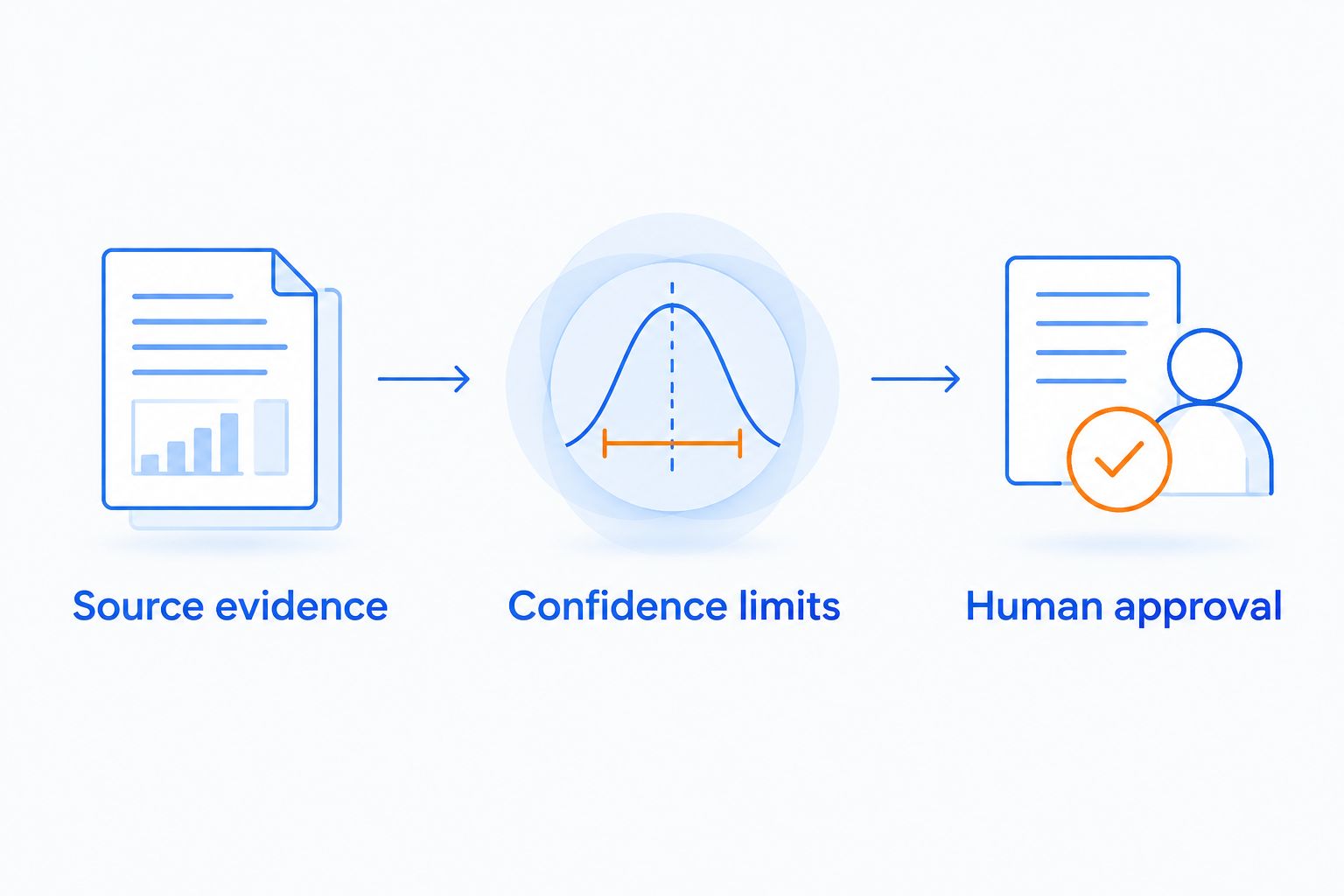
Use these 3 evidence checks before approving a budget change:
- Source evidence: Which advertising, CRM, analytics, or revenue records support the recommendation?
- Confidence limits: What uncertainty remains, and what evidence is incomplete or conflicting?
- Human approval: Who reviews the action, and what must be checked before execution?
These checks make the recommendation reviewable. They do not establish causal impact or guarantee performance improvement.
HubSpot remains useful for inspecting the underlying customer and deal records. The comparative advantage here is the explicit recommendation format, not a claim that CRM reporting lacks value or that every competing reporting feature has been tested.
Both need reliable revenue definitions
Neither platform removes the need to define what revenue means in your reporting. Pipeline, closed-won deals, and recognized revenue answer different questions. Combining them without clear labels weakens the budget argument.
The decision platform connects advertising, CRM, analytics, and revenue data for recommendations. HubSpot provides CRM records and sales outcomes that support revenue analysis. In either workflow, incorrect deal amounts or inconsistent lifecycle stages undermine the interpretation.
This dimension is a tie: both depend on trustworthy inputs and explicit definitions. A better interface cannot correct an undefined conversion event or explain away missing customer records.
For a 2026 revenue review, agree on the outcome before comparing channels. Use closed-won revenue when the question concerns completed sales. Use pipeline when the question concerns opportunity creation, and identify it as pipeline rather than realized revenue.
Attribution also needs a separate caveat. Crediting a channel with a conversion does not prove that the conversion would disappear without that channel. Treat attributed performance as evidence to examine, not automatic proof of incremental return.
Agency suitability is a workflow choice, not a blanket win
Agencies face both problems: explaining budget changes to clients and maintaining the systems that record customer activity. The winner depends on which responsibility the engagement includes.
For performance strategy, the recommendation layer matches the task of presenting ranked actions with evidence. Its limit is that your agency still needs a review process and a reliable source of CRM outcomes. A recommendation cannot compensate for a client that does not maintain its sales records.
For CRM and lifecycle operations, HubSpot matches contact, deal, and marketing workflow work. Its limit in this comparison is that operational breadth does not establish a purpose-built ranked reallocation workflow.
Assign 2 decision owners in your evaluation:
- A data owner who approves the meaning and quality of the CRM outcomes.
- A budget owner who approves the spending change and its rationale.
One person can hold both responsibilities, but both responsibilities must be explicit. Do not assume multi-client permissions, consolidated account views, or agency-specific administration from either product's general positioning. Confirm the exact arrangement your engagements require.
Pricing: compare operating scope before subscription terms
HubSpot offers free tools and paid subscription products. The relevant buying question is which product scope supports your required CRM, automation, and reporting work. Evaluate the actual subscription requirements rather than treating the entire platform as one interchangeable package.
For the decision platform, use the private beta discussion to establish commercial terms and the supported decision workflow. Do not assume a seat-based, account-based, or usage-based charging model.
Compare the cost of the job, not the names on the shortlist. A CRM subscription and a recommendation layer cover different responsibilities. Paying for both needs a clear explanation of what each contributes and which existing work each replaces or improves.
Your 2026 procurement review should also establish integration status. The platform description names Google Ads, Meta, LinkedIn, Salesforce, HubSpot, and Google Analytics, but a named integration is not enough to establish its release status. Ask which required connections are live, which are beta, and which are coming soon.
Then confirm access permissions, supported data fields, and who owns implementation. Those answers determine whether the proposed workflow can operate with your client's actual systems.
Final verdict: buy for the decision you need to make
Choose Paid Lens if you own cross-channel budget decisions
Best for: agency performance leads and marketing leaders who must defend reallocations using advertising and CRM revenue evidence. Choose the budget recommendation platform when customer records already exist and your unresolved problem is deciding what to change, in what order, and why.
Keep the evaluation narrow. Review a real recommendation, inspect the rationale, check confidence limits, and establish how a human approves the action. Do not treat the platform as a CRM replacement or a source of guaranteed returns.
Choose HubSpot if you own customer and marketing operations
Best for: sales and marketing operations leads who need contact records, deal pipelines, and marketing workflows. Choose HubSpot when your team needs the operational system itself rather than another interpretation of its data.
Start with consistent records and process ownership. Add a separate budget decision layer only when the remaining problem is prioritizing and defending spending changes.
| Dimension | Winner |
|---|---|
| Best for | Decision platform for budget owners; HubSpot for CRM operators |
| Budget decisions | Decision platform |
| CRM operations | HubSpot |
| Marketing execution | HubSpot |
| Explicit recommendation rationale | Decision platform |
| Revenue definitions and input quality | Tie: both need reliable records |
| Agency suitability | Tie: match the engagement's responsibilities |
| Pricing | No general winner; compare scope and terms |
Apply for the private beta
Bring your cross-channel budget question and confirm the supported integrations and review workflow.
FAQ
Is Paid Lens better than HubSpot for advertising budget decisions?
Paid Lens is the more direct fit for ranked, evidence-backed advertising budget recommendations. HubSpot is the stronger fit for CRM and marketing operations; reporting that informs a decision is different from a prioritized recommendation queue.
Can a budget recommendation platform replace HubSpot?
A budget recommendation platform does not replace HubSpot's CRM role. You still need a system to maintain contacts, deals, and customer workflows.
Which option is better for an agency managing client budgets?
The decision platform better matches recommendation and budget-defense work; HubSpot better matches CRM and lifecycle operations. Confirm client-specific access, integration status, and administrative requirements before choosing either.
Does a confidence score prove a budget recommendation will work?
A confidence score does not prove that a recommendation will work. Review the supporting evidence, uncertainty, and conditions before a human approves the change.
Can HubSpot revenue data help justify advertising spend?
HubSpot's deal and sales records can help justify advertising spend when the records and definitions are reliable. Distinguish pipeline from completed sales, and do not treat attributed revenue as proof of incremental impact.
How should I compare subscription costs?
Compare the scope and terms required for your actual workflow. Establish the HubSpot products you need and confirm private beta commercial terms for the decision platform rather than assuming the charging models match.
What should I check before applying for the private beta?
Check whether your required integrations and data fields support the budget question you need to answer. Confirm which connections are live, beta, or coming soon, then establish permissions and human approval responsibilities.
One last thing
A technically correct recommendation can still be operationally unusable if nobody owns the decision. Finish your evaluation with 1 review record containing the proposed change, supporting evidence, uncertainty, approver, and outcome to monitor.
That record is the bridge from analysis to accountability. If your team cannot explain the action without reopening every dashboard, tighten the review process before expanding the software stack.