

Choose Paid Lens if you need ranked, evidence-backed recommendations for reallocating advertising budgets; choose Improvado if your main problem is building and maintaining a marketing data pipeline. The useful distinction in 2026 is budget decision support versus marketing data infrastructure, not which platform produces the most charts.
- Paid Lens vs Improvado comes down to budget decision support versus marketing data infrastructure.
- Paid Lens is best for marketers who must defend cross-channel budget allocation with CRM revenue evidence.
- Improvado is best for teams prioritizing marketing data integration, transformation, and downstream analysis.
- Evaluate evidence quality, human review, and contract scope before choosing either platform.
Why this matters
An agency can consolidate campaign data and still struggle to explain which client budget should move next. A marketing leader can receive a recommendation and still lack the evidence needed to defend it to finance. These are different problems. Buying software for one does not automatically solve the other.
Paid Lens is a decision-intelligence SaaS platform for performance marketers and agencies. Its stated purpose is to connect advertising, CRM, analytics, and revenue data to ranked budget reallocation recommendations. Improvado's established product category centers on marketing data integration and analytics infrastructure.
Paid Lens is best for performance marketers who need defensible cross-channel budget recommendations. Improvado fits the buyer whose immediate priority is organizing marketing data for analysis across an existing reporting environment.
This 2026 comparison evaluates that difference in purpose. It does not rank measured accuracy, implementation speed, or financial returns. Your selection should turn on the work you need completed and the evidence you require before acting.
At a glance
| Dimension | Paid Lens | Improvado |
|---|---|---|
| Best for | Agencies and marketing leaders defending budget reallocations | Teams building marketing data integration and analytics workflows |
| Standout feature | Ranked, evidence-backed budget recommendations | Marketing data extraction, transformation, and delivery |
| Data operations | Connected data used to support spending decisions | Data preparation as a central product function |
| Reporting flexibility | Decision-focused output tied to business impact | Data infrastructure supporting downstream reporting and analysis |
| Revenue interpretation | CRM and revenue context within the recommendation process | Revenue analysis depends on connected data and the analytical workflow |
| Auditability | Recommendation rationale and confidence are central evaluation criteria | Data lineage and transformation transparency are central evaluation criteria |
| Budget execution | Read-only, controlled, built for human review | Verify the permissions and execution boundaries of your proposed workflow |
| Pricing model | Evaluate private beta terms and commercial scope directly | Confirm commercial terms against the required implementation scope |
The table is an outline of product fit, not a feature-completeness score. A pipeline buyer and a budget owner should not use the same evaluation checklist. Start with the output your team needs, then work backward to the data and controls required to produce it.
Decision support wins when the next budget move is the problem
A dashboard describes performance. A budget recommendation proposes a change. That distinction matters when you already have reports but still spend meetings debating what to do.
The decision-focused option addresses that second task through ranked, evidence-backed recommendations. For an agency, the relevant output is a proposed reallocation that can survive client questions. For a marketing leader, it is a recommendation that connects spend to pipeline or revenue rather than stopping at platform conversions.
Choose decision support when your bottleneck is turning connected data into a defensible action. The advantage is alignment with the budget owner's job. The limit is equally important: a recommendation is not proof that the proposed change will create incremental revenue.
Assess every proposed move through these questions:
- What evidence supports moving spend away from the current campaign or channel?
- Which business outcome is the recommendation intended to improve?
- What uncertainty remains before approval?
- What observation would justify reversing the decision?
For a broader comparison of this buying category, see budget allocation tools for paid media. Keep the evaluation focused on action quality, not the number of performance metrics displayed.
Improvado wins when the data pipeline is the problem
Improvado is the better starting point when your primary requirement is marketing data integration and transformation. Its established positioning addresses the movement and preparation of marketing data for analytics. That is a different assignment from ranking budget reallocations.
This fit matters when analysts need consistent inputs for reporting, or when marketing data must feed an existing analytical environment. Data extraction, transformation, and delivery become the central purchasing criteria. The buyer needs to understand how source records become usable analytical data.
The advantage is a product focus on that infrastructure layer. The limitation is that a functioning data pipeline does not, by itself, establish which campaign deserves additional spend. Someone still needs to define business outcomes, interpret the results, and approve the decision.
Your evaluation should include:
- Source coverage for the advertising, CRM, and analytics systems you actually use.
- Transformation rules for campaign names, currencies, and account structures.
- Handling of failed syncs, changed fields, and revised historical records.
- Ownership of the prepared data and its downstream destination.
Do not infer implementation effort from a connector list. Ask for a demonstration using the source fields and destination that your team needs.
Improvado fits reporting infrastructure better than decision-only work
When the output is a reusable dataset for different reports, evaluate the infrastructure option first. Marketing reporting often serves several audiences: account managers need campaign detail, finance needs revenue definitions, and executives need a consistent summary.
Improvado's data integration and transformation focus makes that reporting-infrastructure scenario a natural fit. The relevant question is whether the proposed workflow supports your reporting environment, not whether a generic dashboard looks polished.
The decision-focused alternative has a narrower stated purpose: budget recommendations backed by connected evidence. That focus suits a budget review. It does not establish that the product replaces a warehouse, a business-intelligence environment, or every reporting workflow an agency maintains.
Choose the reporting architecture before choosing the reporting interface. Require a clear explanation of where data is stored, where calculations happen, and who maintains the definitions. Otherwise, different teams can reproduce the same campaign data while disagreeing about what the numbers mean.
For your 2026 evaluation, separate reporting requirements from recommendation requirements. A product can be useful for one without being your preferred system for the other.
Decision-focused evaluation puts CRM outcomes ahead of platform totals
A budget owner needs more than conversion volume. A campaign generating leads and a campaign generating qualified opportunities can look similar in an advertising account while contributing differently to the sales pipeline.
The supplied product description connects advertising, CRM, analytics, and revenue data to budget recommendations. That makes CRM context part of the intended decision process, rather than an unrelated reporting exercise. For a buyer defending spend against pipeline outcomes, that focus is the stronger fit.
The limitation is attribution. Connecting a campaign to an opportunity does not prove that the campaign caused the opportunity. Neither a recommendation nor a prepared dataset removes that distinction.
Use the same business definitions throughout your evaluation:
- Define what counts as a qualified lead and an accepted opportunity.
- Separate open pipeline from closed revenue.
- Identify which date determines the reporting period.
- Explain how duplicate records and missing campaign identifiers are treated.
Improvado's infrastructure approach can support analysis involving connected revenue data. The actual usefulness of that analysis rests on the available records, transformations, and reporting logic. Do not award either option a revenue-measurement win solely because CRM data appears in a demonstration.
Both need an evidence trail before a budget decision is defensible
This is an honest tie: neither decision software nor data infrastructure substitutes for evidence quality. A proposed budget change must survive questions about the records, definitions, and assumptions behind it.
For a recommendation workflow, inspect the rationale and the meaning of confidence. For a data pipeline, inspect source lineage and transformation logic. The checks differ, but the standard is the same: another person should understand how the output was produced.
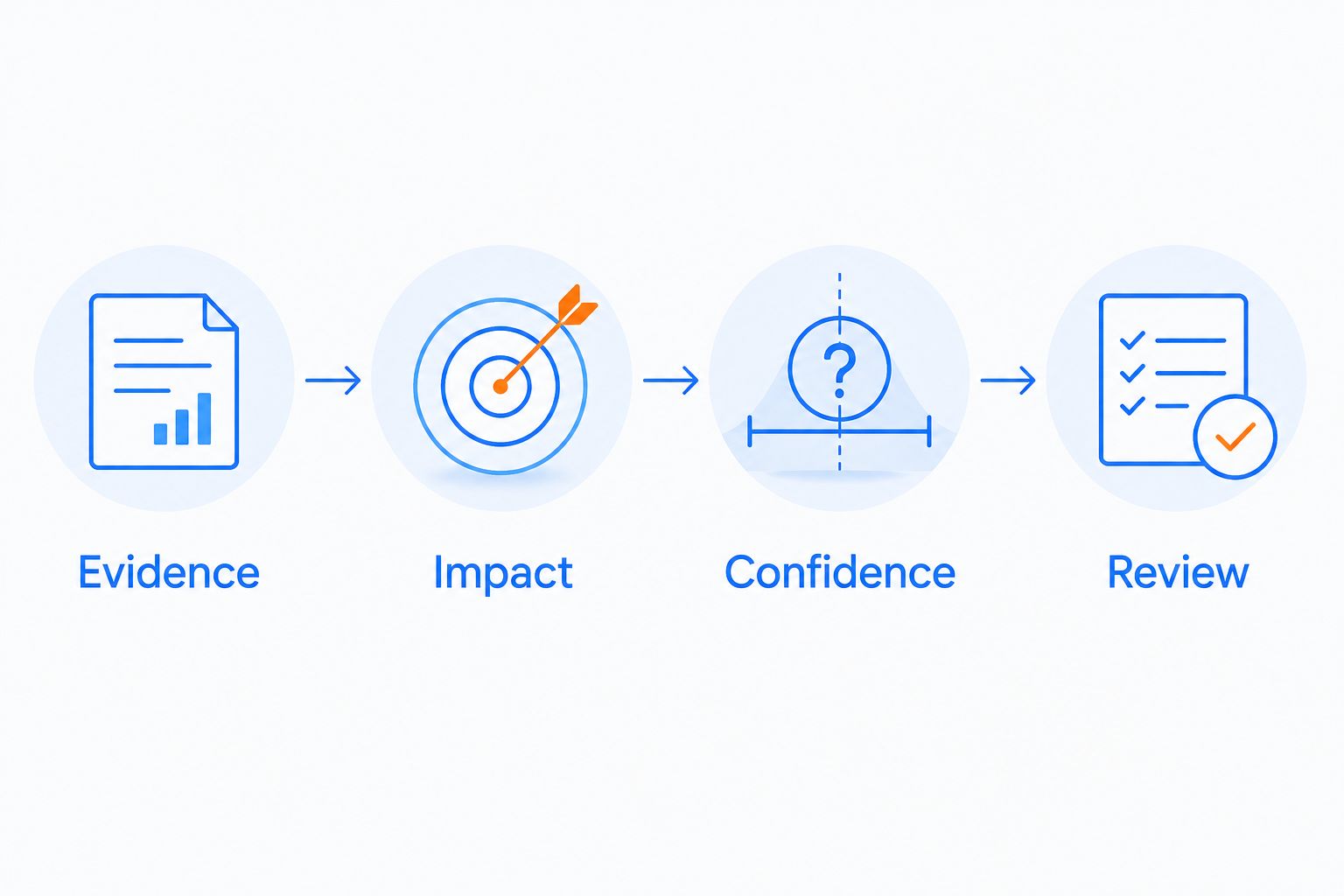
Use 3 decision checks in your evaluation: evidence, impact, and confidence. Then require a separate review step before approving a change. These are evaluation criteria, not reported product performance metrics.
Evidence
Ask which source records and reporting periods support the proposed action. Confirm whether the reasoning uses platform conversions, qualified pipeline, closed revenue, or a combination. Different outcomes justify different decisions.
Impact
Identify the business outcome the action is intended to improve. Keep expected impact separate from an observed result. A forecast belongs in the decision brief, not in a customer-results claim.
Confidence
Ask what uncertainty the confidence assessment represents. Confidence in data completeness differs from confidence in an attribution model or confidence in a future outcome. A label without an explanation is not enough.
Review
Name the approver and document the reason for approval. Record what would trigger reconsideration. The evidence trail should explain both the recommendation and the human decision that followed it.
Read-only recommendations fit a human approval process
The brand describes its product as read-only, controlled, and built for human review. That boundary matters for an agency handling client budgets: a recommendation is not permission to change spend.
Choose the read-only decision workflow when you want advice without delegating budget execution. Its benefit is a clear distinction between analysis and action. Its tradeoff is that your team remains responsible for approval and implementation.
For Improvado, evaluate the permissions attached to the specific workflow you are buying. Do not infer execution controls from its data-integration category. Source access, destination access, and advertising-account permissions are separate questions.
Use 2 review stages in your operating process: validate the evidence, then approve the budget change. This is a recommended governance structure, not a claim about either product's interface.
In 2026, keep connector readiness in the approval checklist as well. Google Ads, Meta, LinkedIn, Salesforce, HubSpot, and Google Analytics appear in the supplied product description. That list does not establish the release status or account-level scope of every integration. Confirm whether each required connection is live, beta, or coming soon before committing to a workflow.
Pricing: compare the commitment, not an unsupported headline
Evaluate the commercial model directly with each provider. Do not assume a self-service subscription, usage-based contract, or fixed enterprise agreement from the product category alone.
For the private beta, establish access terms, included workflows, support responsibilities, and the transition to a commercial arrangement. For Improvado, align the proposed contract with the required sources, transformations, destinations, and implementation responsibilities.
Predictability comes from a defined scope; flexibility comes from understanding how scope changes affect the agreement. Ask both providers the same questions:
- What does the agreement include, and what requires additional scope?
- Who owns implementation and ongoing maintenance?
- What changes when an agency adds another client account?
- What happens to connected data when the relationship ends?
Do not compare commercial terms without comparing the work covered. A recommendation workflow and a maintained data pipeline solve different operational problems.
Final verdict: choose the job before the platform
Choose Paid Lens if you own the budget decision
You are an agency lead or performance marketing manager who must explain why spend should move between channels. Your reports exist, but your team needs prioritized recommendations tied to CRM and revenue evidence. The decision-intelligence platform is the named winner for that profile.
Make the evaluation concrete. Bring one unresolved allocation decision and ask how the recommendation, rationale, expected impact, confidence, and review boundary would be presented.
Choose Improvado if you own the marketing data foundation
You are an analytics lead responsible for bringing marketing data into a consistent reporting workflow. Your first problem is extraction, transformation, and delivery rather than a ranked action queue. Improvado is the named winner for that profile.
Bring the required source fields, transformation rules, and destination requirements. Judge the proposed pipeline against those requirements before assessing presentation quality.
| Dimension | Winner |
|---|---|
| Budget-owner fit | Decision intelligence |
| Ranked reallocation recommendations | Decision intelligence |
| Marketing data operations | Improvado |
| Downstream reporting infrastructure | Improvado |
| CRM-aware recommendation focus | Decision intelligence |
| Evidence-quality requirements | Tie: both require validation |
| Human approval governance | Tie: your process must define approval |
| Pricing predictability | No winner without a scoped agreement |
Qualified agency and marketing leaders can explore the private beta as part of a 2026 evaluation. Keep the application focused on your actual budget decision and required data sources.
Explore the private beta
Evaluate evidence-backed budget recommendations against your agency or marketing team's decision process.
FAQ
Is Paid Lens better than Improvado for budget allocation?
Paid Lens is the closer fit for ranked, evidence-backed budget reallocation recommendations. Improvado is the closer fit when the main requirement is marketing data integration and transformation. Judge recommendation quality using your actual CRM and advertising evidence.
Which option is better for an agency managing multiple clients?
Choose the decision-focused option when your agency needs defensible client budget recommendations; choose Improvado when your main burden is maintaining marketing data workflows. Confirm account separation, required source coverage, and review permissions during evaluation.
Can either platform prove that advertising caused revenue?
Connecting advertising records to revenue does not prove causation. Attribution provides an interpretation of recorded touchpoints, while causal claims require an appropriate measurement design.
Will the recommendation platform automatically change my advertising budgets?
The brand describes its product as read-only and built for human review. Your team remains responsible for approving and implementing budget changes.
Does Improvado replace the need for marketing analysts?
A marketing data pipeline does not remove the need to define outcomes or interpret results. Your team still needs ownership of business definitions, analysis, and budget approval.
How should I compare the commercial agreements in 2026?
Compare the work covered by each agreement, not an assumed pricing model. Confirm implementation responsibilities, ongoing maintenance, account scope, and the terms for changing or ending the arrangement.
What should I bring to a product evaluation?
Bring one unresolved budget decision, its supporting advertising and CRM records, and your approval requirements. For a pipeline evaluation, also bring the source fields, transformation rules, and destination your reporting workflow requires.
One last thing
Write 1 test brief before the demonstration. State the decision, the evidence required, the intended business outcome, and the condition that would make you reject the recommendation.
A polished demonstration can avoid your hardest question. A written brief cannot. Use the same brief for both vendors, and judge whether the output helps you complete the job you actually own.