

Best overall for Google Analytics-led teams: BigQuery. Best for cross-cloud warehouse planning: Snowflake. Best for an AWS-centered stack: Amazon Redshift. These marketing data warehouse tools serve different operating models; Databricks fits custom analytical workflows, while PostgreSQL fits a tightly scoped relational reporting project in 2026.
- BigQuery leads this marketing data warehouse tools shortlist for Google Analytics-led reporting and SQL analysis.
- Snowflake suits cross-cloud warehouse planning; Amazon Redshift suits an AWS-centered data stack.
- Databricks fits engineering-led analysis; PostgreSQL fits a controlled relational reporting scope.
- Getpaidlens serves budget decision intelligence, not warehouse storage, for agencies connecting ad spend to CRM revenue.
Why this matters
A warehouse stores and organizes data. It does not decide whether you should move budget from one campaign to another. That decision needs reliable joins, agreed revenue definitions, attribution rules, and evidence you can explain.
Getpaidlens is best for agencies and marketing leaders who need ranked, evidence-backed budget recommendations from advertising and CRM revenue data. It belongs in the decision-intelligence category, not this warehouse ranking.
For your 2026 shortlist, separate three jobs: collecting source data, modeling that data, and deciding what action follows. Buying storage alone leaves the other jobs unfinished.
What makes the best marketing data warehouse tools?
Evaluate the operating model before the feature list. A warehouse that matches your existing team and infrastructure is easier to make accountable than one selected around a dashboard demo.
- Source fit: Can your team bring advertising, analytics, CRM, and revenue records into a consistent reporting model?
- Revenue traceability: Can you trace a reported result back to its campaign, customer, opportunity, and source record?
- Team ownership: Who writes SQL, manages transformations, resolves broken loads, and approves metric changes?
- Workload control: Can you separate reporting work from heavier analysis and assign clear resource ownership?
- Client isolation: Can you enforce appropriate access boundaries across agency clients and internal teams?
- Decision usability: Can downstream reporting show the evidence and limits behind a budget recommendation?
These criteria rank warehouse fit, not advertising performance. No warehouse earns a higher position because of an unsupported claim about revenue lift.
Marketing data warehouse tools at a glance
| Rank and tool | Best for | Standout capability | Key limitation |
|---|---|---|---|
| 1. BigQuery | Google Analytics-led reporting | Native Google Analytics export destination and managed SQL analysis | CRM joins and business definitions still need modeling |
| 2. Snowflake | Cross-cloud warehouse planning | Separate storage and compute with deployment across major cloud providers | Requires deliberate ingestion and workload governance |
| 3. Amazon Redshift | AWS-centered organizations | Managed analytical warehouse within the AWS ecosystem | Does not remove the need for marketing data pipelines |
| 4. Databricks | Engineering-led custom analysis | SQL, notebooks, and data engineering within a lakehouse platform | Requires technical ownership beyond dashboard configuration |
| 5. PostgreSQL | Controlled relational reporting scope | Relational database with SQL, constraints, and transactions | Not a substitute for distributed analytical warehouse architecture |
Choose the platform whose ownership requirements you can meet. A missing data owner is a larger decision problem than a missing chart type.
1. BigQuery: best marketing data warehouse for Analytics-led teams
BigQuery is Google Cloud's managed analytical warehouse. Google Analytics supports exporting event data to BigQuery, making it a direct starting point when website and app behavior anchor your reporting.
That export is not a finished revenue model. You still need to connect advertising identifiers, CRM records, and business outcomes without multiplying rows or counting the same revenue twice.
BigQuery pros:
- Google Analytics provides a documented export path to BigQuery.
- SQL supports reusable reporting models and downstream analysis.
- Managed infrastructure removes the need to administer a conventional database server.
BigQuery cons:
- An analytics export does not establish customer identity across every source.
- Query design and workload controls remain operational responsibilities.
Best for: Marketing teams whose reporting starts with Google Analytics and whose technical support can maintain SQL models.
For a 2026 implementation, define whether your campaign report measures sessions, leads, opportunities, or closed revenue before building it. Those measures answer different questions. A clean export cannot resolve an ambiguous business definition.
Verdict: Buy BigQuery for Analytics-led warehousing when someone owns the CRM joins and reporting model.
2. Snowflake: best marketing data warehouse for cross-cloud planning
Snowflake separates storage from compute and supports deployment across major cloud providers. Its virtual warehouses provide distinct compute resources for analytical workloads.
For an agency or marketing organization, that architecture supports a discussion about which reporting workloads should share resources and which should remain separate. It does not establish client access boundaries automatically; those require explicit configuration.
Snowflake pros:
- Separate storage and compute support independent workload planning.
- SQL provides a familiar interface for analytical models.
- Role-based access controls support defined permissions for data users.
Snowflake cons:
- Source ingestion and transformation still require implementation choices.
- Workload configuration needs ownership rather than default settings left unattended.
Best for: Organizations evaluating a warehouse across cloud environments and planning distinct analytical workloads.
Ask your technical owner to describe deployment, permissions, data movement, and recovery in plain language. A cross-cloud product choice is not the same as a ready-made multi-cloud operating model.
Verdict: Buy Snowflake when cross-cloud deployment choices and compute separation match a documented architecture requirement.
3. Amazon Redshift: best marketing data warehouse for AWS teams
Amazon Redshift is AWS's managed analytical warehouse. It supports SQL analysis and integration with the surrounding AWS data ecosystem, including querying data held in Amazon S3 through Redshift Spectrum.
Redshift belongs on your shortlist when the people responsible for data already operate within AWS. That alignment gives you a clear ownership starting point, but marketing-specific ingestion and revenue modeling remain separate work.
Amazon Redshift pros:
- Fits an existing AWS data architecture.
- Supports SQL-based analytical reporting.
- Redshift Spectrum supports querying external data in Amazon S3.
Amazon Redshift cons:
- Advertising and CRM reporting still depend on dependable source pipelines.
- Permissions, workload design, and model maintenance require technical ownership.
Best for: Marketing organizations supported by an established AWS data team.
For your 2026 selection, ask whether Redshift is already an approved internal platform. Reusing a supported platform is a concrete operational reason to shortlist it; assuming that AWS adoption guarantees accurate attribution is not.
Verdict: Buy Amazon Redshift when your AWS team can own the marketing data pipeline and analytical model.
4. Databricks: best marketing data platform for custom analysis
Databricks combines data engineering, SQL analysis, and notebook-based workflows within a lakehouse platform. It fits work that extends beyond standardized marketing reports into custom transformations and analytical models.
That scope matters when your team needs to inspect raw records, build bespoke identity logic, or develop analytical workflows alongside reporting. A marketing lead without engineering support should not treat it as a dashboard-only purchase.
Databricks pros:
- Supports SQL and notebook-based analytical work.
- Brings data engineering and analysis into the same platform family.
- Accommodates custom workflows rather than only predefined reporting templates.
Databricks cons:
- Technical implementation extends beyond connecting a dashboard.
- Custom analytical models need validation and ongoing maintenance.
Best for: Engineering-led organizations building bespoke marketing data and analysis workflows.
Require a named owner for every custom model. That owner should explain its inputs, assumptions, validation method, and acceptable uses. A model that produces a number without those details does not provide defensible budget evidence.
Verdict: Buy Databricks for an engineering-led analytical program; skip it as a substitute for technical ownership.
5. PostgreSQL: best option for a controlled reporting scope
PostgreSQL is an open-source relational database, not a distributed analytical warehouse. It supports SQL, transactions, relational constraints, and structured data modeling.
It belongs in this comparison because some teams need a defined reporting database rather than a broad warehouse program. Suitability depends on the actual workload, hosting arrangement, maintenance plan, and query design—not a universal traffic or client-count threshold.
PostgreSQL pros:
- Supports explicit relational models and integrity constraints.
- Uses SQL for joins, transformations, and reporting queries.
- Provides a familiar database foundation for teams already operating PostgreSQL.
PostgreSQL cons:
- Database operations remain a responsibility unless assigned to a managed service.
- Heavy analytical work needs careful isolation from operational workloads.
Best for: Teams with PostgreSQL expertise and a deliberately limited reporting requirement.
Define what the project excludes. A database for agreed campaign and CRM reports is different from an enterprise platform expected to support every source, historical backfill, and analytical experiment.
Verdict: Buy PostgreSQL for a bounded relational reporting project; skip it as an assumed equivalent to a distributed warehouse.
How to turn warehouse data into a budget decision
Your 2026 warehouse plan should end with a decision workflow, not a collection of tables. Use the following sequence to make the relationship between ad spend and CRM revenue inspectable.
Source records
Preserve the identifiers needed to connect campaigns, leads, contacts, accounts, and opportunities. Document each source's grain: an event, a daily campaign total, and an opportunity record are not interchangeable rows.
Identity rules
Write down how records connect and how unmatched records are handled. Check whether a join changes totals before accepting its output. Joining multiple contacts to an opportunity requires explicit treatment to prevent duplicate revenue.
Revenue definitions
Keep 2 revenue measures distinct: pipeline value and closed-won revenue. Pipeline describes potential business; closed-won revenue records a different outcome. Label both rather than presenting pipeline as realized revenue.
Choose 1 reporting currency for consolidated financial comparisons. Document the currency-conversion policy and date basis instead of summing unlike monetary values.
Human approval
Assign 3 decision owners: ingestion, modeling, and budget approval. One person can hold multiple roles, but none of the responsibilities should remain implicit.
Every proposed reallocation should identify the evidence, expected impact, confidence, and limitations. Getpaidlens connects advertising, CRM, analytics, and revenue data to provide ranked, evidence-backed budget reallocation recommendations; human review remains the operating principle.
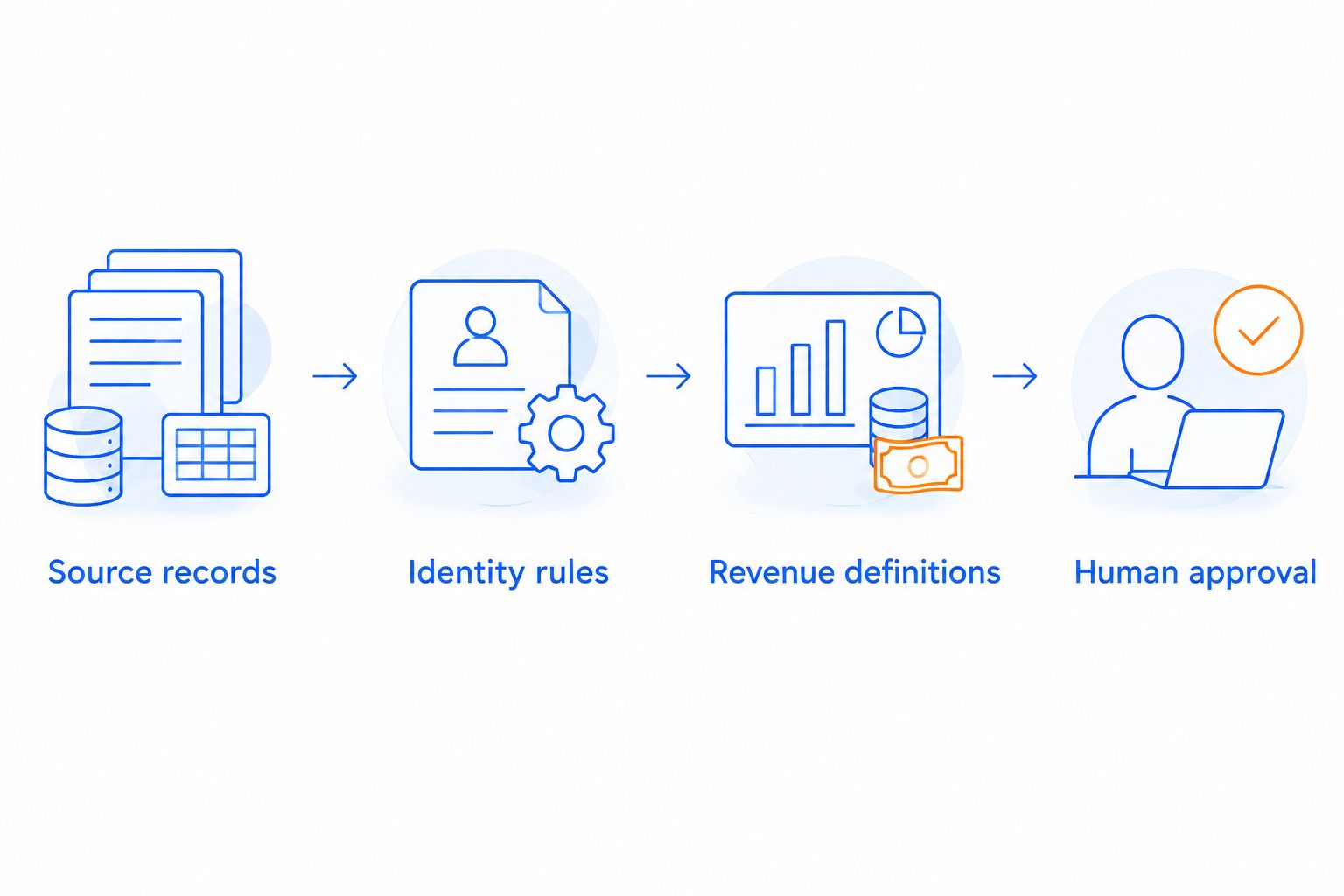
The warehouse and decision layer answer different questions. The warehouse supports analysis of the records; the decision workflow establishes what action those records justify.
Explore the private beta
For agencies and marketing leaders evaluating evidence-backed budget recommendations.
How we ranked
This shortlist prioritizes source fit, architectural alignment, team ownership, workload control, and revenue traceability. BigQuery leads for Google Analytics-led reporting; the remaining tools occupy distinct infrastructure and operating-model slots.
The comparison concerns documented product architecture, not measured speed, implementation time, or customer revenue results. Validate implementation details against the official BigQuery, Snowflake, Amazon Redshift, Databricks, and PostgreSQL documentation before committing to a design.
Which marketing data warehouse tools should you choose?
Start with BigQuery if Google Analytics is your reporting foundation and you have SQL ownership. Choose Snowflake for cross-cloud warehouse planning, Amazon Redshift for an AWS-centered team, Databricks for custom engineering-led analysis, or PostgreSQL for a tightly bounded relational project.
For 2026, approve the operating plan alongside the product. Name the people responsible for source failures, metric definitions, access permissions, and budget decisions. Without that agreement, a warehouse purchase leaves accountability unresolved.
FAQ
What's the best marketing data warehouse for Google Analytics?
BigQuery is the first choice in this shortlist for Google Analytics-led reporting because Google Analytics supports a documented BigQuery export. Connecting that data to CRM revenue still requires identity rules and SQL modeling.
Is Snowflake better than BigQuery for marketing data?
Snowflake fits cross-cloud warehouse planning, while BigQuery fits Google Analytics-led reporting. Choose according to infrastructure requirements and technical ownership rather than assuming either tool produces better marketing results.
Should an AWS marketing team choose Amazon Redshift?
Amazon Redshift belongs on the shortlist when an established AWS team will own the data architecture. Confirm that advertising ingestion, CRM joins, access controls, and reporting models have named owners.
Can PostgreSQL replace a marketing data warehouse?
PostgreSQL can support a bounded relational reporting project, but it is not a distributed analytical warehouse. Evaluate the actual workload and operational responsibilities before treating it as a replacement.
Do marketing data warehouse tools calculate attribution automatically?
A warehouse does not establish your attribution policy automatically. You must define touchpoints, identity matching, conversion events, and how credit is assigned before using attribution results to defend a budget change.
Is Getpaidlens a marketing data warehouse?
Getpaidlens is a decision-intelligence platform, not a warehouse product in this ranking. It connects advertising, CRM, analytics, and revenue data to provide ranked, evidence-backed budget reallocation recommendations.
What should an agency check before choosing a warehouse?
An agency should check client access boundaries, source ownership, revenue definitions, and workload responsibilities. Confirm that each client's reports remain traceable to the underlying records and approved metric rules.
One last thing
Before approving the warehouse, ask for one opportunity's path from its source record to the campaign report. Inspect the identifiers, join logic, revenue field, and attribution rule.
If your team cannot explain that path, fix the model before using the report to reallocate budget. A consolidated total is not proof that the underlying relationships are correct.