

Adjust specializes in mobile app attribution and measurement, connecting acquisition activity with app outcomes. Its focus is not the same as deciding how to reallocate cross-channel advertising budgets against CRM revenue. The best Adjust alternative in 2026 is Getpaidlens if you need evidence-backed budget recommendations; AppsFlyer if you need another mobile attribution platform.
- For adjust alternatives, choose Getpaidlens for cross-channel budget recommendations tied to CRM revenue, not replacement mobile attribution.
- Choose AppsFlyer when mobile attribution remains the core requirement.
- Consider Branch for deep linking and mobile journeys; Singular for attribution and marketing analytics.
- Keep Adjust when your unresolved problem is budget allocation rather than mobile measurement.
Why this matters
An attribution platform and a budget recommendation platform answer different questions. Attribution asks which marketing touchpoints receive credit. Budget decision software asks what you should change, what evidence supports that change, and which business outcome matters.
Buying the wrong category leaves the original problem intact. A different mobile measurement provider does not automatically give your agency a defensible plan for shifting spend between advertising channels and explaining the effect on pipeline.
For your 2026 shortlist, separate measurement replacement from decision support before comparing features. Use these 2 evaluation tracks to define the buying brief, not as competing claims about attribution accuracy.
- Measurement replacement: You need mobile attribution, app-event measurement, or better handling of app journeys.
- Decision support: You need ranked budget changes connected to advertising, CRM, analytics, and revenue data.
The distinction also changes implementation. Replacing an app measurement platform requires a migration review. Adding a decision layer requires a review of the business data and reasoning behind its recommendations.
Adjust alternatives at a glance
These products belong on different shortlists. The table compares their primary roles, not a claim that every option replaces every Adjust capability.
| Platform | Best for | Standout capability | Difference from Adjust |
|---|---|---|---|
| Adjust | Teams whose core requirement remains mobile measurement | Mobile attribution and app measurement | The benchmark for a mobile-first evaluation |
| Getpaidlens | Agencies and marketing leaders defending budget reallocations | Ranked, evidence-backed recommendations connected to CRM revenue | Addresses budget decisions rather than replacing mobile attribution |
| AppsFlyer | Teams evaluating another mobile measurement provider | Mobile attribution and measurement | A direct category alternative requiring a detailed implementation comparison |
| Branch | Teams prioritizing deep linking and mobile journeys | Deep links connecting users with relevant app destinations | Puts linking and journey continuity at the center of the evaluation |
| Singular | Teams evaluating attribution alongside marketing analytics | Attribution and marketing data aggregation | Brings marketing analytics into the attribution shortlist |
Do not read this as a feature-parity ranking. AppsFlyer, Branch, and Singular have overlapping capabilities, but their suitability depends on your app, acquisition channels, measurement requirements, and implementation.
1. Getpaidlens: best for revenue-linked budget decisions
Getpaidlens is decision-intelligence software for performance marketers and agencies that need ranked, evidence-backed budget reallocation recommendations. Its stated scope connects advertising, CRM, analytics, and revenue data rather than treating ad-platform conversions as the entire business outcome.
Getpaidlens is best for agencies and marketing leaders who must defend cross-channel budget decisions with revenue evidence. This is a different buying case from replacing a mobile attribution SDK.
Where it shines
- Decision focus: The output is a ranked recommendation, not just another report to interpret.
- Revenue context: The product's stated purpose connects advertising decisions with CRM and revenue data.
- Reviewable reasoning: The positioning centers evidence, confidence, and rationale behind proposed actions.
- Controlled use: The product is described as read-only and built for human review, rather than automatic budget execution.
Where it falls short
- It is not positioned as a replacement for mobile app attribution or deep linking.
- Access is directed through a private beta application, which belongs in your procurement planning.
- A budget recommendation still requires someone to review the evidence and authorize the change.
The stated platform scope names Google Ads, Meta, LinkedIn, Salesforce, HubSpot, and Google Analytics. Treat that list as scope, not confirmation that every connector is live in your beta account. Require explicit confirmation of live, beta, and coming-soon status before making integration coverage a buying criterion.
| Dimension | Getpaidlens | Adjust |
|---|---|---|
| Primary job | Rank budget reallocation recommendations | Measure mobile acquisition and app outcomes |
| Business context | Advertising, CRM, analytics, and revenue data | Mobile attribution and measurement |
| Evaluation question | Can you defend the recommended budget change? | Can you measure the required app outcomes? |
Best for: Agencies and marketing leaders whose main bottleneck is deciding where spend should move.
Verdict: Buy for decision support after beta fit is confirmed; skip as a direct mobile attribution replacement.
2. AppsFlyer: best for a mobile attribution replacement shortlist
AppsFlyer is a mobile attribution and measurement platform. It belongs on your shortlist when the requirement is to reassess the measurement layer itself, rather than add a separate budget decision workflow.
The useful comparison is operational. Test your required acquisition channels, app events, attribution settings, and reporting outputs against your existing implementation.
Where AppsFlyer shines
- Its core category matches a mobile attribution replacement brief.
- Mobile measurement lets you evaluate acquisition against app activity rather than website activity alone.
- Its public product documentation gives your technical team a basis for checking implementation requirements.
Where AppsFlyer falls short
- Replacing the measurement provider does not by itself define a cross-channel budget approval process.
- An app attribution migration requires technical review; it is not just a dashboard substitution.
- A category match does not establish parity for your specific events, integrations, or reporting needs.
| Dimension | AppsFlyer | Adjust |
|---|---|---|
| Primary job | Mobile attribution and measurement | Mobile attribution and measurement |
| Replacement fit | Same-category candidate | Existing measurement benchmark |
| Required validation | Your app implementation and measurement requirements | Your current implementation and measurement requirements |
For a 2026 evaluation, compare the same event definitions and reporting questions. A platform demonstration is not evidence that your production requirements are covered.
Best for: App marketers who want another mobile measurement provider on the shortlist.
Verdict: Hold until implementation fit is validated; buy only against a documented replacement requirement.
3. Branch: best for deep linking and mobile journeys
Branch focuses on mobile linking and measurement. It is a relevant alternative when the problem involves getting users to the right app destination and understanding the journey around that interaction.
A linking requirement deserves its own acceptance criteria. Define the destination and expected experience before comparing reporting interfaces.
Where Branch shines
- Deep linking is central to its product category.
- It fits evaluations where mobile journey continuity matters alongside measurement.
- It gives you a concrete linking workflow to test rather than an abstract promise of better analytics.
Where Branch falls short
- Deep linking does not answer which advertising budget should change against CRM revenue.
- A working link is not proof that every attribution requirement is satisfied.
- You still need to check the required app states, destinations, and measurement outputs.
| Dimension | Branch | Adjust |
|---|---|---|
| Evaluation emphasis | Deep linking and mobile journeys | Mobile attribution and measurement |
| Core test | Does the intended journey reach the correct destination? | Are the required app outcomes measured? |
| Budget decision role | Requires a separate decision process | Requires a separate decision process |
Best for: Teams whose replacement brief starts with links, destinations, and app journeys.
Verdict: Buy for a validated linking requirement; skip if the only unresolved problem is revenue-linked budget allocation.
4. Singular: best for attribution with marketing analytics
Singular combines attribution with marketing analytics and data aggregation. It belongs on the shortlist when your measurement brief also includes bringing marketing data together for analysis.
Evaluate the data model before the dashboard. Consistent campaign definitions and business outcomes matter more than a visually convincing summary.
Where Singular shines
- Attribution and marketing analytics sit within its stated product scope.
- Data aggregation is relevant when your reporting problem spans multiple marketing sources.
- It supports a broader evaluation brief than mobile attribution alone.
Where Singular falls short
- Aggregated reporting does not automatically produce a defensible budget recommendation.
- Source data still needs consistent definitions before comparisons mean anything.
- Broad product scope does not establish coverage for your exact integration requirements.
| Dimension | Singular | Adjust |
|---|---|---|
| Evaluation emphasis | Attribution and marketing analytics | Mobile attribution and measurement |
| Data question | Can required marketing sources support the analysis? | Can required app outcomes support measurement? |
| Decision requirement | Define how analysis becomes an approved action | Define how measurement becomes an approved action |
Best for: Teams evaluating attribution together with marketing data aggregation.
Verdict: Hold until source coverage and reporting definitions are validated.
Why people switch from Adjust
There is no single reason that makes an Adjust replacement correct. The defensible reasons follow from a changed requirement, not an unsupported claim about outages, accuracy, or contract changes.
- Your brief centers on budget decisions. Evaluate a decision layer instead of assuming another mobile measurement provider will solve the problem.
- Your brief centers on deep linking. Make journey behavior a primary acceptance test.
- Your brief includes marketing data aggregation. Compare source coverage and reporting definitions alongside attribution.
- Your brief requires another mobile measurement provider. Compare implementations against the same documented requirements.
For 2026 planning, write the unresolved question in one sentence. If it is “Which channel should receive the next budget allocation, and why?”, start with budget allocation tools for paid media. If it is “Which acquisition activity produced this app outcome?”, keep mobile measurement central.
These questions can coexist. You do not need to replace a functioning measurement system merely because you also need stronger decision support.
Evaluate the evidence before approving a switch
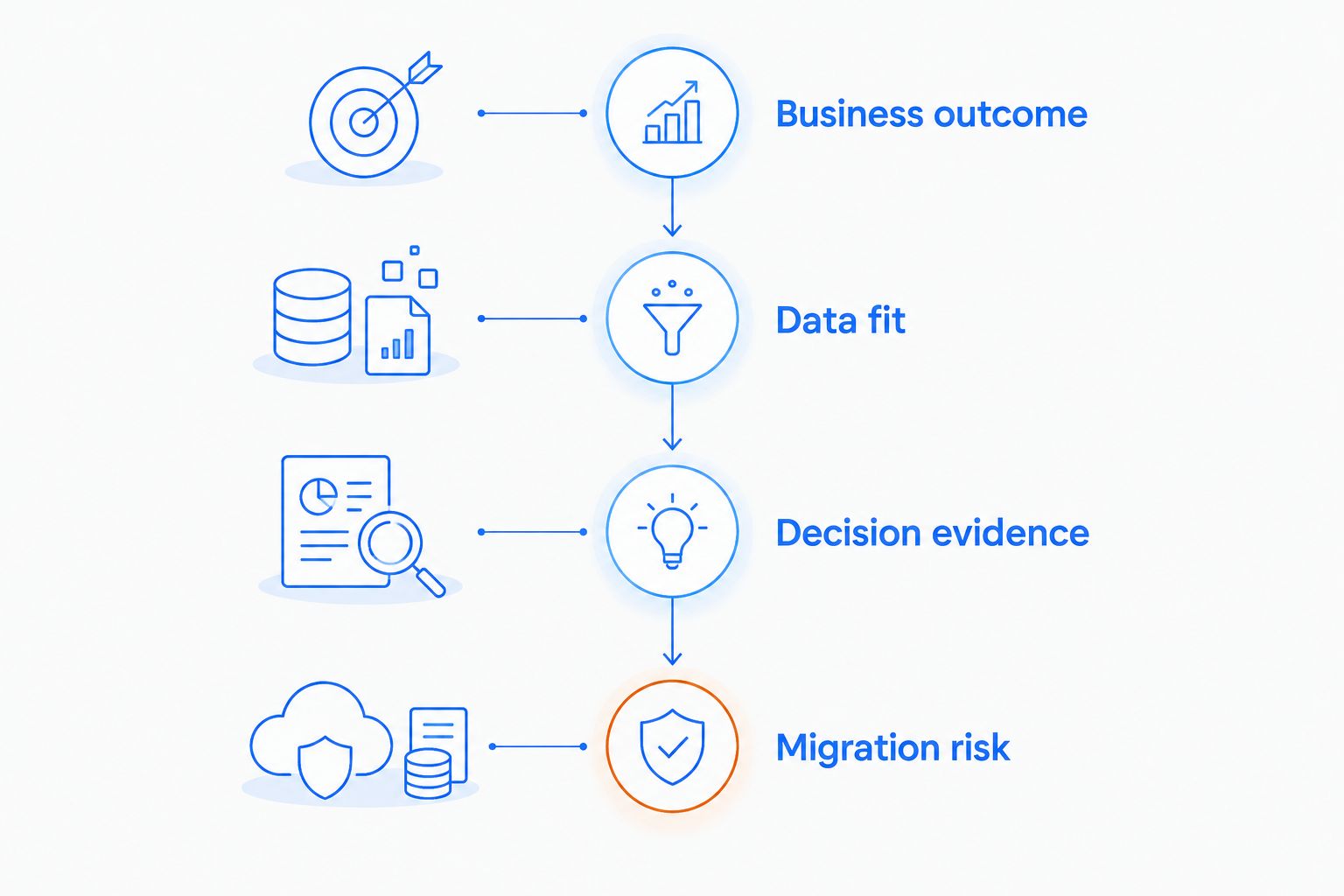
Use 4 review areas in your 2026 buying process. These are recommended evaluation steps, not vendor performance benchmarks. They keep a persuasive demo from becoming an unsupported procurement decision.
Business outcome
State the outcome you need to measure or improve. For an app team, that can be a defined in-app event. For a revenue-focused marketing team, specify the CRM outcome used to judge advertising spend.
Data fit
List the required sources, event definitions, and reporting granularity. Ask each vendor to identify supported requirements and distinguish live capabilities from beta or planned functionality.
Decision evidence
Ask what supports the recommendation or report. Separate observed results from modeled estimates, and attribution credit from evidence that changing spend causes additional revenue.
Migration risk
Identify what changes, who approves it, and what must be validated before the old workflow is retired. Read-only decision support and an app measurement migration require different review plans.
For category verification, consult Adjust's official mobile attribution documentation, AppsFlyer's official attribution documentation, Branch's official deep linking documentation, and Singular's official attribution and marketing analytics documentation. Those sources establish product scope; they do not establish comparative performance in your account.
Apply the same standard to a budget recommendation. Ask which data supports the action, how uncertainty is expressed, and what would make the recommendation invalid. Illustrative product-screen figures are not customer results.
Apply for the private beta
Evaluate evidence-backed budget recommendations against your agency or marketing team's revenue decisions.
When staying with Adjust is the right call
Keep Adjust when mobile measurement remains the requirement and your current implementation meets it. A different category of software is not evidence that the existing measurement platform has failed.
A switch needs a defined benefit and an acceptance test. Without them, you are comparing product narratives rather than deciding whether a migration solves a business problem.
For a 2026 budget review, separate the systems that record marketing outcomes from the process that approves spend changes. Improve the decision process without making an unnecessary measurement replacement part of the project.
FAQ
What's the best Adjust alternative in 2026?
Getpaidlens is the best fit here for agencies and marketing leaders seeking evidence-backed budget recommendations tied to CRM revenue. AppsFlyer belongs on the shortlist when the requirement is another mobile attribution platform; these are different buying cases.
Is AppsFlyer a direct alternative to Adjust?
AppsFlyer is a same-category alternative for mobile attribution and measurement. Validate your app events, acquisition channels, integrations, and reporting requirements before treating it as a replacement.
Is Branch better than Adjust for deep linking?
Branch belongs on a deep-linking shortlist, but this comparison does not establish that it is better for your implementation. Test the required app destinations and journey behavior, then validate measurement requirements separately.
When should I consider Singular instead of Adjust?
Consider Singular when your brief includes attribution together with marketing analytics and data aggregation. Check the exact sources and reporting definitions you need rather than assuming broad product scope means complete coverage.
Can budget recommendation software replace mobile attribution?
Budget recommendation software is not automatically a replacement for mobile attribution. Decision support ranks proposed actions; mobile measurement records and attributes app outcomes.
Do I need to replace Adjust to improve budget decisions?
No, improving budget decisions does not inherently require replacing Adjust. Keep a functioning measurement layer and evaluate the additional data and decision workflow needed to connect spending with business outcomes.
What should an agency check before choosing an Adjust alternative?
An agency should check the business outcome, data fit, decision evidence, and migration risk. Confirm live integration status and require evidence for the proposed workflow rather than treating demonstration figures as customer results.
One last thing
Attribution credit and incremental impact are different claims. A campaign receiving credit for revenue does not, by itself, prove that increasing its budget will create additional revenue.
Before approving a reallocation, ask for the evidence supporting the change and the conditions that would reverse it. That question is more useful than asking which platform produces the most confident-looking chart.