

Best overall for budget decisions: Getpaidlens. Best for website and app analysis: Google Analytics 4. Best for executive reporting: Microsoft Power BI. This 2026 guide ranks marketing analytics software for enterprise by the decision you need to defend, not by the number of charts you can build.
- Getpaidlens is best for agencies and marketing leaders seeking evidence-backed budget recommendations, subject to private beta evaluation.
- Google Analytics 4 fits website and app analysis; it does not replace a CRM revenue model.
- Microsoft Power BI fits executive reporting across modeled business data.
- Evaluate enterprise marketing analytics and cross-channel reporting against revenue definitions, permissions, and recommendation evidence.
Why this matters
Enterprise marketing analytics has two separate jobs: explain performance and support a decision. A dashboard can show spend rising without establishing which campaign deserves the next allocation. You need an explicit connection between advertising activity, CRM outcomes, and the business question.
For your 2026 shortlist, separate measurement, reporting, and budget recommendations. These products serve different functions. Buying a stronger reporting layer does not automatically give you a defensible reallocation recommendation.
Choose the software around your unresolved decision. If your existing reports already reconcile, another dashboard is not the first requirement. If revenue definitions disagree, a recommendation layer does not remove that disagreement.
What makes the best enterprise marketing analytics software
Use these 5 evaluation criteria before comparing vendors:
- Revenue connection: Can you connect campaign activity to the CRM outcomes your finance team recognizes? Distinguish leads, qualified pipeline, and closed revenue.
- Decision evidence: Can a reviewer inspect the data and assumptions behind a recommendation? Separate descriptive reporting from a proposed action.
- Data control: Can your team manage permissions, definitions, and ownership? Require evidence for your actual enterprise requirements.
- Operating fit: Does the product suit a marketing operator, an agency managing clients, or a technical analytics team? These workflows are not interchangeable.
- Measurement limits: Does the evaluation distinguish observed attribution from causal impact? A reported conversion is not, by itself, proof of incremental revenue.
For procurement in 2026, require a demonstration against your definitions rather than a generic product tour. Write down the decision, the input data, the reviewer, and the condition that would reverse the decision. This creates an evaluation you can repeat across vendors.
Enterprise marketing analytics software at a glance
| Rank and platform | Best for | Standout capability | Key limitation |
|---|---|---|---|
| 1. Getpaidlens | Evidence-backed budget reallocation | Ranked recommendations connecting advertising, CRM, analytics, and revenue data | Private beta evaluation is not a substitute for enterprise readiness checks |
| 2. Google Analytics 4 | Website and app behavior | Event-based reporting and explorations | Revenue reconciliation requires a defined connection to business systems |
| 3. Adobe Analytics | Detailed digital journey analysis | Analysis Workspace for custom analysis and segmentation | Digital behavior analysis does not establish causal marketing impact |
| 4. Microsoft Power BI | Executive reporting | Reports built on governed semantic models | Marketing definitions and recommendation logic need explicit design |
| 5. Looker | Shared warehouse-based metrics | LookML modeling and governed exploration | Requires ownership of the underlying data and modeling layer |
The order reflects the budget-decision focus of this guide. It is not a claim that one platform outperforms every other platform at every task. An enterprise with an unresolved event-tracking problem needs a different first purchase from an agency with reliable reporting and unclear allocation decisions.
1. Getpaidlens: best for evidence-backed budget reallocation
Getpaidlens is marketing analytics software for enterprise agencies and marketing leaders who need evidence-backed budget reallocation recommendations. Its stated purpose is to connect advertising, CRM, analytics, and revenue data, then present ranked recommendations. That places it closer to decision support than to a general-purpose dashboard builder.
Best for: Teams that must explain why spend should move between channels or campaigns.
Getpaidlens pros:
- Centers the budget decision rather than the presentation of another chart.
- Connects the recommendation to advertising and business-outcome data.
- Uses ranked, evidence-backed recommendations for human review.
Getpaidlens cons:
- Private beta evaluation requires a separate check of enterprise operating requirements.
- A recommendation still depends on the definitions and quality of the underlying data.
Ask for the rationale, confidence, expected business impact, and limits behind a proposed allocation. Confirm the current status of every required integration. Treat live, beta, and coming-soon connections as different categories; do not approve a workflow based on a roadmap promise.
Verdict: Hold for private beta evaluation before making an enterprise rollout commitment.
2. Google Analytics 4: best for website and app analysis
Google Analytics 4 organizes website and app measurement around events. Its reports and explorations help you examine acquisition, engagement, and conversion behavior. This makes it a relevant starting point when the unresolved question concerns what people do after arriving from a campaign.
Best for: Marketing teams investigating website and app behavior.
Google Analytics 4 pros:
- Provides a common event-based framework for website and app analysis.
- Supports explorations for questions beyond standard reports.
- Helps connect acquisition activity with observed on-site behavior.
Google Analytics 4 cons:
- Website conversions do not automatically reconcile to qualified CRM pipeline.
- Attribution reports do not establish the causal effect of advertising spend.
In a 2026 enterprise evaluation, follow a conversion through to its business outcome. A form submission, an accepted opportunity, and closed revenue are different measurements. Decide which one supports your budget decision before interpreting campaign performance.
Verdict: Buy into the workflow for digital behavior analysis; skip it as a standalone answer to CRM revenue allocation.
3. Adobe Analytics: best for detailed digital journey analysis
Adobe Analytics provides digital analytics through reporting, segmentation, and Analysis Workspace. You can use that analysis environment to investigate behavior across defined customer segments and journeys. Its fit is strongest when detailed digital measurement is the primary requirement.
Best for: Enterprises with a defined digital measurement program and dedicated analytics ownership.
Adobe Analytics pros:
- Supports custom analysis through Analysis Workspace.
- Provides segmentation for examining different groups of visitors.
- Keeps detailed digital behavior analysis central to the workflow.
Adobe Analytics cons:
- Results depend on consistent implementation and measurement definitions.
- Journey analysis alone does not prove that a budget increase will create additional revenue.
Evaluate the implementation, not just the interface. Ask your team to reproduce a business question using documented events and segments. Then inspect how the result connects to CRM outcomes and how it changes the proposed action.
Verdict: Buy for detailed digital analysis when measurement ownership is already defined.
4. Microsoft Power BI: best for executive marketing reporting
Microsoft Power BI is a business intelligence platform for modeling data and publishing reports. It fits marketing teams that need to present spend, pipeline, and revenue alongside other business measures. The important work is defining the semantic model so the report answers a shared business question.
Best for: Marketing leaders preparing executive reports across business systems.
Microsoft Power BI pros:
- Supports reporting across modeled business data.
- Uses semantic models to organize measures and relationships.
- Accommodates executive views that extend beyond advertising performance.
Microsoft Power BI cons:
- Marketing attribution rules need explicit design rather than assumption.
- A report does not inherently supply an evidence-backed budget recommendation.
For a 2026 evaluation, ask the report owner to explain each revenue measure without referring to a chart. Which opportunity stage counts? Which date assigns revenue to a period? Who owns corrections? A board-ready report needs consistent answers to those questions.
Verdict: Buy for executive reporting when your team can own the business definitions.
5. Looker: best for shared warehouse-based marketing metrics
Looker is a business intelligence platform with a modeling layer built around LookML. It supports shared metric definitions and exploration of modeled data. It fits organizations that want marketing analysis to use the same governed data foundation as other business functions.
Best for: Enterprises with warehouse-based analytics and technical modeling ownership.
Looker pros:
- Supports centrally defined business metrics through LookML.
- Enables exploration using the modeled data layer.
- Fits reporting that spans marketing and other business functions.
Looker cons:
- Requires ownership of data preparation and model maintenance.
- Shared metrics do not automatically produce ranked budget actions.
Ask the team to demonstrate how a marketing measure is defined, changed, and reviewed. The buying question is not whether the product displays revenue. It is whether every team reads revenue using the same business definition.
Verdict: Buy for governed metrics when your data team owns the modeling layer.
How the ranking works
The ranking applies the five criteria above to each product's documented purpose. It prioritizes budget decisions, then distinguishes digital measurement from executive reporting and warehouse-based analysis. It does not assign unsupported performance scores.
The documentation basis for this 2026 shortlist is Google Analytics Help for reports and explorations; Adobe Experience League for Analysis Workspace; Microsoft Learn for Power BI semantic models; and Google Cloud documentation for Looker and LookML. These sources establish product scope, not comparative customer outcomes.
There is no claimed head-to-head accuracy test, implementation benchmark, or measured revenue uplift in this ranking. Confirm current capabilities, permissions, integrations, and deployment requirements during procurement. An appropriate product category is the start of qualification, not its completion.
Validate a budget recommendation before approving it
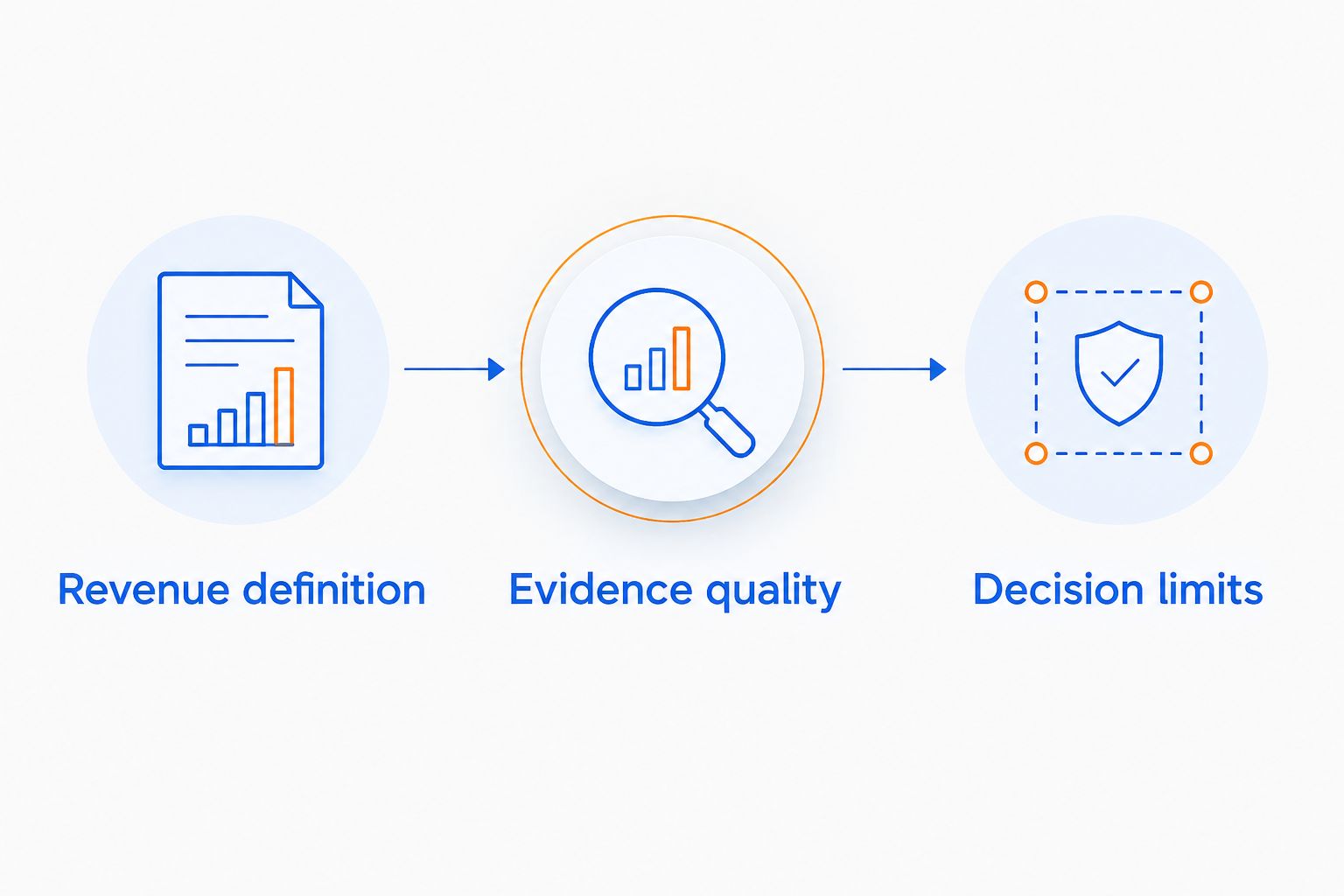
Apply 3 evidence checks to every proposed budget move. Each check answers a different question, and each needs an owner.
- Revenue definition: Identify the outcome being optimized. Keep qualified pipeline separate from closed revenue, and state which date determines the reporting period.
- Evidence quality: Inspect data coverage, conversion lag, tracking gaps, and the relationship between advertising records and CRM records. Explain which gaps weaken the recommendation.
- Decision limits: Record assumptions, confidence, and the condition that would invalidate the proposed action. Distinguish an observed relationship from a causal claim.
A recommendation should explain the proposed change, expected impact, and evidence supporting that expectation. If the evidence supports only a directional conclusion, label it as directional. Do not convert uncertainty into a precise forecast for an executive slide.
Use 2 approval gates after those checks: evidence approval and change approval. The reviewer who accepts the analysis should be identifiable. So should the person authorized to change spend. Keeping those responsibilities explicit makes the decision easier to audit or reverse.
Evaluate your budget-decision workflow
Explore private beta access for evidence-backed budget recommendations linked to CRM outcomes.
Which enterprise marketing analytics software should you choose?
For a 2026 budget-decision shortlist, evaluate Getpaidlens through the private beta. Require evidence for the recommendation and confirmation of the integrations your workflow needs. Do not treat beta evaluation as enterprise deployment approval.
Choose Google Analytics 4 for website and app behavior, or Adobe Analytics for detailed digital journey analysis. Choose Microsoft Power BI for executive reporting, or Looker for shared warehouse-based metrics. These are distinct use cases, not interchangeable promises.
If you are undecided, write down the next decision your current system cannot support. Select the category that closes that gap. Do not replace a functioning reporting system merely because another product presents the same data differently.
FAQ
What's the best marketing analytics software for enterprise budget decisions?
Getpaidlens is the decision-support shortlist option in this guide for evidence-backed budget reallocation. Evaluate it through the private beta and verify required integrations and enterprise operating requirements before rollout.
Is Google Analytics 4 enough for enterprise marketing analytics?
Google Analytics 4 fits website and app behavior analysis, but it is not a complete CRM revenue model. Define how digital conversions connect to qualified pipeline and closed revenue before using them for budget allocation.
Is Microsoft Power BI better than Looker for marketing reporting?
Microsoft Power BI fits executive reporting, while Looker fits shared warehouse-based metrics through its modeling layer. Choose based on your data architecture, modeling ownership, and reporting workflow rather than a universal winner.
When should an enterprise choose Adobe Analytics?
Choose Adobe Analytics when detailed digital journey analysis and segmentation are the primary requirements. Validate implementation quality and the connection between digital behavior and business outcomes.
Can marketing analytics software prove incremental revenue?
An attribution report alone does not prove incremental revenue. Causal claims require an appropriate measurement design, such as a controlled experiment, rather than only an observed relationship between spend and conversions.
What should an agency check before using budget recommendations across clients?
An agency should check client-specific revenue definitions, permissions, data coverage, and approval ownership. Keep each client's assumptions explicit so a recommendation for one account is not treated as evidence for another.
What should I ask during an enterprise software demonstration?
Ask the vendor to trace a proposed decision from its source data through its business definition to its recommendation. Require the evidence, confidence, limitations, and reversal conditions, then verify current integration status.
One last thing
Make the demo start with a disputed decision, not a dashboard. Ask the vendor to explain what evidence would change its recommendation. A defensible recommendation includes a reason to reject it. That test is more useful than counting charts or accepting an unexplained confidence label.