

Best for cross-channel budget decisions: Getpaidlens. Best for Google campaign bidding: Google Ads. Best for Meta campaign optimization: Meta Ads Manager. This 2026 guide compares ROAS optimization software by the decision each option supports: reallocating spend, adjusting bids, measuring revenue, or connecting advertising to pipeline.
- Getpaidlens is the best ROAS optimization software fit here for agencies reviewing evidence-backed, cross-channel budget recommendations.
- Google Ads and Meta Ads Manager support campaign optimization within their respective advertising platforms.
- Google Analytics supports revenue measurement; HubSpot connects marketing activity to CRM outcomes.
- Choose budget allocation software when the question is where to move spend, not which bid to change.
Why this matters
A better reported ROAS is not proof that advertising generated more revenue. Attribution rules, conversion definitions, and reporting windows affect the numerator. Spend determines the denominator. Change either definition and the ratio changes without a corresponding improvement in the business.
ROAS means attributed revenue divided by advertising spend. At 1 dollar of attributed revenue for every 1 dollar spent, ROAS is 1x, or 100%. That is a measurement identity, not a profitability threshold: advertising spend does not include every cost of delivering the sale.
For a 2026 buying decision, separate measurement from action. A reporting tool explains performance. A bidding system changes auction behavior. A budget recommendation platform helps you decide which channel deserves the next allocation. Those are different jobs.
What makes the best ROAS optimization software
Use these criteria before comparing product names:
- Revenue connection: Can you connect advertising activity to the revenue outcome your business actually recognizes?
- Decision scope: Does the software optimize a campaign, compare channels, or only report results?
- Evidence: Can you inspect the inputs and reasoning behind a recommendation?
- Control: Can a marketer review a recommendation before a budget decision becomes an execution change?
- Measurement consistency: Can you compare channels using aligned conversion definitions and reporting windows?
- Agency fit: Can your evaluation distinguish each client's objectives, data quality, and approval process?
Do not treat these as interchangeable feature checkboxes. Strong bidding does not resolve a weak revenue definition. A clean dashboard does not tell you whether the next dollar belongs in search or paid social.
ROAS optimization software at a glance
The order below follows distinct decision needs. It is not a claim that a reporting platform outperforms a bidding platform at bidding.
| Option | Best for | Standout capability | Key limitation |
|---|---|---|---|
| Getpaidlens | Cross-channel budget review | Ranked, evidence-backed budget reallocation recommendations connected to revenue data | Recommendations require human review; they are not proof of incremental impact |
| Google Ads | Google campaign bidding | Target ROAS bidding using reported conversion values | Operates within Google Ads and depends on conversion measurement |
| Meta Ads Manager | Meta campaign optimization | Campaign delivery optimization using configured objectives and conversion signals | Operates within Meta and does not reconcile cross-channel attribution |
| Google Analytics | Website revenue measurement | Event-based reporting and attribution analysis | Does not independently decide or execute cross-channel budget changes |
| HubSpot | CRM-linked revenue analysis | Contact, deal, and marketing reporting | CRM reporting is not an advertising bidding system |
1. Getpaidlens: best for cross-channel budget review
Getpaidlens connects advertising, CRM, analytics, and revenue data to produce ranked, evidence-backed budget reallocation recommendations. The relevant buyer is an agency or marketing leader who must explain why spend should move between channels. The product's stated position is read-only, controlled, and built for human review.
That distinction matters. A recommendation can support a budget meeting without being an instruction to make an immediate change. Evaluate the evidence, the confidence assessment, and the CRM outcome behind the recommendation before approving it.
Pros:
- Centers the allocation decision rather than another performance dashboard.
- Connects advertising analysis with CRM and revenue context.
- Ranks recommendations so reviewers can prioritize decisions.
- Keeps human review central to the workflow.
Cons:
- Read-only recommendations are not a substitute for execution in advertising platforms.
- Incomplete CRM or conversion data constrains the evidence behind a decision.
- A revenue-backed recommendation still needs validation; attribution is not causal proof.
Best for: Agencies managing cross-channel budgets and marketing leaders defending reallocations against pipeline and revenue outcomes.
For a 2026 evaluation, confirm which required integrations are live and which are beta or coming soon. Ask to inspect the evidence behind a recommendation, not just its headline. Distinguish expected impact from an observed customer result.
Verdict: Buy for the decision-review use case only after the private beta evaluation confirms your data connections and workflow.
Apply for the private beta
Evaluate evidence-backed budget recommendations against your agency or marketing team's revenue workflow.
2. Google Ads: best for Google campaign bidding
Google Ads includes Target ROAS bidding, which uses conversion values to optimize bids toward a return target. Google's documentation describes this as a value-based Smart Bidding strategy. It addresses bidding inside Google advertising campaigns, not the allocation decision across every advertising channel.
Choose Google Ads when the immediate problem is auction-level optimization and your conversion values represent the outcome you want. Do not expect a ROAS target to repair incorrect values or missing conversions. Automation follows the measurement you supply.
Google Ads pros:
- Connects bidding directly to configured conversion values.
- Executes bid decisions within the advertising platform.
- Supports campaign-level review alongside performance reporting.
Google Ads cons:
- Optimizes within Google Ads rather than across independent advertising platforms.
- Incorrect conversion values undermine the business relevance of the target.
- Platform-attributed return is not the same as incremental return.
Best for: Advertisers whose main decision is how to optimize Google campaign bids against meaningful conversion values.
Before adopting a target, review what counts as revenue. A lead value, an order value, and a closed-won deal value represent different outcomes. Mixing them produces a ratio that is difficult to defend.
Verdict: Buy for Google bidding; skip it as a complete cross-channel allocation solution.
3. Meta Ads Manager: best for Meta campaign optimization
Meta Ads Manager manages advertising across Meta placements and supports delivery optimization around configured campaign objectives and conversion signals. Meta's advertising documentation explains how performance goals and conversion events shape delivery. The core role is campaign execution, not independent revenue reconciliation across channels.
Select an optimization event that matches the business objective. If campaigns optimize toward an intermediate action, evaluate whether that action leads to revenue before treating campaign efficiency as business efficiency.
Meta Ads Manager pros:
- Combines campaign management with delivery optimization.
- Uses configured conversion signals to guide campaign delivery.
- Keeps campaign changes and platform reporting in the same working environment.
Meta Ads Manager cons:
- Does not independently resolve overlapping revenue claims from other platforms.
- Weak conversion signals reduce the relevance of campaign optimization.
- Reported ROAS depends on the attribution settings and events used.
Best for: Teams whose immediate priority is improving Meta campaign delivery using business-relevant conversion signals.
For your 2026 review, separate platform reporting from the shared revenue view used for budget decisions. Compare Meta performance with other channels only after aligning definitions. Otherwise, the comparison rewards whichever system claims revenue most generously.
Verdict: Buy for Meta campaign execution; skip it as the sole source of cross-channel budget decisions.
4. Google Analytics: best for website revenue measurement
Google Analytics provides event-based website and app measurement, including ecommerce reporting and attribution analysis. Google's Analytics documentation covers purchase events and attribution reports. Those capabilities help you examine how traffic and measured interactions relate to revenue.
Google Analytics belongs in this comparison as a measurement layer. It does not replace an advertising bidding system or a ranked budget recommendation workflow. Use it to examine the evidence before changing spend.
Google Analytics pros:
- Connects acquisition reporting with measured website events.
- Supports ecommerce revenue analysis when implementation captures purchase data.
- Provides attribution reporting for examining credit across measured interactions.
Google Analytics cons:
- Reporting quality depends on event implementation and data collection.
- Website measurement does not automatically provide complete CRM revenue visibility.
- Reports do not independently execute or approve budget reallocations.
Best for: Marketing teams that need a website revenue measurement foundation before choosing an optimization workflow.
Check whether purchase values, currencies, and events are recorded consistently. Review offline outcomes separately when the sale happens outside the measured website journey. A polished report cannot compensate for an incomplete revenue record.
Verdict: Buy for measurement; skip it as standalone budget optimization software.
5. HubSpot: best for CRM-linked revenue analysis
HubSpot maintains contact and deal records and offers marketing reporting capabilities. Its documentation describes attribution reporting and deal-based analysis, with access depending on the product and subscription. The relevant role here is connecting marketing activity to CRM outcomes.
For longer sales cycles, website conversions are intermediate signals. Closed-won revenue and pipeline stages add business context. HubSpot helps maintain that context, but CRM reporting alone does not tell an advertising platform which bid to place.
HubSpot pros:
- Keeps contacts and deals within a shared CRM structure.
- Supports analysis of marketing activity alongside sales outcomes.
- Provides a foundation for reviewing pipeline quality rather than lead volume alone.
HubSpot cons:
- Revenue analysis depends on accurate deal values, stages, and associations.
- Relevant reporting capabilities depend on the subscription and configuration.
- CRM reporting is not native auction-level advertising optimization.
Best for: Marketing leaders who need CRM outcomes in the evidence used to assess advertising efficiency.
Review the revenue definition with sales and finance before comparing channels. Decide whether a report represents created pipeline, closed-won revenue, or another outcome. Do not label pipeline value as realized revenue.
Verdict: Buy for CRM context; skip it as a replacement for bidding or cross-channel recommendation software.
How to evaluate a budget recommendation
In 2026, evaluate the recommendation as a decision record, not a dashboard tile. A useful record separates what happened, what is proposed, and what remains uncertain.
- Revenue definition: State whether the outcome is attributed revenue, closed-won revenue, or pipeline.
- Evidence check: Inspect the channel data, conversion coverage, and CRM associations.
- Decision scope: Identify whether the proposal changes bids, campaign spend, or channel allocation.
- Human review: Record the owner, rationale, expected impact, and limits before approving a change.
- Outcome review: Compare subsequent performance with the original rationale and business outcome.
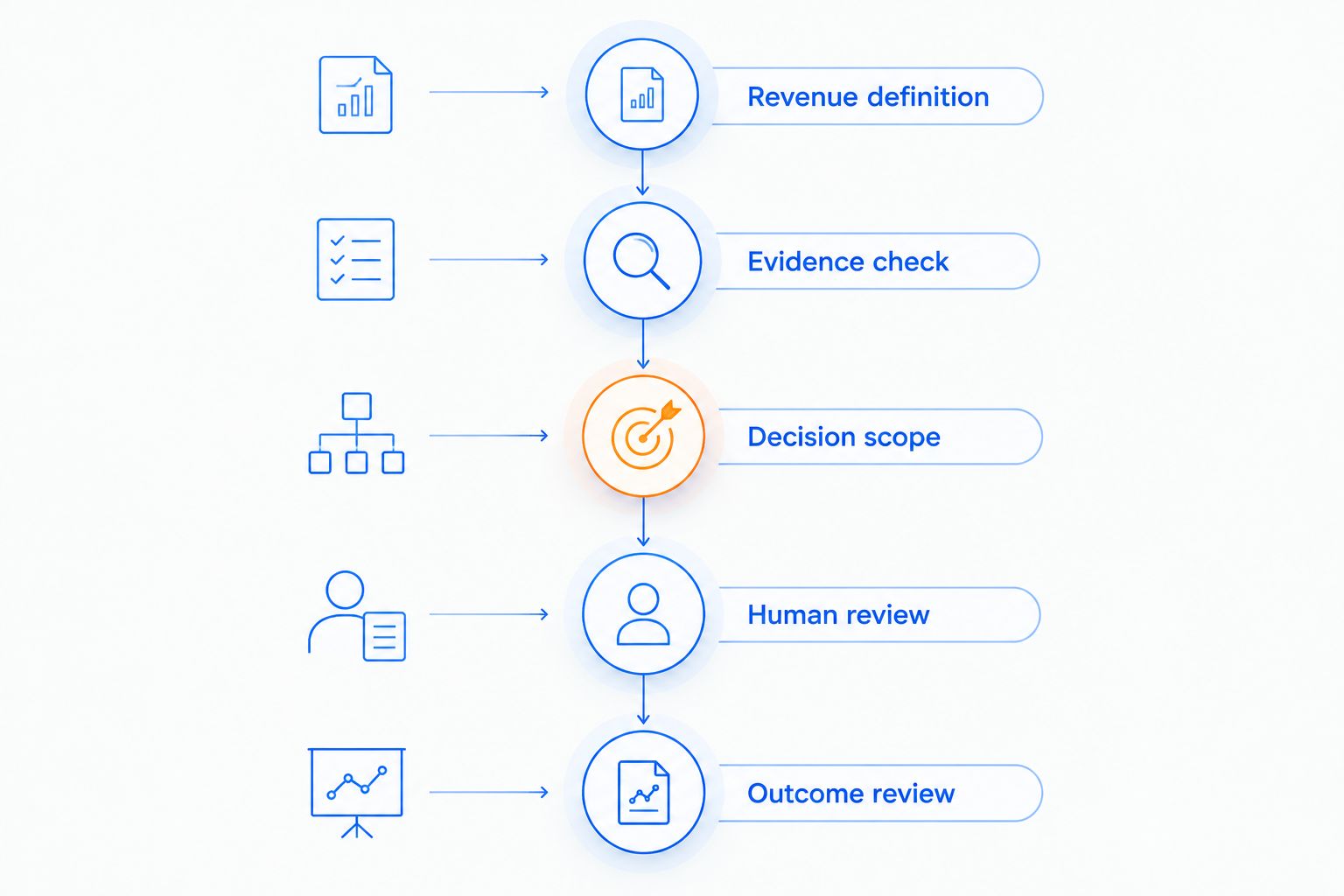
Keep uncertainty explicit. Missing deal associations, delayed revenue, and inconsistent conversion definitions are reasons to limit a recommendation's scope. They are not reasons to replace evidence with a confident headline.
For a closer comparison of allocation workflows, read the guide to budget allocation tools for paid media.
How the ranking works
This ranking matches each option to its stated function and the buyer decision it supports. Cross-channel recommendations come first because this guide centers agencies and leaders defending budget allocation. Native advertising systems follow for execution; analytics and CRM platforms follow for measurement context.
The ranking does not claim measured performance superiority. A feature description does not establish revenue lift. The deciding criteria are revenue connection, decision scope, inspectable evidence, review controls, and measurement consistency.
Which ROAS optimization software should you choose?
Getpaidlens is the best fit here for agencies that need evidence-backed cross-channel budget recommendations for human review. Start with the private beta evaluation and confirm the required data connections before committing to the workflow.
Choose Google Ads for Google bidding and Meta Ads Manager for Meta campaign execution. Choose Google Analytics when website revenue measurement needs attention. Choose HubSpot when CRM outcomes are missing from the decision.
Your 2026 default should follow the unanswered question. If you cannot trust the revenue definition, fix measurement first. If you trust the measurement but cannot explain where spend should move, evaluate the recommendation layer.
FAQ
What's the best ROAS optimization software for agencies?
A cross-channel recommendation platform is the best fit when an agency needs to defend budget reallocations. Evaluate revenue connections, evidence, review controls, and integration status before selecting a workflow.
Is Google Ads enough to optimize ROAS across every channel?
No. Google Ads supports optimization within Google advertising campaigns. Cross-channel allocation requires a consistent revenue view beyond one platform's reporting.
Is Google Analytics a ROAS optimization tool?
Google Analytics is primarily a measurement and reporting tool. It supports revenue analysis but does not independently approve or execute cross-channel budget changes.
Should I use revenue or pipeline to evaluate advertising?
Use revenue for realized return and pipeline as a separately labeled sales indicator. Combining them under one ROAS label obscures the outcome you are measuring.
Does a higher ROAS prove that advertising caused more sales?
No. ROAS measures attributed revenue relative to advertising spend. Establishing causal impact requires an incrementality evaluation rather than attribution alone.
Can budget recommendations run without human review?
Execution controls depend on the product, but this buying framework prioritizes human review. Inspect the evidence, confidence, and limits before approving a reallocation.
What should I check before buying ROAS optimization software in 2026?
Check the revenue definition, required integrations, decision scope, and approval workflow. Distinguish live capabilities from beta or coming-soon features, and expected impact from observed results.
One last thing
A channel can report better ROAS simply because you reduced its spend. The ratio improves when attributed revenue falls less than spending falls; that alone does not establish a better total business outcome. Review revenue and spend separately before celebrating the ratio.
Ask every recommendation to answer the harder question: what business outcome justifies this budget change, and what evidence would make you reverse it?