

HockeyStack gives B2B marketers attribution and analytics for understanding marketing’s contribution to revenue. That answers a measurement question; your next budget decision still needs evidence, a rationale, and a reviewable action. The best HockeyStack alternative in 2026 is Paid Lens if you need ranked budget recommendations; Dreamdata if your priority is B2B revenue attribution.
- For HockeyStack alternatives, choose Paid Lens for evidence-backed budget allocation recommendations linked to CRM revenue.
- Choose Dreamdata when B2B revenue attribution remains your main requirement.
- Choose Google Analytics when website and app measurement is the actual gap.
- Keep HockeyStack when attribution already supports your decisions; a replacement needs a specific business reason.
Why this matters
An attribution platform and a budget recommendation platform solve different problems. Attribution assigns credit to marketing interactions. Decision intelligence proposes an action and explains the evidence behind it.
For an agency, that distinction affects what you deliver to clients. A channel report shows performance. A defensible recommendation explains what to change, which revenue evidence supports the change, and where confidence ends.
For a marketing leader, the distinction matters in the budget meeting. You need to explain why a channel deserves more investment, not just why it received more attribution credit. Those are different arguments.
Choose the replacement around the decision you cannot make today. If the missing piece is revenue measurement, evaluate attribution platforms. If the missing piece is prioritizing budget changes, evaluate decision intelligence. If you only need better website measurement, a broader platform replacement can address the wrong problem.
HockeyStack alternatives at a glance in 2026
These options are not interchangeable. The table compares their primary jobs, not an unsupported overall performance ranking.
| Platform | Best for | Standout capability | Difference from HockeyStack |
|---|---|---|---|
| HockeyStack | B2B marketing attribution and analytics | Understanding marketing interactions in relation to revenue | The attribution benchmark for this comparison |
| Paid Lens | Agencies and leaders reviewing cross-channel budget decisions | Ranked recommendations with expected impact, confidence, and rationale | Centers the budget action rather than the attribution report |
| Dreamdata | Teams prioritizing B2B revenue attribution | Connecting marketing activity with the B2B revenue journey | Another attribution-focused option, not a different measurement category |
| Google Analytics | Website and app behavior measurement | Event-based measurement and acquisition reporting | Focuses on digital interactions rather than serving as a direct B2B revenue-attribution replacement |
Use this shortlist to identify the right category before requesting demonstrations. A reporting improvement does not automatically justify replacing your attribution platform. Neither does a recommendation engine eliminate the need for reliable measurement.
1. Paid Lens: best for reviewable budget recommendations
This decision-intelligence software is built for performance marketers and agencies that need to connect advertising, CRM, analytics, and revenue evidence to budget decisions. Its ranked action queue presents expected business impact, confidence, and the rationale behind recommendations. The product is read-only and built for human review.
That positioning matters when your team already has reports but still struggles to decide what deserves attention. The output is a proposed action to assess, not permission to treat an estimate as a guaranteed result.
Where it shines
- Decision prioritization: A ranked queue gives your review a starting point instead of another unprioritized report.
- Revenue context: CRM and revenue evidence keep the discussion connected to business outcomes rather than ad-platform metrics alone.
- Reviewable reasoning: Expected impact, confidence, and rationale make the recommendation inspectable.
- Controlled use: Read-only operation keeps execution under human control.
Where it falls short
- It is not the same product category as a dedicated attribution platform. Do not assume it replaces every attribution workflow you currently use.
- A recommendation still requires a responsible reviewer. Read-only operation does not execute the budget change for you.
- Confidence does not establish causality. You still need to distinguish an observed relationship from evidence that a spending change caused an outcome.
- Private beta evaluation requires checking your actual account requirements. Confirm the integration status for each required system rather than treating a named system as proof of a live connector.
The brand description names Google Ads, Meta, LinkedIn, Salesforce, HubSpot, and Google Analytics in its data scope. Before applying, establish which connections are live, which are beta, and which are coming soon for your intended workflow. Do not design your rollout around an unconfirmed integration.
Head-to-head: decision intelligence versus attribution
| Dimension | Paid Lens | HockeyStack |
|---|---|---|
| Primary question | Which budget action deserves review? | How does marketing activity connect to revenue? |
| Central output | Ranked recommendations with impact, confidence, and rationale | B2B attribution and analytics |
| Evaluation focus | Whether evidence supports a proposed allocation change | Whether measurement supports your revenue analysis |
| Important limit | Expected impact is not a guaranteed outcome | Attribution credit is not experimental proof |
Best for: Agencies managing multiple clients and marketing leaders who must defend cross-channel budget decisions.
Verdict: Evaluate through the private beta. Bring a real allocation question and inspect the recommendation’s evidence before relying on it in a client or executive discussion.
2. Dreamdata: best for B2B revenue attribution
Dreamdata is a B2B revenue-attribution option. It belongs on your shortlist when the central requirement is connecting marketing activity to the revenue journey, rather than changing the category of software you use.
The evaluation should begin with your current measurement problem. If your team disagrees about which interactions contribute to pipeline, compare how each attribution platform represents the journey and explains its model.
Where Dreamdata shines
- Its B2B revenue-attribution focus matches a revenue-measurement requirement.
- It offers an attribution-focused alternative without requiring you to redefine the problem as website analytics.
- Its category is relevant when marketing and sales interactions both matter to your analysis.
Where Dreamdata falls short
- Attribution does not, by itself, prove the incremental return from additional spending.
- Changing platforms does not remove incomplete CRM records or inconsistent campaign naming.
- Another attribution platform is the wrong category choice if your main bottleneck is deciding which action to take after reading the report.
Head-to-head: Dreamdata versus HockeyStack
| Dimension | Dreamdata | HockeyStack |
|---|---|---|
| Broad category | B2B revenue attribution | B2B attribution and analytics |
| Relevant buying question | Does its approach fit your revenue journey? | Does its approach fit your revenue journey? |
| Shared measurement limit | Attribution is not causal proof | Attribution is not causal proof |
Best for: B2B teams that want to reassess their attribution approach while keeping revenue measurement as the main objective.
Verdict: Evaluate alongside HockeyStack. Require a concrete improvement in your own reporting workflow, not a different-looking explanation of the same data.
3. Google Analytics: best for website and app measurement
Google Analytics measures website and app interactions through events. It is a relevant alternative only when your underlying requirement is digital behavior measurement, acquisition reporting, or conversion-event analysis.
It is not a like-for-like substitute for B2B revenue attribution. Choose it because it answers your actual question, not because every analytics product appears interchangeable on a shortlist.
Where Google Analytics shines
- Event-based measurement supports analysis of website and app behavior.
- Acquisition reporting helps you examine how visitors reach your digital properties.
- Conversion-event analysis gives you a way to inspect defined actions within those properties.
Where Google Analytics falls short
- A website conversion event is not automatically a qualified opportunity or closed-won revenue.
- Event configuration still requires clear definitions and validation.
- Website and app reports do not, by themselves, provide a complete view of a B2B sales journey.
Head-to-head: Google Analytics versus HockeyStack
| Dimension | Google Analytics | HockeyStack |
|---|---|---|
| Primary scope | Website and app behavior | B2B attribution and analytics |
| Measurement focus | Events and acquisition | Marketing activity in relation to revenue |
| Best evaluation question | Are digital interactions measured correctly? | Is marketing’s revenue contribution represented usefully? |
Best for: Teams whose immediate gap is digital measurement rather than cross-channel budget recommendations or B2B revenue attribution.
Verdict: Use for the narrower requirement. Keep revenue measurement separate unless your workflow explicitly connects digital events to CRM outcomes.
Why people switch from HockeyStack
A defensible switch starts with a workflow mismatch. It does not require claiming that HockeyStack is a bad product, or inventing a pricing change, outage, or dissatisfied customer story.
For a 2026 evaluation, identify which of these requirements describes your situation:
- You need actions after analysis. Your team can explain channel performance but still lacks a prioritized, evidence-backed budget decision.
- You need a different attribution approach. Revenue measurement remains the objective, but your current workflow does not answer the questions stakeholders ask.
- You need narrower measurement. Website behavior and event quality are the immediate issues, rather than the wider B2B revenue journey.
These are reasons to evaluate alternatives, not claims about why existing customers have left HockeyStack. Validate the requirement inside your own team before beginning procurement.
If the actual problem is unreliable source data, address that first. Moving the same inconsistent records into another platform does not make the resulting recommendation more defensible.
How to evaluate a replacement before committing
Use the same business question across every candidate. For an agency, choose a question a client already asks. For a marketing leader, choose a decision that requires finance or sales agreement.
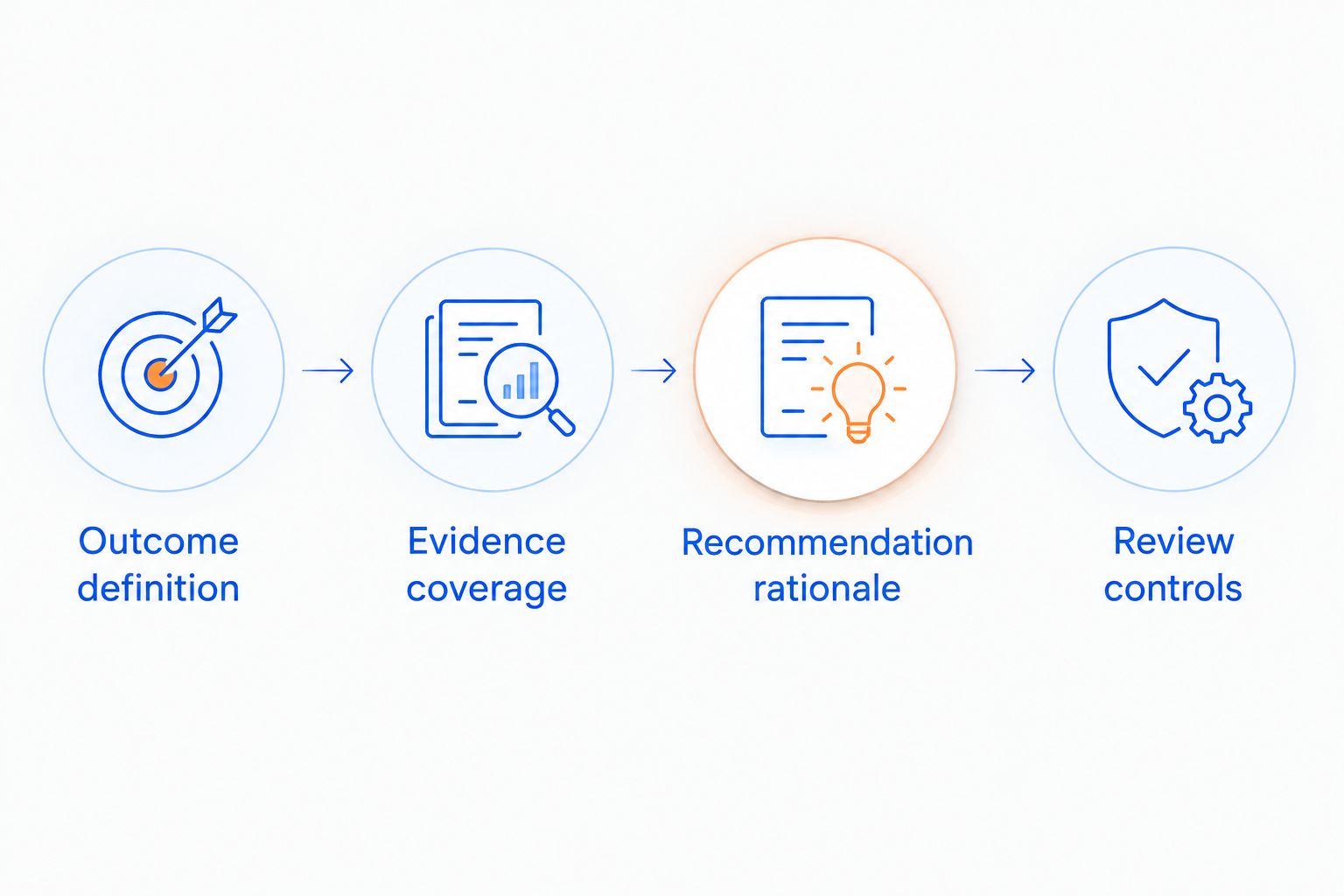
A useful question is: which channel deserves the next budget adjustment, and what evidence supports that decision? Keep the outcome definition consistent throughout the evaluation.
Outcome definition
State the business result you are optimizing. A lead, a qualified opportunity, and closed-won revenue are not interchangeable outcomes. Define the relevant CRM stage before comparing platform outputs.
Evidence coverage
Check which sources support the answer. Identify disconnected accounts, missing CRM fields, and inconsistent campaign identifiers. Ask the vendor to distinguish live integrations from beta and planned connections.
Recommendation rationale
Inspect how the platform reaches its conclusion. For attribution software, ask how the model assigns credit. For decision intelligence, ask why the proposed action ranks above the alternatives and what evidence would change that ranking.
Review controls
Define who approves an action and how the team records the rationale. Separate the recommendation from execution. A useful output should support scrutiny, not make the reviewer disappear.
Reject conclusions that outrun their evidence. Expected impact is an estimate, attribution is a model, and a confidence score needs an understandable explanation. Your evaluation should make those limits visible before the tool enters a recurring budget review.
For a private beta assessment, bring the decision, the relevant data sources, and your approval requirements. Ask to see the rationale and limits before discussing a wider rollout.
Explore the private beta
Evaluate ranked budget recommendations against your agency or marketing team's decision requirements.
When staying with HockeyStack is the right call
Keep HockeyStack if it already answers your B2B attribution questions and supports the reporting your team needs. A different product category is not automatically a better replacement.
In 2026, assess whether the missing capability belongs beside your current measurement workflow rather than instead of it. If your attribution reports are useful but your budget-review process is weak, changing attribution platforms does not necessarily fix the decision process.
Require a replacement to improve a named task. Better evidence, clearer interpretation, or a more useful action is a reason to evaluate. A new interface alone is not.
FAQ
What's the best HockeyStack alternative in 2026 for budget decisions?
Paid Lens is the best fit in this shortlist for ranked, evidence-backed budget recommendations. Its focus is expected impact, confidence, and rationale for human review, rather than attribution reporting alone.
Is Dreamdata better than HockeyStack?
There is no evidence here supporting an overall winner between Dreamdata and HockeyStack. Compare their B2B attribution approaches against the same revenue journey and reporting requirement.
Can Google Analytics replace HockeyStack?
Google Analytics can address website and app measurement, but it is not a like-for-like B2B revenue-attribution replacement. Choose it when digital behavior measurement is your actual requirement.
Should an agency choose attribution software or budget recommendation software?
Choose attribution software to understand revenue contribution and budget recommendation software to prioritize allocation decisions. An agency can need both jobs, so define the missing capability before replacing a platform.
Does attribution prove that increasing a channel's budget will increase revenue?
No. Attribution assigns credit to observed interactions; it does not establish the causal effect of additional spending. Treat the spending decision as a separate question requiring supporting evidence.
What should I check before joining a private beta?
Check the current integration status, recommendation evidence, and human-review requirements. Ask the vendor to identify live, beta, and coming-soon capabilities separately.
Should I replace HockeyStack if the reports already work?
No, not without a specific unmet requirement. Keep useful attribution reporting and evaluate whether the missing decision capability belongs alongside it.
One last thing
The clearest test is not whether a platform agrees with your preferred allocation. It is whether the platform exposes enough evidence for someone else to challenge it.
For your 2026 evaluation, select a recommendation your team disputes. Ask what supports it, what weakens it, and what new evidence would reverse it. That discussion reveals more about decision quality than a polished dashboard.
A defensible budget decision includes a reason to reconsider it. If your team cannot explain that condition, the recommendation is not ready for a client review or an executive meeting.