

LeadSources focuses on a useful attribution task: capturing where website leads come from. When you need to defend cross-channel budget changes against CRM pipeline and revenue, source capture is only part of the decision. The best LeadSources alternative in 2026 is Getpaidlens if you need ranked budget recommendations; HubSpot if you need lead attribution inside a CRM-centered workflow.
- For leadsources alternatives, choose Getpaidlens for evidence-backed budget allocation tied to CRM revenue.
- Choose HubSpot when lead records, sales activity, and marketing reporting belong in one CRM workflow.
- Choose Google Analytics when your immediate problem is website acquisition and conversion analysis.
- Keep LeadSources when source capture solves the problem; replacing it is not automatically a better decision.
Why this matters
A source label answers where a lead originated. A budget decision asks whether the next unit of spend belongs in that channel. Those are different questions, and a clean answer to the first does not settle the second.
For an agency, the distinction matters across clients. One client needs cleaner lead-source records; another needs to explain why spend should move between Google Ads, Meta, and LinkedIn. Choosing the same replacement for both creates a scope mismatch.
Choose your LeadSources alternative around the decision you need to make, not the longest feature list. In 2026, the useful comparison is source capture versus CRM reporting versus revenue-linked budget recommendations. This shortlist separates those jobs rather than treating every marketing platform as interchangeable.
LeadSources alternatives at a glance
The table compares each option's central purpose. It is not a claim that every option replaces every LeadSources workflow. Your existing forms, CRM configuration, and reporting requirements still determine whether a replacement fits.
| Option | Best for | Standout capability | Difference from LeadSources | Main limit to consider |
|---|---|---|---|---|
| LeadSources | Capturing acquisition-source information for website leads | Lead-source capture | Baseline for the comparison | Source information alone does not justify a budget change |
| Getpaidlens | Revenue-linked paid-media budget decisions | Ranked, evidence-backed reallocation recommendations | Centers the next spending decision rather than source capture alone | Private beta requires a fit assessment; do not assume a drop-in tracking replacement |
| HubSpot | CRM-centered lead and sales reporting | Connecting contact records with marketing and sales activity | Places attribution questions inside a broader CRM workflow | Reporting depends on configuration and the capabilities of the selected subscription |
| Google Analytics | Website acquisition and conversion analysis | Event-based measurement and acquisition reporting | Examines website behavior and acquisition rather than centering CRM lead records | Website reporting is not a complete CRM revenue decision system |
For your 2026 shortlist, separate 3 decisions: what needs measuring, where revenue evidence lives, and who approves budget changes. A platform can fit one decision without fitting the others. That is a reason to define the scope, not a reason to reject the platform.
1. Getpaidlens: best for revenue-linked budget decisions
Getpaidlens is budget recommendation software for performance marketers and agencies that need to connect advertising, CRM, analytics, and revenue evidence. Its stated product scope is ranked, evidence-backed budget reallocation recommendations. The relevant question is not simply which channel generated a lead, but which spending change deserves review.
Getpaidlens is best for agencies and marketing leaders who must defend cross-channel budget decisions with CRM revenue evidence. That is a narrower recommendation than calling it the best replacement for every lead-tracking setup.
Where the platform shines
- Decision priority: A ranked recommendation queue gives you an order for reviewing proposed budget changes.
- Business context: CRM and revenue evidence brings the discussion beyond advertising-platform conversion totals.
- Review discipline: Confidence scoring and rationale support scrutiny of a recommendation before a person approves action.
- Cross-channel scope: The product description connects advertising, CRM, analytics, and revenue data rather than treating a single advertising account as the whole business.
Where the platform falls short
- Different primary job: Budget recommendations do not establish that the platform replaces your existing form-level source-capture workflow.
- Beta evaluation: The private beta needs an explicit fit assessment before you rely on it for client delivery.
- Evidence dependence: A recommendation is only defensible when the underlying conversion, pipeline, and revenue records support it.
The named data systems include Google Ads, Meta, LinkedIn, Salesforce, HubSpot, and Google Analytics. Treat that list as the product's connection scope, not permission to assume every integration has the same release status. Confirm which required connections are live, in beta, or coming soon during the application process.
| Dimension | Budget recommendation platform | LeadSources |
|---|---|---|
| Central question | Which budget change deserves review? | Where did this website lead come from? |
| Evidence emphasis | Advertising, CRM, analytics, and revenue | Lead acquisition source |
| Evaluation task | Inspect recommendation rationale and confidence | Inspect source capture against your forms |
| Replacement test | Does it support the budget decision? | Does it preserve the source record you need? |
Best for: Agencies and marketing leaders evaluating revenue-linked budget recommendations in 2026.
Verdict: Hold deployment until the private beta fit assessment confirms your required workflow.
2. HubSpot: best for CRM-centered lead attribution
HubSpot is a CRM platform with marketing and sales tools. It belongs on a LeadSources shortlist when the real requirement is to examine acquisition information alongside contact records and sales activity. The value is the relationship between records, not simply another attribution chart.
Start with the CRM questions you already ask. Which source produced the contact? What happened after qualification? Can the report connect the relevant contact and deal records without a manual reconstruction?
Where HubSpot shines
- Contact context: Acquisition information can sit alongside a contact's broader marketing and sales history.
- Sales workflow: CRM records give marketing and sales a shared place to examine lead progression.
- Reporting scope: HubSpot offers attribution reporting, with capabilities that depend on the product and subscription you use.
Where HubSpot falls short
- Configuration burden: Contact properties, lifecycle stages, and deal associations need consistent definitions.
- Scope mismatch: Adopting a broader CRM platform solely to capture lead sources adds work beyond the original tracking problem.
- Decision gap: An attribution report is evidence for a budget recommendation; it is not, by itself, an approved reallocation plan.
| Dimension | HubSpot | LeadSources |
|---|---|---|
| Central question | How does acquisition relate to the CRM record? | Where did this website lead come from? |
| Workflow emphasis | Marketing and sales activity around contacts | Capturing lead-source information |
| Evaluation task | Check properties, associations, and report access | Check source capture against your forms |
For an agency, evaluate HubSpot against the client's existing CRM before recommending a change. Replacing a source-capture tool and changing the system of record are separate projects. Keep them separate in the scope and approval process.
Best for: Teams whose attribution questions depend on contact and deal records in HubSpot.
Verdict: Hold a CRM migration unless the broader marketing and sales workflow justifies it.
3. Google Analytics: best for website acquisition analysis
Google Analytics measures website and app interactions through an event-based model. Its acquisition reports help you examine how visitors arrive and what they do afterward. It is the relevant alternative when the missing answer concerns website behavior rather than a CRM-centered budget recommendation.
Where Google Analytics shines
- Acquisition analysis: Traffic-source reporting helps you examine channels and campaigns.
- Behavior context: Events connect acquisition questions with activity on the website.
- Measurement diagnosis: You can inspect whether the intended website action is represented in your measurement setup.
Where Google Analytics falls short
- Different record: A website event is not the same thing as a qualified CRM lead or a closed deal.
- Implementation dependence: Event definitions and campaign tagging affect what your reports mean.
- Revenue gap: Website acquisition reports alone do not establish the pipeline and revenue consequences of a spending change.
| Dimension | Google Analytics | LeadSources |
|---|---|---|
| Central question | How did visitors arrive and behave? | Where did this website lead come from? |
| Measurement emphasis | Website events and acquisition | Source information associated with leads |
| Evaluation task | Validate events and campaign tagging | Validate form-level source capture |
Best for: Marketers diagnosing website acquisition and conversion measurement.
Verdict: Hold replacement if you still need source information attached to individual CRM leads.
Why people switch from LeadSources
The defensible reason to switch is a changed requirement. This comparison does not establish a LeadSources outage, a pricing change, or a product failure. It identifies different jobs that require different evidence.
You need a budget recommendation, not just a source label
A channel can produce leads without producing the pipeline your business needs. Before moving spend, connect acquisition evidence to qualification, opportunity progression, and revenue. Then explain the proposed action and its limits.
You need attribution inside the CRM workflow
If the team reviews contacts and deals together, source data needs to support that workflow. Evaluate the CRM-centered option against the records and associations your sales team actually uses. Do not choose it because it has more screens.
You need to diagnose website measurement
If the immediate question is whether a campaign attracts visitors who complete a website action, start with acquisition and event measurement. A revenue recommendation will not repair an incorrectly defined conversion event.
You need a decision trail for clients
An agency recommendation needs a rationale another person can challenge. Record the proposed change, the supporting evidence, and what would make the recommendation wrong. That standard applies to every option on this page.
Evaluate a replacement before moving the workflow
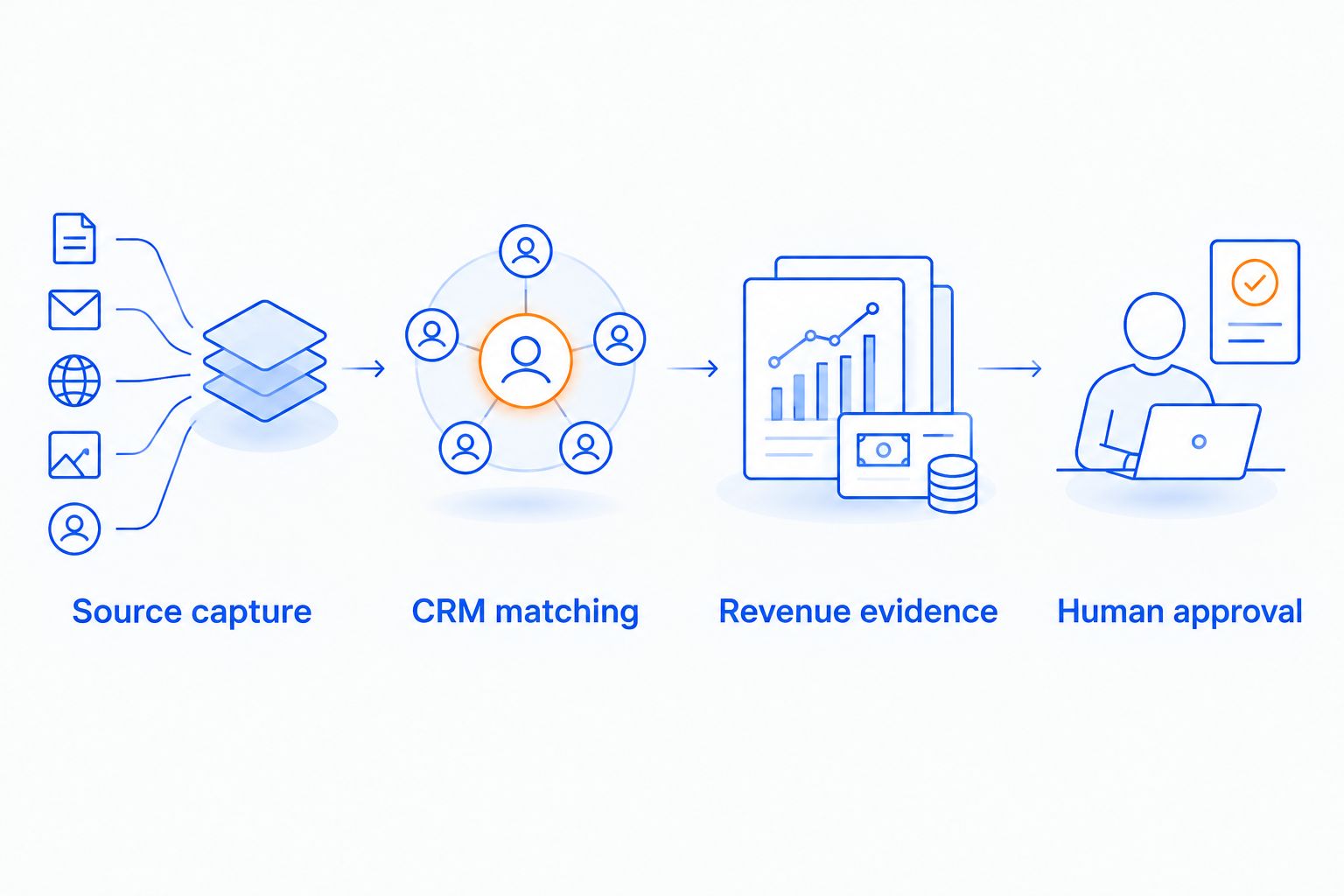
Use 4 checks for a 2026 evaluation: Source capture, CRM matching, Revenue evidence, and Human approval. These are acceptance criteria, not claims that every platform performs all four tasks.
- Source capture: Verify that the acquisition information required by your forms and reports survives the proposed change.
- CRM matching: Check that lead records connect to the relevant contacts, accounts, or deals without changing their meaning.
- Revenue evidence: Separate lead volume, qualified pipeline, and closed revenue. State which outcome supports the recommendation.
- Human approval: Assign a person to review the action, confidence, and limitations before a budget changes.
For each proposed move, write 5 fields: action, evidence, expected impact, confidence, and limit. Expected impact is a forecast, not a customer result. If the evidence does not support a quantified impact, state the intended outcome without manufacturing a number.
For agencies, apply these checks separately to each client. A valid CRM association for one client does not prove the same setup works for another. Your approval process should preserve that distinction.
Apply for the private beta
Evaluate revenue-linked budget recommendations against your agency or marketing team's decision workflow.
When staying with LeadSources is the right call
Keep LeadSources when your primary requirement is source capture and the current implementation meets it. A broader platform is not automatically a better substitute. Replacing working measurement to obtain a different reporting layer creates an unnecessary migration unless the replacement preserves the original requirement.
Your 2026 decision can also be to separate the jobs. Keep source capture in place while evaluating CRM reporting or budget recommendation software independently. That lets you assess the new decision workflow without assuming it must replace every existing measurement component.
FAQ
What's the best LeadSources alternative in 2026?
Getpaidlens is the strongest fit in this shortlist for agencies and marketing leaders seeking evidence-backed budget recommendations tied to CRM revenue. HubSpot fits CRM-centered attribution, while Google Analytics fits website acquisition analysis. Choose by the job you need, not by a universal ranking.
Is HubSpot a direct replacement for LeadSources?
HubSpot is not automatically a direct replacement for your LeadSources implementation. Confirm that your forms, source fields, contact records, and required reports preserve the workflow you use today.
Can Google Analytics replace lead-source tracking?
Google Analytics fits website acquisition and event analysis, but that does not establish a replacement for source information attached to individual CRM leads. Test the required lead-record workflow separately from website reporting.
Which alternative is best for an agency managing several clients?
Choose a budget recommendation platform when the agency's main task is defending cross-channel spending decisions. Evaluate each client's source capture, CRM associations, and revenue evidence separately before standardizing the workflow.
Do I need to replace LeadSources to improve budget allocation?
No, improving budget allocation does not inherently require replacing source capture. Preserve a working measurement setup and evaluate the additional decision layer against pipeline, revenue, and approval requirements.
How should I compare integration support?
Confirm the release status of every required connection before approving a replacement. Distinguish live integrations from beta and coming-soon integrations, then test the records and fields your workflow depends on.
What should a defensible budget recommendation include?
A defensible budget recommendation includes an action, evidence, expected impact, confidence, and a stated limit. Forecasts must remain distinct from observed results, and a person should approve the change before execution.
One last thing
Ask a question that feature tables often miss: What evidence would make you reject this recommendation? A useful answer identifies a missing revenue connection, an inconsistent qualification definition, or a measurement problem. A recommendation that cannot name its limits is not ready for approval.
For your 2026 selection, make that question part of the demonstration. The strongest fit is the platform that supports your actual decision and exposes the evidence you need to challenge it.