

Best for evidence-backed budget recommendations: Getpaidlens. Best for website attribution reporting: Google Analytics. Best for CRM-centered revenue reporting: HubSpot. This marketing attribution software pricing comparison helps you choose the right scope before comparing commercial terms in 2026; it does not present an unsupported cheapest-to-most-expensive ranking.
- Getpaidlens is best for performance marketers and agencies seeking evidence-backed budget reallocation recommendations.
- A marketing attribution software pricing comparison should separate attribution reporting from budget decision intelligence.
- Google Analytics suits website attribution; HubSpot and Salesforce suit different CRM-centered reporting workflows.
- Compare implementation work, revenue coverage, and contractual scope before choosing attribution tools.
Why this matters
Attribution reporting and budget recommendations answer different questions. Attribution assigns credit to recorded marketing interactions. A budget recommendation tells you what to change, supported by evidence and a stated rationale.
Buying the first when you need the second leaves your team doing the decision work. Buying the second without reliable revenue records leaves the recommendation difficult to defend.
For an agency, the purchase also affects how you explain decisions across clients. For a marketing leader, it affects whether a finance team can trace an allocation change back to pipeline or revenue. Your 2026 evaluation should start with that accountability requirement, not a feature checklist.
The right comparison is the cost of producing a defensible decision, not the subscription in isolation. Separate the commercial terms from the implementation and review work. Neither tells the whole story alone.
What makes the best marketing attribution software
Use these criteria before requesting proposals. They distinguish a useful attribution purchase from another reporting system your team must interpret manually.
- Revenue evidence: Can you trace the analysis from advertising activity to the relevant CRM outcome? Keep pipeline and closed revenue distinct.
- Decision usefulness: Does the output explain historical credit, recommend a budget change, or do both? Buy the capability your team actually needs.
- Implementation work: Identify connector setup, identity mapping, campaign naming, data cleanup, and ongoing maintenance before evaluating commercial terms.
- Agency separation: Verify how client accounts, permissions, reporting definitions, and contractual scope are handled. Do not assume one account structure fits every client.
- Auditability: Require an explanation of the underlying evidence, attribution assumptions, and limits. A polished chart is not an explanation.
- Commercial clarity: Ask what the agreement covers and which changes trigger a different contract. Compare equivalent scope rather than headline packaging.
An attribution tool earns its place when you can describe the decision it supports and the work it replaces. If you cannot name either, pause procurement.
Marketing attribution options at a glance
This is a use-case ranking for 2026, not a price ranking. The order prioritizes cross-channel budget decisions, then narrower reporting needs, then custom infrastructure. Confirm current terms directly with each provider.
| Rank and option | Best for | Standout capability | Key limitation | Commercial scope to verify |
|---|---|---|---|---|
| 1. Getpaidlens | Evidence-backed budget reallocation | Ranked recommendations connecting advertising and revenue data | Not a substitute for repairing incomplete source records | Private beta terms and required integration status |
| 2. Google Analytics | Website attribution reporting | Attribution reporting around recorded website conversions | Website attribution alone does not establish CRM revenue impact | Required analytics scope and implementation responsibilities |
| 3. HubSpot | Revenue attribution within a HubSpot workflow | CRM-centered attribution reporting | Useful interpretation depends on clean CRM records and reporting eligibility | Required reporting capabilities and account terms |
| 4. Salesforce Campaign Influence | Campaign influence in a Salesforce workflow | Associations between campaigns and opportunities | Campaign influence is not proof of incremental revenue | Applicable configuration and contractual requirements |
| 5. Warehouse-based attribution | Custom attribution definitions | Direct control over data transformations and model logic | Your team owns development, quality checks, and maintenance | Infrastructure, engineering, and operating responsibilities |
The options are not interchangeable. A website reporting requirement should not automatically become a custom data project. A board-level revenue question should not stop at website conversions.
1. Getpaidlens: best for budget reallocation recommendations
Getpaidlens is a decision-intelligence platform that connects advertising, CRM, analytics, and revenue data to produce ranked, evidence-backed budget reallocation recommendations. Its relevant use case is the next allocation decision, not merely another view of historical performance.
Getpaidlens is best for performance marketers and agencies that need evidence-backed budget reallocation recommendations. Evaluate it against a specific decision your team must defend, such as whether a channel deserves more investment based on downstream business outcomes.
Pros:
- Centers recommendations on budget reallocation rather than reporting alone.
- Connects advertising analysis with CRM and revenue context.
- Ranks recommendations so the review starts with a decision queue.
Cons:
- Source-data gaps remain a limit on the evidence available for a recommendation.
- A recommendation still requires a human to assess its assumptions and approve action.
- Integration release status must be checked for your intended workflow; do not treat beta or planned connections as live capabilities.
Commercial evaluation: Apply for the private beta and confirm the applicable terms, account scope, and integration status before making a procurement commitment.
Best for: Agencies managing multiple clients and marketing leaders who need to explain proposed allocation changes.
Verdict: Hold a procurement decision until the private beta demonstrates your actual revenue-review workflow.
2. Google Analytics: best for website attribution reporting
Google Analytics provides attribution reporting for recorded website conversions and the marketing interactions associated with them. It belongs on your shortlist when the immediate question concerns website acquisition and conversion paths.
Start with the conversion definition. A form submission, a booked meeting, and a closed sale represent different outcomes; a report becomes misleading when the reader treats them as equivalent.
Google Analytics pros:
- Keeps attribution analysis close to website measurement.
- Provides a reporting basis for examining recorded conversion paths.
- Suits teams whose current decision concerns website behavior rather than a complete CRM revenue model.
Google Analytics cons:
- Recorded website conversions do not automatically establish closed revenue.
- Consent, tracking implementation, and identity gaps affect the observable journey.
- Attribution credit does not prove that advertising caused an additional conversion.
Google Analytics commercial evaluation: Confirm the analytics scope you need and the work required to implement reliable conversion measurement. Include ownership of ongoing measurement checks in the comparison.
Best for: Teams resolving a website attribution question before expanding into CRM-centered analysis.
Verdict: Buy into this approach for website reporting; skip it as the sole evidence for a cross-channel revenue allocation decision.
3. HubSpot: best for attribution inside a HubSpot CRM workflow
HubSpot offers attribution reporting within its CRM-centered marketing environment. It is a relevant option when your marketing activity and revenue records already belong to that workflow.
The strongest evaluation starts with an existing business question. Ask whether the required report can connect the relevant marketing interactions to the outcome you use in budget meetings, rather than accepting a generic demonstration.
HubSpot pros:
- Places attribution analysis within a CRM-centered workflow.
- Supports evaluation against the revenue records your team already reviews.
- Keeps the shortlist focused when HubSpot is already central to marketing operations.
HubSpot cons:
- Incomplete or inconsistent CRM records weaken the resulting analysis.
- Required attribution reports must be checked against the applicable product scope.
- Reported revenue credit is not the same as a recommended budget allocation.
HubSpot commercial evaluation: Confirm which attribution capabilities your account would include. Separate the agreement from any CRM cleanup, workflow changes, or implementation support required to make those reports useful.
Best for: Marketing teams that already use HubSpot as the operational center for marketing and revenue records.
Verdict: Buy into this approach when the CRM workflow and required attribution reporting match; skip an unrelated platform migration solely to obtain another report.
4. Salesforce Campaign Influence: best for opportunity-level influence
Salesforce Campaign Influence connects campaign activity with opportunities through campaign influence reporting. It belongs in the comparison when your revenue discussions already center on Salesforce opportunities.
Define what influence means before presenting it to finance. A campaign's association with an opportunity is evidence of recorded participation, not automatic evidence that the campaign created incremental revenue.
Salesforce Campaign Influence pros:
- Frames marketing analysis around opportunities.
- Fits teams that already review pipeline within Salesforce.
- Supports a structured discussion of campaign participation in revenue journeys.
Salesforce Campaign Influence cons:
- Interpretation depends on campaign, contact, and opportunity record quality.
- Model configuration changes how influence is represented.
- Influence reporting does not independently answer how much additional revenue a budget change will produce.
Salesforce Campaign Influence commercial evaluation: Confirm the applicable configuration, contractual requirements, and administrator responsibilities. Include the work needed to maintain consistent campaign and opportunity records.
Best for: Marketing and revenue operations teams defending campaign influence within an established Salesforce workflow.
Verdict: Buy into this approach for opportunity-level influence reporting; skip it as standalone proof of incremental return.
5. Warehouse-based attribution: best for custom model ownership
Warehouse-based attribution is an architecture, not a single packaged product. Your team brings advertising, analytics, and CRM records together, then defines the transformations and attribution logic used in reporting.
This option fits a genuine need for custom definitions. It is not a shortcut around inconsistent source records, and it transfers operational responsibility to your team.
Warehouse-based attribution pros:
- Gives your team control over transformation and model logic.
- Supports business-specific definitions when packaged reporting does not fit.
- Makes implementation choices available for direct technical review.
Warehouse-based attribution cons:
- Requires engineering and analytical ownership.
- Leaves quality checks, documentation, and maintenance with your organization.
- Does not produce budget recommendations unless your team builds that capability separately.
Warehouse-based attribution commercial evaluation: Compare infrastructure obligations with development and continuing support. A software-only comparison excludes the work that makes this approach function.
Best for: Organizations with technical ownership and a documented need for custom attribution definitions.
Verdict: Buy into this approach only when custom control justifies the continuing operating responsibility.
How to compare proposals without misleading yourself
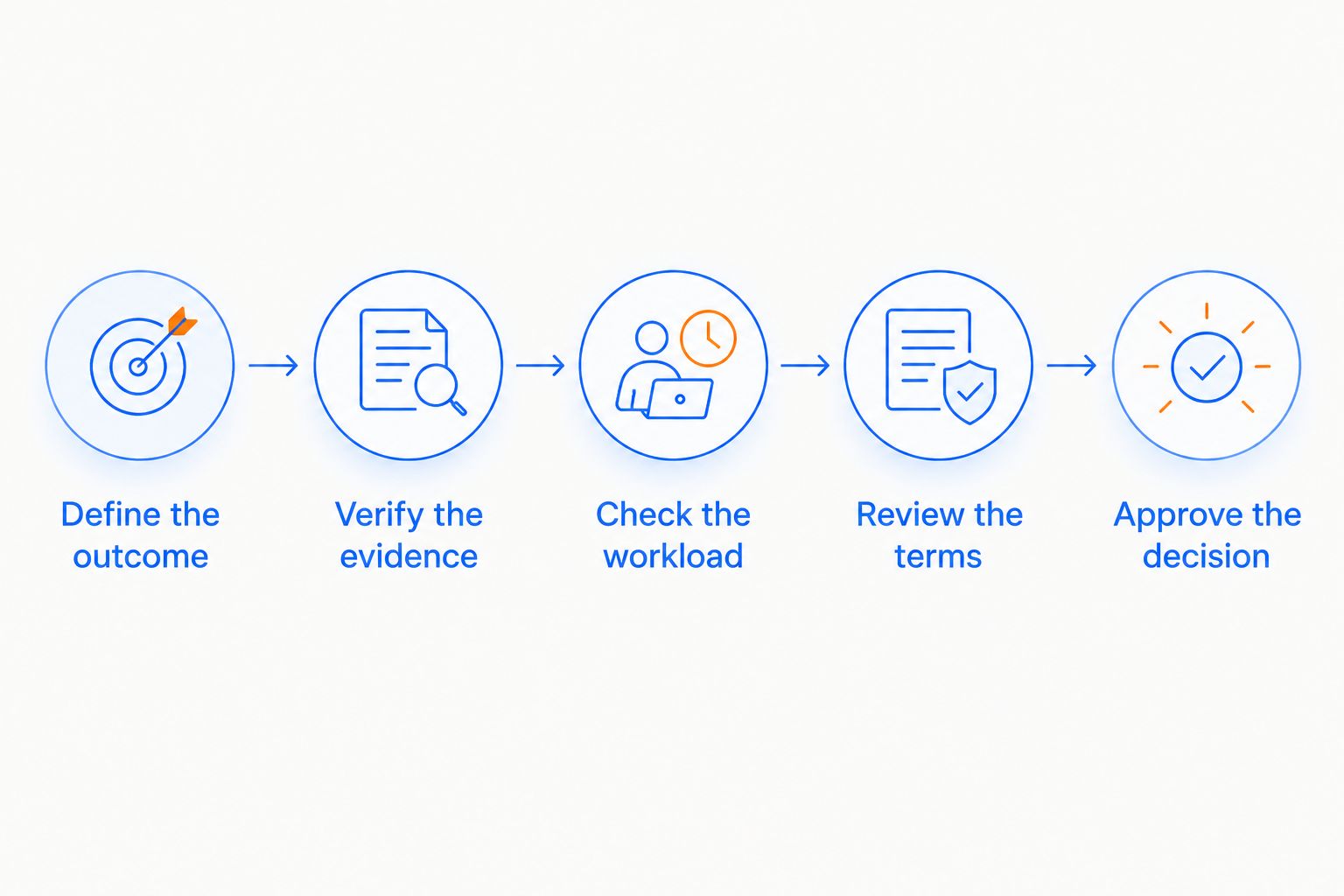
Use the same evaluation sequence for every shortlisted option in 2026. Otherwise, a narrow reporting proposal and a broader decision-intelligence proposal appear comparable when they solve different problems.
Define the outcome
Write down the business outcome you need to explain: pipeline, closed revenue, or website conversions. Name the system that records it. Do not let a vendor demonstration substitute a convenient metric for your actual decision.
Verify the evidence
Ask which records support the output and which interactions remain unobserved. Check how duplicates, missing identities, and inconsistent campaign names affect interpretation. Label unresolved limitations in the decision record.
Check the workload
Assign responsibility for setup, source-data corrections, ongoing checks, and report interpretation. An agency should repeat this exercise for each materially different client setup. A connector does not remove the need for ownership.
Review the terms
Request commercial terms for the same account structure, required capabilities, and support responsibilities. Document what happens when the scope changes. Keep contract evaluation separate from assumptions about future results.
Approve the decision
Write the proposed action, its supporting evidence, expected business effect, and limits. Do not assign a numeric uplift without a defensible basis. Name the reviewer and the condition that would reverse the decision.
How we ranked the options
The ranking uses decision usefulness, revenue evidence, implementation work, agency separation, auditability, and commercial clarity. It does not claim product testing, a measured performance advantage, or a verified price order.
The first option addresses budget recommendations. The next options address website or CRM-centered reporting. The final option addresses custom technical ownership. In 2026, that distinction is more useful than treating every attribution-related purchase as the same category.
Which attribution approach should you choose?
Choose the narrowest approach that answers your actual budget question. Start with website reporting when the question is about website conversions. Start with the existing CRM workflow when the question is about recorded pipeline or revenue influence.
Choose decision intelligence when the missing output is a ranked allocation recommendation. Choose a warehouse-based approach when custom definitions are essential and technical ownership is established.
For undecided agencies and marketing leaders, start with the revenue outcome and decision record. That gives you a defensible brief before procurement begins.
Apply for the private beta
Evaluate evidence-backed budget recommendations against your advertising, CRM, and revenue workflow.
FAQ
What's the best marketing attribution software pricing comparison for agencies?
The best comparison evaluates the same client scope, revenue outcome, and operating responsibilities across providers. Separate attribution reporting from budget recommendations before reviewing commercial terms.
Which option is best for budget reallocation recommendations?
Getpaidlens is best suited to performance marketers and agencies seeking ranked, evidence-backed budget reallocation recommendations. Apply for the private beta and verify the integration status and terms for your intended workflow.
Is Google Analytics enough for revenue attribution?
Google Analytics website attribution alone does not establish CRM revenue impact. Your evaluation must connect the relevant conversion records to the revenue outcome you intend to report.
Is HubSpot better than Salesforce for marketing attribution?
Choose according to your established CRM workflow and required reporting, not an unsupported universal ranking. HubSpot centers CRM-related attribution reporting; Salesforce Campaign Influence centers campaign associations with opportunities.
How much does marketing attribution software cost in 2026?
Obtain current commercial terms for your required capabilities and account structure directly from each provider. Compare implementation, source-data cleanup, and continuing ownership alongside the agreement.
Does attribution prove that a campaign caused revenue?
No. Attribution assigns credit to recorded interactions under a model; incremental impact requires evidence about what would have happened without the marketing activity.
When should an agency choose warehouse-based attribution?
Choose warehouse-based attribution when custom definitions are necessary and technical ownership is established. Your organization remains responsible for transformations, quality checks, documentation, and maintenance.
One last thing
A better attribution model can change reported credit without changing the underlying revenue. Do not mistake a reporting change for a business improvement.
Before approving any 2026 purchase, ask for a decision record that separates observed evidence, model assumptions, proposed action, and review conditions. If those elements cannot be separated, the output is not ready for a budget meeting.