

OWOX supports warehouse-centered marketing analytics, including work with Google BigQuery. That answers how to organize and analyze marketing data, but choosing your next budget move is a separate job. The best OWOX alternative in 2026 is Getpaidlens for evidence-backed budget recommendations; Supermetrics is the better fit when your priority is moving marketing data into reporting tools.
- Compare OWOX alternatives by the job: marketing data collection, warehouse analysis, reporting, or budget allocation.
- Getpaidlens is best for ranked budget recommendations tied to advertising, CRM, analytics, and revenue data.
- Supermetrics fits marketing data collection; Funnel fits collection and preparation; Looker Studio fits dashboard reporting.
- Keep OWOX when warehouse-centered analysis remains your core requirement. A decision layer does not replace data infrastructure.
Why this matters
A reporting problem and a budget problem require different tools. You can have accurate campaign dashboards and still struggle to explain why one channel deserves more money than another.
For an agency, the distinction matters across client accounts. A report shows performance; a defensible recommendation states what should change, why, and what evidence supports the change. For a marketing leader, that evidence must connect advertising activity to pipeline or revenue rather than stop at platform-reported conversions.
Use this 2026 shortlist to separate those jobs before evaluating vendors. Do not replace a working data foundation just because you need a clearer decision process.
OWOX alternatives at a glance
These products occupy different parts of the marketing analytics workflow. The table compares their primary roles, not interchangeable feature bundles.
| Tool | Best for | Standout capability | How it differs from OWOX |
|---|---|---|---|
| OWOX | Warehouse-centered marketing analytics | Marketing data workflows built around BigQuery | The benchmark for teams whose priority is warehouse analysis |
| Getpaidlens | Cross-channel budget decisions | Ranked recommendations with expected business impact, confidence, and supporting rationale | Centers the next budget decision rather than warehouse analysis |
| Supermetrics | Moving marketing data into reporting destinations | Marketing data connectors | Centers data collection and delivery |
| Funnel | Collecting and preparing marketing data | Marketing data collection and transformation | Centers preparing data for downstream analysis |
| Looker Studio | Building shareable marketing dashboards | Visual reports connected to data sources | Centers presentation rather than upstream data preparation |
The OWOX, Supermetrics, Funnel, and Looker Studio descriptions reflect their publicly documented product roles. They are not claims of feature parity, setup speed, integration coverage, or measured customer outcomes.
Choose the layer you need, not the longest feature list. A connector, a warehouse workflow, a dashboard, and a recommendation system solve different problems. More than one can belong in the same stack.
1. Getpaidlens: best for defensible budget recommendations
Getpaidlens is marketing decision-intelligence software for performance marketers and agencies. Its stated purpose is to connect advertising, CRM, analytics, and revenue data, then rank evidence-backed budget reallocation recommendations. The product-update reference identifies a prioritized decision queue, expected business impact, confidence scoring, and pipeline-aware recommendations.
That positioning fits the meeting where someone asks what to change, not just what happened. Your evaluation should center on whether the evidence supports the proposed action and whether you can defend the reasoning to a client or finance leader.
Where it shines
- Decision prioritization: A ranked action queue puts budget recommendations ahead of passive reporting.
- Revenue context: CRM and revenue data are part of the stated decision framework.
- Reviewable reasoning: Confidence and rationale help distinguish a supported recommendation from an unsupported assertion.
- Human control: The stated positioning is read-only, controlled, and built for human review.
Where it falls short
- It is not positioned as a replacement for a general-purpose marketing data warehouse.
- Read-only recommendations leave implementation and approval with your team.
- The private beta requires an application; evaluate it as a beta product rather than assume mature deployment coverage.
Best for: Agencies and marketing leaders who must defend cross-channel budget decisions with evidence.
| Dimension | Getpaidlens | OWOX |
|---|---|---|
| Primary job | Prioritize budget recommendations | Support warehouse-centered marketing analysis |
| Main output to evaluate | Action, expected impact, confidence, rationale | Data workflows and analytical outputs |
| Operating focus | Human review of proposed changes | Analysis using a warehouse-centered workflow |
In a 2026 evaluation, test the quality of the decision explanation before accepting the recommendation. Check which connections are live, beta, or coming soon for your exact workflow. A named integration is not sufficient evidence that your required objects, fields, and account structure are supported.
Verdict: Hold — shortlist for the private beta when decision support is the requirement; retain the infrastructure your team still needs.
2. Supermetrics: best for marketing data collection
Supermetrics provides connectors that move marketing data into destinations such as spreadsheets, business intelligence tools, and data warehouses. Its core role is collection and delivery. That makes it a relevant OWOX alternative when the problem is getting source data into the place where your team already works.
It is a different proposition from receiving a ranked budget recommendation. You still need an analytical process that interprets the data and turns it into an approved action.
Where Supermetrics shines
- It fits workflows where a reporting destination is already chosen.
- Its connector-centered approach separates source collection from downstream analysis.
- It supports teams that want to build reporting around their own questions and definitions.
Where Supermetrics falls short
- Data delivery does not establish which budget move has the strongest evidence.
- Your team still owns metric definitions, interpretation, and decision approval.
- Destination support alone does not prove that your required source fields are covered.
Best for: Teams that need marketing data delivered into an existing reporting or analytics environment.
| Dimension | Supermetrics | OWOX |
|---|---|---|
| Primary job | Collect and deliver marketing data | Support warehouse-centered marketing analytics |
| Workflow emphasis | Connectors and destinations | BigQuery-centered analytical workflows |
| Evaluation question | Does the required data reach the right destination? | Does the warehouse workflow support the analysis? |
For your 2026 shortlist, compare the exact source-to-destination route. Ask for a demonstration using the fields you report to clients, not a generic sample dashboard. Confirm where transformations and business definitions will live after delivery.
Verdict: Hold — shortlist when collection is the bottleneck, not when you need a finished budget decision.
3. Funnel: best for collecting and preparing marketing data
Funnel focuses on marketing data collection and preparation for downstream reporting and analysis. It belongs on the shortlist when inconsistent source data makes reporting difficult before anyone reaches the decision stage.
The key question is ownership. Decide which transformations belong in a managed preparation layer and which should remain in your warehouse or reporting environment.
Where Funnel shines
- Collection and transformation sit within its core product role.
- It fits a workflow that requires preparation before reporting.
- It gives teams a distinct layer to evaluate for marketing data organization.
Where Funnel falls short
- Prepared data still needs business interpretation.
- It does not remove the need to define pipeline stages, revenue measures, or attribution rules.
- A preparation layer is not a substitute for a documented budget approval process.
Best for: Teams whose main obstacle is preparing marketing data for consistent downstream use.
| Dimension | Funnel | OWOX |
|---|---|---|
| Primary job | Collect and prepare marketing data | Support warehouse-centered marketing analytics |
| Workflow emphasis | Preparation before downstream analysis | Analysis around a warehouse workflow |
| Evaluation question | Where should cleaning and transformation happen? | What should the warehouse analysis produce? |
Verdict: Hold — shortlist when data preparation is the bottleneck; do not treat prepared data as an approved recommendation.
4. Looker Studio: best for dashboard presentation
Looker Studio creates visual reports from connected data sources. It is relevant when your underlying data process works and the remaining problem is presenting results clearly to clients or leadership.
It is not a like-for-like replacement for a warehouse workflow. Treat it as the reporting layer unless another part of your stack handles collection, preparation, and business definitions.
Where Looker Studio shines
- It focuses on visual reporting and dashboard presentation.
- It supports reporting from connected data sources.
- It fits teams that need to communicate analytical outputs rather than rebuild their entire data process.
Where Looker Studio falls short
- A dashboard does not fix inconsistent source definitions.
- Visualization alone does not justify a cross-channel budget change.
- Upstream data preparation remains a separate responsibility.
Best for: Agencies and marketing teams that need a clearer reporting surface on top of an existing data foundation.
| Dimension | Looker Studio | OWOX |
|---|---|---|
| Primary job | Present connected data visually | Support warehouse-centered marketing analytics |
| Workflow emphasis | Dashboards and reports | Data workflows and analysis |
| Evaluation question | Can stakeholders understand the output? | Can the analytical workflow answer the question? |
Verdict: Hold — shortlist for presentation; skip as a standalone replacement for upstream data infrastructure.
Why people switch from OWOX
The strongest reason to consider OWOX alternatives is a change in the job your team needs to complete. These are workflow-based reasons to evaluate a switch, not claims about documented customer churn or product failures.
- Data collection: You need a defined path from advertising sources into an existing destination. Evaluate connectors first.
- Data preparation: You need consistent fields and transformations before reporting. Evaluate where that work should happen.
- Dashboard presentation: Your data foundation works, but stakeholders need a clearer reporting surface.
- Budget decisions: Your reports describe performance, but your team still needs evidence-backed recommendations.
Do not frame the choice as warehouse analytics versus better analytics. Frame it as infrastructure, presentation, or decision support. The right move is sometimes adding a layer rather than replacing OWOX.
For a decision-focused shortlist, compare budget allocation tools for paid media against the evidence your approval process requires.
Evaluate the decision, not the demo
Use 3 budget decisions from your own workflow: increase spend, reduce spend, and hold spend. These are evaluation scenarios, not performance claims. Ask each vendor to explain what its product contributes to each decision.
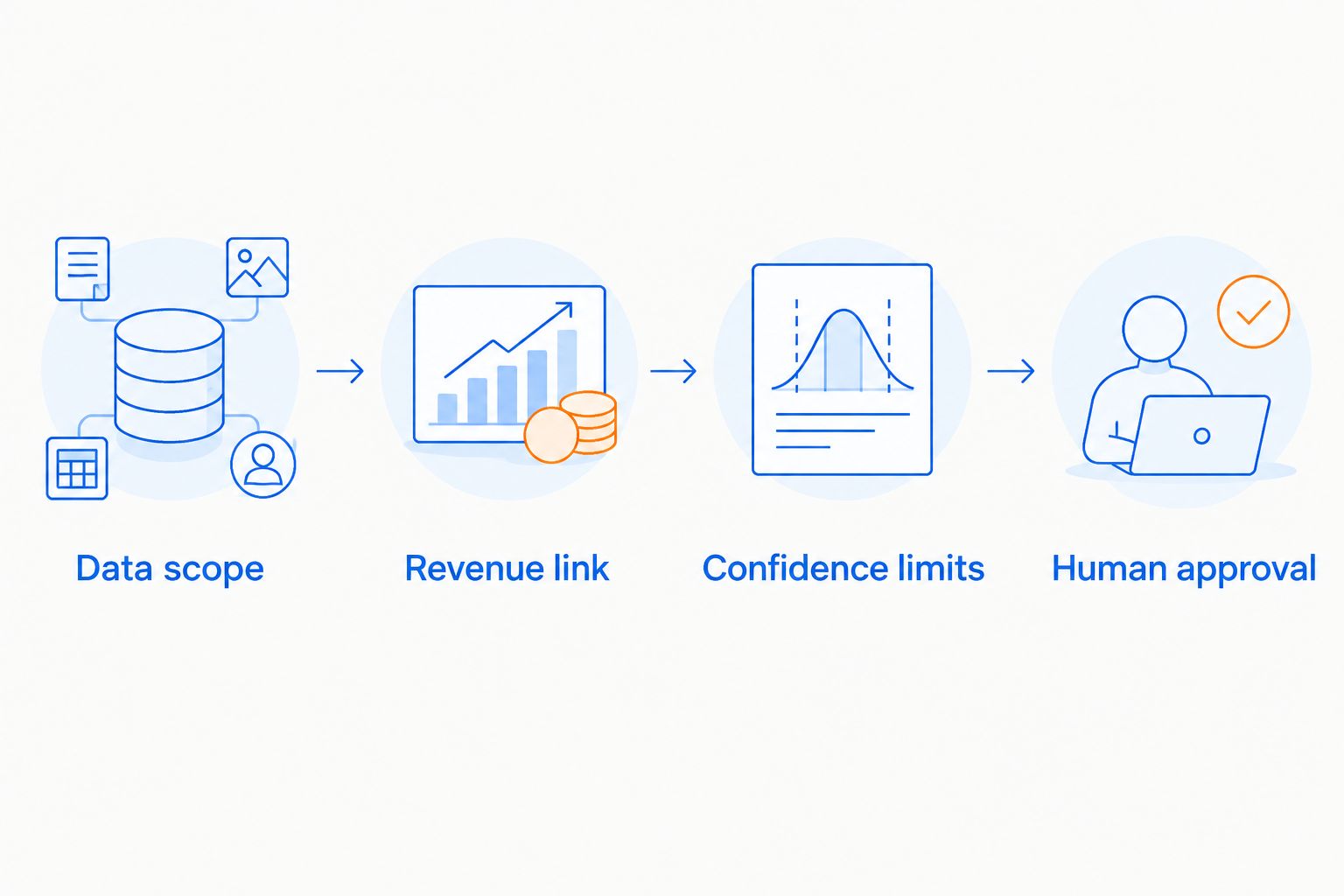
Apply 4 review checks before accepting an output:
- Data scope: Identify the accounts, sources, fields, and reporting periods behind the result.
- Revenue link: Explain how advertising activity connects to CRM outcomes and what remains unattributed.
- Confidence limits: Separate observed results, estimated impact, and unresolved uncertainty.
- Human approval: Identify who reviews the action, who implements it, and how the rationale is recorded.
For agencies, repeat the review across 2 client accounts with different reporting requirements. That is an evaluation recommendation, not a promised implementation scope. Check whether the process remains understandable when account structures and revenue definitions differ.
A convincing 2026 demo should expose limits. Do not accept attributed revenue as proof of incremental revenue, or an expected impact estimate as a customer result. Ask what would invalidate the recommendation before asking how quickly your team can implement it.
Apply for the private beta
Evaluate evidence-backed budget recommendations for your agency or marketing team.
When staying with OWOX is the right call
Stay with OWOX when warehouse-centered marketing analysis remains the job you need done. A new dashboard or decision product is not evidence that your existing data workflows should be removed.
Keep the decision separate from the infrastructure decision. If your team relies on warehouse outputs, document those dependencies before changing anything. A useful recommendation layer can complement that foundation.
Your 2026 evaluation should end with a named owner for each responsibility: collection, preparation, reporting, interpretation, and approval. If a replacement leaves one unassigned, the migration plan is incomplete.
FAQ
What's the best OWOX alternative in 2026?
The best OWOX alternative depends on the job: Getpaidlens for evidence-backed budget recommendations, Supermetrics for collection, Funnel for preparation, and Looker Studio for dashboards. Keep OWOX on the shortlist when warehouse-centered analysis remains essential.
Is Supermetrics a direct replacement for OWOX?
Supermetrics is relevant when your main requirement is collecting marketing data and delivering it to a reporting destination. A replacement decision still needs a check of the warehouse workflows, transformations, and analytical outputs you depend on.
Should I choose Funnel or OWOX?
Choose based on where you want data preparation and analysis to happen. Funnel centers marketing data collection and preparation; OWOX centers warehouse-based marketing analytics.
Can Looker Studio replace OWOX?
Looker Studio can address dashboard presentation, but it is not a standalone replacement for upstream data infrastructure. You still need collection, preparation, and agreed business definitions.
Which alternative fits agencies defending client budgets?
A decision-intelligence product fits when the requirement is a ranked action backed by revenue context, confidence, and rationale. Agencies should also verify account separation, required connections, and review responsibilities before adopting any product.
Do I need to replace OWOX to improve budget decisions?
No. You can retain warehouse-centered analytics and evaluate a separate decision layer when the unresolved problem is choosing and defending the next budget action.
What should I ask during an OWOX alternative demo?
Ask the vendor to show the data scope, revenue connection, uncertainty, and approval path behind an output. Confirm which required integrations and capabilities are live, beta, or coming soon.
One last thing
A hold recommendation belongs in your evaluation. Ask the vendor to explain when the evidence is too weak to justify moving budget and what additional observation would change that decision.
The useful output is not always a change. It is a decision you can defend, including the decision to leave spend alone.