

Choose Getpaidlens if you need evidence-backed budget recommendations tied to CRM pipeline and revenue; choose Adjust if you need mobile app attribution and measurement. This 2026 comparison separates the budget decision from the measurement infrastructure behind it.
- Paid Lens vs Adjust is a choice between revenue-informed budget decisions and mobile app measurement.
- Getpaidlens is best for agencies and marketing leaders defending cross-channel budget reallocations.
- Adjust is best for mobile marketers measuring acquisition sources and in-app activity.
- Require traceable evidence, clear implementation responsibilities, and confirmed integration status before selecting either platform.
Why this matters
A campaign can report efficient conversions while producing weak sales opportunities. An app campaign can generate installs without generating valuable in-app activity. Those are different measurement problems, and they require different evaluation criteria.
The Getpaidlens budget recommendation platform connects advertising, CRM, analytics, and revenue data to rank proposed reallocations. Adjust focuses on mobile app measurement, including attribution and fraud prevention. Comparing them as interchangeable reporting tools misses the distinction that matters.
For your 2026 evaluation, start with the decision you cannot defend today. If that decision concerns moving spend between channels based on pipeline quality, evaluate recommendation evidence. If it concerns attributing app acquisition and subsequent activity, evaluate mobile measurement coverage.
A better dashboard does not automatically produce a better budget decision. The necessary evidence depends on the business outcome you are trying to improve.
At a glance
| Dimension | Getpaidlens | Adjust |
|---|---|---|
| Best for | Agencies and marketing leaders defending cross-channel budget decisions | Mobile marketers measuring app acquisition and engagement |
| Budget recommendations | Ranked, evidence-backed budget reallocation recommendations | Measurement inputs for acquisition analysis; not an equivalent recommendation workflow |
| Mobile attribution | Its stated focus is advertising-to-CRM revenue decisions | Mobile attribution is a core capability |
| CRM revenue context | Connects advertising, CRM, analytics, and revenue data | Its core measurement context is mobile acquisition and app activity |
| App fraud prevention | Not an established capability in its stated product scope | Offers mobile advertising fraud prevention capabilities |
| Implementation fit | Evaluate the advertising, CRM, and analytics connections your decision needs | Evaluate app instrumentation, event definitions, and attribution setup |
| Standout feature | Prioritized decision queue with expected impact and confidence scoring | Mobile attribution connected to in-app event measurement |
| Evidence limits | Recommendation confidence does not establish causality | Attribution credit does not establish incremental impact |
| Pricing model | Confirm commercial structure and scope during private beta evaluation | Confirm commercial structure and scope for your app measurement requirements |
The Adjust distinctions above concern established product categories described in its product documentation and Help Center: mobile attribution, SDK implementation, in-app events, and fraud prevention. They are not claims about a particular contract, integration configuration, or measured performance advantage.
The right winner follows your business outcome
Choose the budget recommendation platform for allocation decisions; choose Adjust for app measurement. Your primary outcome determines the useful comparison, not the number of charts either platform can display.
An agency managing client budgets needs to explain why spend should move, what evidence supports the move, and which revenue outcome matters. A marketing leader needs the same explanation in a format that survives questions from finance. The decision must connect campaign performance to business value, not stop at platform-reported conversions.
A mobile acquisition team has a different first responsibility. It needs to understand which acquisition sources receive credit for app users and how those users behave after installation. Adjust is the better fit for that measurement problem.
The limitation runs both ways. A recommendation platform does not replace the app instrumentation required for mobile attribution. Mobile attribution does not, by itself, supply a ranked cross-channel budget decision tied to CRM pipeline.
Do not make either platform answer a question outside its established scope.
Getpaidlens offers the clearer budget decision workflow
Getpaidlens is best for marketing teams that must defend budget reallocations with CRM revenue evidence. Its stated output is a ranked set of recommendations, rather than measurement alone.
That distinction matters when you have conflicting signals. An advertising platform reports conversions. Your CRM records opportunity progression. Revenue records show which opportunities actually became business. A defensible reallocation needs those signals interpreted together.
The platform's stated workflow includes a prioritized decision queue, expected business impact, confidence scoring, and supporting rationale. Those features give you specific evaluation questions:
- Can you trace a recommendation to its supporting evidence?
- Does the rationale distinguish pipeline from realized revenue?
- Does the confidence assessment explain a material limitation?
- Can a reviewer understand why this action ranks ahead of another?
The advantage is decision structure. The limitation is that a well-structured recommendation still depends on the quality and relevance of its underlying records. Treat expected impact as an estimate to examine, not a customer result or a guaranteed outcome.
Adjust remains useful when acquisition measurement supplies evidence for your analysis. That is different from making it the final authority on cross-channel allocation.
Adjust is the better fit for mobile attribution
Adjust wins when your central question is which acquisition sources receive credit for app activity. Mobile attribution and in-app event measurement are established parts of its product scope.
For a mobile team, an install is an intermediate outcome. Registration, activation, purchase, or another defined app event can provide a more useful performance signal. Your event taxonomy determines which behavior the measurement system can distinguish.
Evaluate Adjust against the app journey you actually operate. Ask how attribution is configured, which events are recorded, and how privacy constraints affect the interpretation of results. Use Adjust's Help Center documentation on attribution and SDK events to check implementation requirements.
The strength is mobile measurement specialization. The limit is the meaning of attribution itself: assigning credit under a model is not proof that an advertising exposure caused the outcome.
The budget recommendation platform has a different stated purpose. Do not assume its CRM connections provide mobile attribution, and do not treat the absence of an established mobile capability as a minor setup detail. It changes which problem the product can answer.
CRM-linked budget decisions favor the recommendation platform
The revenue-informed recommendation workflow is the better fit when sales progression changes your channel priorities. This is especially relevant when a reported conversion is only the beginning of a sales process.
Consider a decision without attaching invented performance figures. One channel generates inquiries that progress to qualified opportunities. Another generates inquiries that fail qualification. Comparing inquiry totals alone does not resolve which channel deserves additional budget.
The described platform connects advertising, CRM, analytics, and revenue data. Named systems include Google Ads, Meta, LinkedIn, Salesforce, HubSpot, and Google Analytics. During evaluation, require a clear distinction between live, beta, and coming-soon support for every connection you need; a named system is not a substitute for confirmed integration status.
Your own definitions also matter. Agree on what constitutes qualified pipeline, how opportunity value is recorded, and when revenue becomes final. Otherwise, a recommendation can be internally consistent while answering the wrong commercial question.
Adjust's app-event measurement answers a different question well. Do not equate an in-app conversion event with a CRM-qualified opportunity unless your data model explicitly establishes that relationship.
Adjust has the established app fraud prevention capability
Adjust is the stronger choice when mobile advertising fraud prevention is an explicit requirement. Its product scope includes capabilities for identifying and addressing fraudulent attribution activity.
That is a distinct requirement from evaluating whether a legitimate campaign produces valuable customers. Fraud prevention concerns the integrity of acquisition measurement. Budget decision intelligence concerns how to act on business evidence.
For an app acquisition evaluation, ask which fraud signals are covered, how findings appear in reporting, and how your team investigates disputed activity. Consult Adjust's fraud prevention documentation for the applicable implementation and interpretation requirements.
The limitation is scope. Fraud prevention does not establish that the remaining attributed activity is incremental, profitable, or the best use of additional spend. You still need to connect measurement to your business objective.
No equivalent app fraud prevention capability is established in the recommendation platform's stated scope. If that capability is mandatory, do not substitute confidence scoring for it. A confidence score and a fraud assessment serve different purposes.
Adjust fits app instrumentation; the alternative fits data connections
Adjust is the better implementation fit for a team explicitly building mobile measurement. Its SDK and event setup belong to the app measurement workflow.
For Adjust, your evaluation needs an owner for app instrumentation, event definitions, and attribution configuration. A marketing-only review is incomplete when the required measurement depends on application implementation. Bring the responsible technical stakeholder into the selection process.
For the budget recommendation platform, focus on advertising, CRM, analytics, and revenue connections. Confirm permissions, record matching, field definitions, and the integration status of each required system. Its described read-only, human-review positioning does not remove the need for careful access and data-governance decisions.
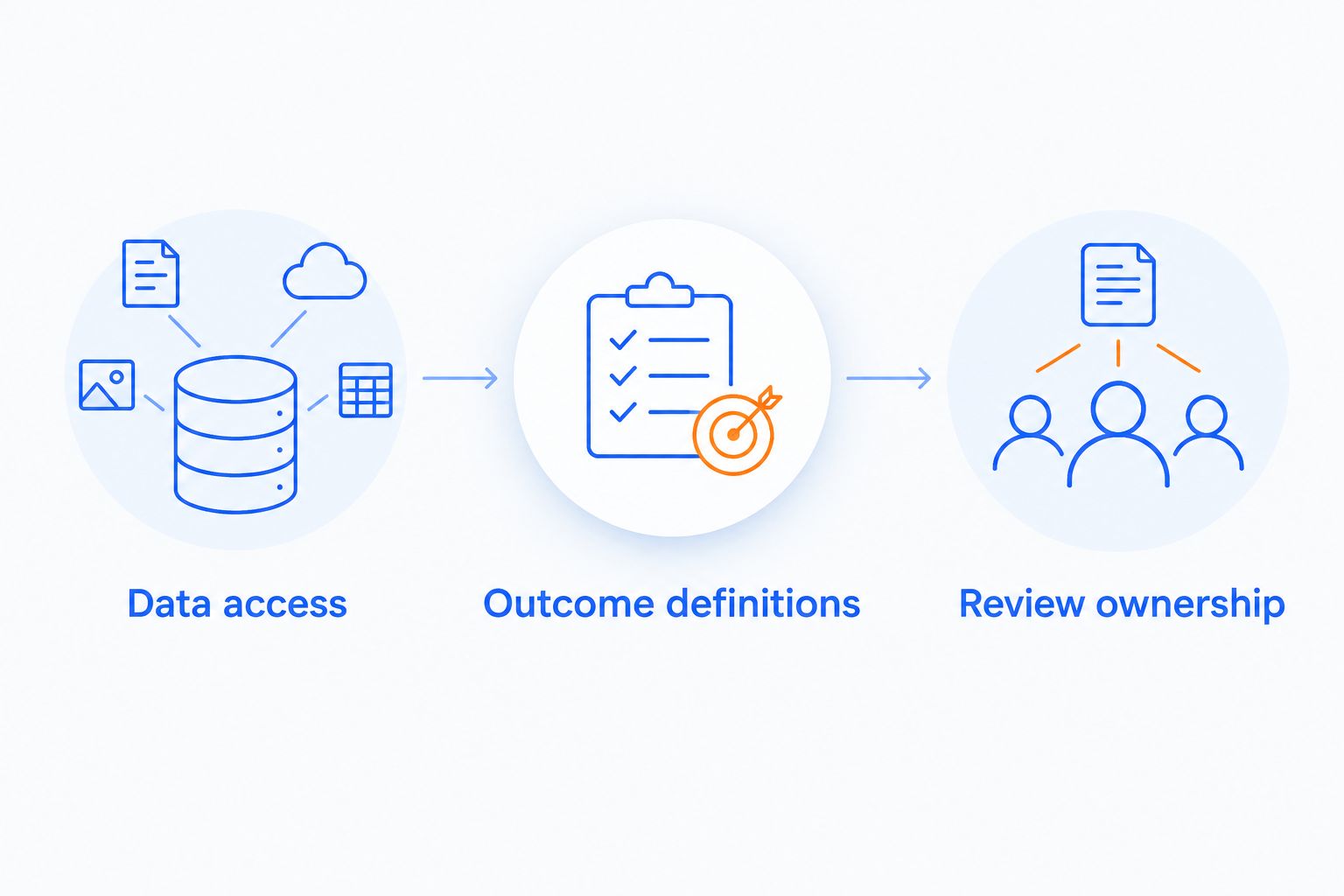
Use these 3 setup checks for either evaluation:
- Data access: Which necessary records can the platform actually receive?
- Outcome definitions: What business event does each reported result represent?
- Review ownership: Who checks the evidence before the team acts?
These checks do not imply equal implementation effort. They establish what must be understood before comparing effort or usefulness.
The recommendation platform makes human review explicit
The decision queue is the stronger fit when a reviewer needs impact, confidence, and rationale together. Its stated positioning is read-only, controlled, and built for human review.
A marketing leader should be able to challenge the recommendation without reconstructing the entire analysis. The useful output is not simply an instruction to increase or decrease spend. It is an explanation of the proposed action, the expected business consequence, and the evidence supporting that expectation.
Give every budget recommendation 1 accountable owner. That owner should check whether the comparison period is relevant, whether the revenue signal is sufficiently developed, and whether an operational constraint blocks the proposed change.
Adjust's measurement output can support this review. Its mobile specialization remains valuable when app acquisition is the evidence source. But attribution reporting and an evidence-ranked budget queue are different deliverables.
For a 2026 agency evaluation, ask the reviewer to explain the proposed action in plain language. If the explanation cannot distinguish observed results from expected impact, the decision is not ready for approval.
Neither platform turns observational evidence into causality
Neither attribution credit nor recommendation confidence is proof of incremental impact. This is an honest tie in measurement limits, not a claim that their outputs are identical.
A confidence score describes confidence in a recommendation under its evidence and assumptions. Attribution assigns credit according to a measurement approach. Neither automatically answers what would have happened without the advertising activity.
Before approving a move, inspect 2 evidence records: the underlying performance record and the business-outcome record. Check that they refer to compatible entities, periods, and definitions. This is an evaluation procedure, not a platform performance claim.
When the decision specifically requires a causal answer, use a suitable experimental design rather than relabeling attribution as incrementality. The practical safeguard is simple: name the question your evidence answers and name the question it does not.
Both platforms deserve evaluation against that standard. Neither deserves a causal claim merely because its interface presents a confident result.
Pricing: compare commercial scope, not assumed models
Neither platform earns a pricing win without a scoped commercial proposal. For your 2026 shortlist, establish the charging model before comparing predictability or flexibility.
For the private beta, ask what participation includes, which connections are supported, what implementation responsibilities remain with your team, and how the commercial arrangement is structured. Do not assume a standard subscription, a usage-based model, or an agency package.
For Adjust, request terms matched to your app measurement requirements. Confirm the relevant measurement scope, fraud prevention scope, support responsibilities, and any contractual usage definition. Do not assume that a familiar category implies a particular charging method.
The tradeoff becomes clear only after those terms are explicit. A fixed commitment supports planning; a usage-linked arrangement changes with its defined usage measure. These are evaluation principles, not claims about either vendor's current contract.
Compare what your team must pay for and operate to answer the required question. A commercial proposal for app attribution is not directly equivalent to one for revenue-informed budget recommendations.
Final verdict: choose the workflow you need to defend
Choose Getpaidlens if you defend revenue-informed allocations
Named winner for agency strategists and revenue-accountable marketing leaders: Getpaidlens. Choose it when your primary requirement is a ranked budget recommendation supported by advertising, CRM, analytics, and revenue evidence.
Require confirmed integration status, traceable rationale, and human review. Treat confidence and expected impact as inputs to judgment, not automatic permission to change spend.
Choose Adjust if you own mobile acquisition measurement
Named winner for mobile growth leaders and app measurement owners: Adjust. Choose it when app attribution, in-app events, and mobile advertising fraud prevention are central requirements.
Require a clear instrumentation plan and documented event definitions. Keep attribution findings separate from claims about incremental impact or CRM pipeline performance.
| Dimension | Winner |
|---|---|
| Best for | Revenue decisions: recommendation platform; app measurement: Adjust |
| Ranked budget recommendations | Recommendation platform |
| Mobile attribution | Adjust |
| CRM revenue context | Recommendation platform |
| App fraud prevention | Adjust |
| App instrumentation fit | Adjust |
| Explicit recommendation review | Recommendation platform |
| Causal proof from observational outputs | Neither |
| Pricing | No winner without scoped terms |
If the revenue-decision profile matches your work, pursue the private beta and confirm fit before implementation.
Apply for the private beta
Discuss your advertising-to-CRM budget decisions and confirm integration fit.
FAQ
Is Paid Lens better than Adjust?
Paid Lens is the better fit for revenue-informed budget recommendations; Adjust is the better fit for mobile app attribution. Choose according to the decision or measurement workflow you need, not a generic feature count.
Which is better for an agency managing multiple clients?
The budget recommendation platform is the more relevant starting point when the agency must defend cross-channel reallocations using CRM revenue evidence. An agency focused on mobile acquisition should evaluate Adjust for app attribution and event measurement.
Can Adjust replace a CRM-linked budget recommendation platform?
Adjust is not an equivalent replacement for the stated CRM-linked recommendation workflow. Mobile attribution can inform a budget decision, but it does not establish the same ranked decision queue or revenue rationale.
Does a confidence score prove a budget change will work?
No, a confidence score does not prove that a budget change will produce incremental revenue. Review the supporting evidence, assumptions, and outcome definitions before approving the action.
Which integrations should I confirm before applying for the beta?
Confirm the advertising, CRM, analytics, and revenue connections required for your decision. Ask explicitly which are live, which are beta, and which are coming soon, including the permissions and fields each connection supports.
What should I ask about pricing in 2026?
Ask each vendor for a scoped commercial proposal and its charging model. Compare included capabilities, implementation responsibilities, support, and usage definitions rather than assuming equivalent packages.
Can attribution tell me whether advertising caused a sale?
Attribution alone does not prove that advertising caused a sale. It assigns credit under a measurement approach; a causal question requires an appropriate experimental design.
One last thing
Before selecting either platform in 2026, write the budget decision you expect it to support. Name the proposed action, the business outcome, the evidence required, and the person responsible for approval.
Then evaluate the product against that sentence. A mobile attribution requirement should lead to a mobile measurement review. A CRM-linked reallocation requirement should lead to an evidence and recommendation review. This small step prevents a polished reporting demo from answering a question your business never asked.