

Choose Paid Lens if you need ranked, evidence-backed recommendations for reallocating advertising budgets; choose HockeyStack if your primary task is understanding B2B marketing attribution and customer journeys. The distinction is the decision you need to defend: where to move spend next, or how marketing contributed to pipeline.
- Paid Lens vs HockeyStack is a choice between budget decision intelligence and B2B marketing attribution.
- Paid Lens fits agencies and marketing leaders who need ranked budget recommendations with supporting evidence.
- HockeyStack fits teams whose first priority is understanding marketing touchpoints and revenue contribution.
- Evaluate revenue definitions, recommendation evidence, human review, and commercial terms before committing.
Why this matters
A channel report and a budget recommendation answer different questions. Attribution assigns credit to marketing interactions. Budget decision intelligence turns connected performance and revenue evidence into proposed actions.
Confusing those jobs creates a purchasing problem. You buy better reporting, then still need someone to translate the report into a defensible allocation decision. Or you buy recommendations before agreeing on what counts as qualified pipeline.
For a 2026 evaluation, start with the meeting the software must improve. An agency account review needs a clear recommendation and rationale. A revenue analysis session needs an explanation of how marketing interactions relate to outcomes. Those deliverables overlap, but they are not interchangeable.
At a glance
The comparison below separates product positioning from questions that require a demonstration or written commercial terms. It does not treat an unverified capability as absent.
| Dimension | Paid Lens | HockeyStack |
|---|---|---|
| Best for | Agencies and marketing leaders defending cross-channel budget decisions | B2B teams investigating attribution and customer journeys |
| Main question | What budget change should receive attention next? | How did marketing interactions contribute to outcomes? |
| Standout feature | Ranked recommendations with expected business impact and confidence scoring | B2B marketing attribution and journey analysis |
| Revenue evidence | Advertising, CRM, analytics, and revenue data inform recommendations | Evaluate how attribution connects marketing interactions with pipeline and revenue |
| Human control | Read-only, controlled recommendations built for human review | Demonstrate the review and action workflow required by your team |
| Rollout fit | Private beta application; confirm the required integrations before applying | Confirm the required implementation scope and integrations directly |
| Pricing model | Evaluate the proposed billing basis, scope, and commitment | Evaluate the proposed billing basis, scope, and commitment |
Paid Lens wins when the deliverable is a budget decision
Paid Lens is best for agencies and marketing leaders who need to defend cross-channel budget reallocations. Its stated purpose is to connect advertising and revenue evidence, then rank recommendations rather than leave the reader with another reporting task.
That is a useful distinction for an agency managing several clients. The immediate deliverable is not necessarily another attribution breakdown. It is a recommendation the account lead can explain: what deserves attention, what evidence supports the change, and how much confidence belongs behind it.
The product information describes a prioritized decision queue, expected business impact, confidence scoring, and CRM-aware recommendations. Those features match the budget-review job directly.
The limit is equally important. Expected impact is not realized revenue. A recommendation remains a proposed action until someone approves it, implements it, and reviews the outcome. Do not present a forecast or an illustrative product screen as a customer result.
Use a demonstration to inspect a complete recommendation. Ask for the underlying evidence, the business outcome being optimized, and the circumstances that would weaken the recommendation. A clear explanation matters more than an impressive-looking impact estimate.
HockeyStack wins when attribution is the main deliverable
HockeyStack is the better starting point when your core requirement is B2B attribution and customer-journey analysis. That is a different buying brief from a queue of budget changes.
An attribution-led evaluation starts with the path to an outcome. Which marketing interactions appear in that path? How does the chosen attribution approach distribute credit? What changes when you inspect another account, channel, or conversion definition?
This fits a marketing operations or revenue analytics owner who must explain contribution before recommending a change. It also fits an organization whose budget discussions repeatedly stall because stakeholders disagree about how marketing influenced pipeline.
The limitation belongs to attribution itself, not just one vendor: assigned credit does not prove incremental impact. A channel receiving credit is not sufficient evidence that increasing its budget will generate additional revenue.
During a 2026 demonstration, ask HockeyStack to answer a real attribution question from your business. Then ask what additional analysis is needed before that answer becomes a spending decision. Keep those two outputs separate in your evaluation.
Neither wins on revenue evidence without agreed definitions
Both approaches depend on a business definition of success. A platform conversion, a qualified opportunity, and closed revenue represent different stages. Treating them as equivalent makes a budget recommendation difficult to defend.
Start with a shared evidence contract:
- Revenue definition: Specify whether the decision concerns pipeline, closed revenue, or another approved outcome.
- Spend scope: Include the campaigns and channels relevant to that outcome.
- CRM quality: Check stage consistency, duplicate records, and missing outcomes.
- Time alignment: Allow for the delay between advertising activity and revenue recognition.
- Decision owner: Name the person accountable for approving the interpretation.
These are evaluation requirements, not claims that either product automatically resolves every data problem. Software cannot settle a disagreement about what your organization means by qualified pipeline.
For more selection criteria, see the guide to tools that tie ad spend to pipeline revenue. Use the same revenue definition across your shortlist so that each demonstration answers the same business question.
Recommendation-led review suits human-approved budget changes
A read-only recommendation workflow fits teams that require approval before money moves. It separates analysis from execution. The reviewer can examine the rationale without treating the recommendation as an instruction already carried out.
That control is a stated part of the client's positioning. It is especially relevant when an agency must obtain client approval or a marketing leader must document the reason for a change.
The tradeoff is operational: someone still owns implementation. A recommendation queue does not remove the need for approval, account changes, and follow-up measurement.
For HockeyStack, test the handoff from attribution analysis to action rather than assuming how it works. Ask who turns an insight into a proposed change and where that approval is recorded. An unverified workflow is not a product weakness; it is an evaluation task.
Use the same review sequence for either option:
- Evidence: Inspect the spend and revenue inputs behind the conclusion.
- Recommendation: State the action and its intended business effect.
- Approval: Record who accepts the rationale and its limits.
- Outcome review: Revisit the result after the relevant business outcome matures.
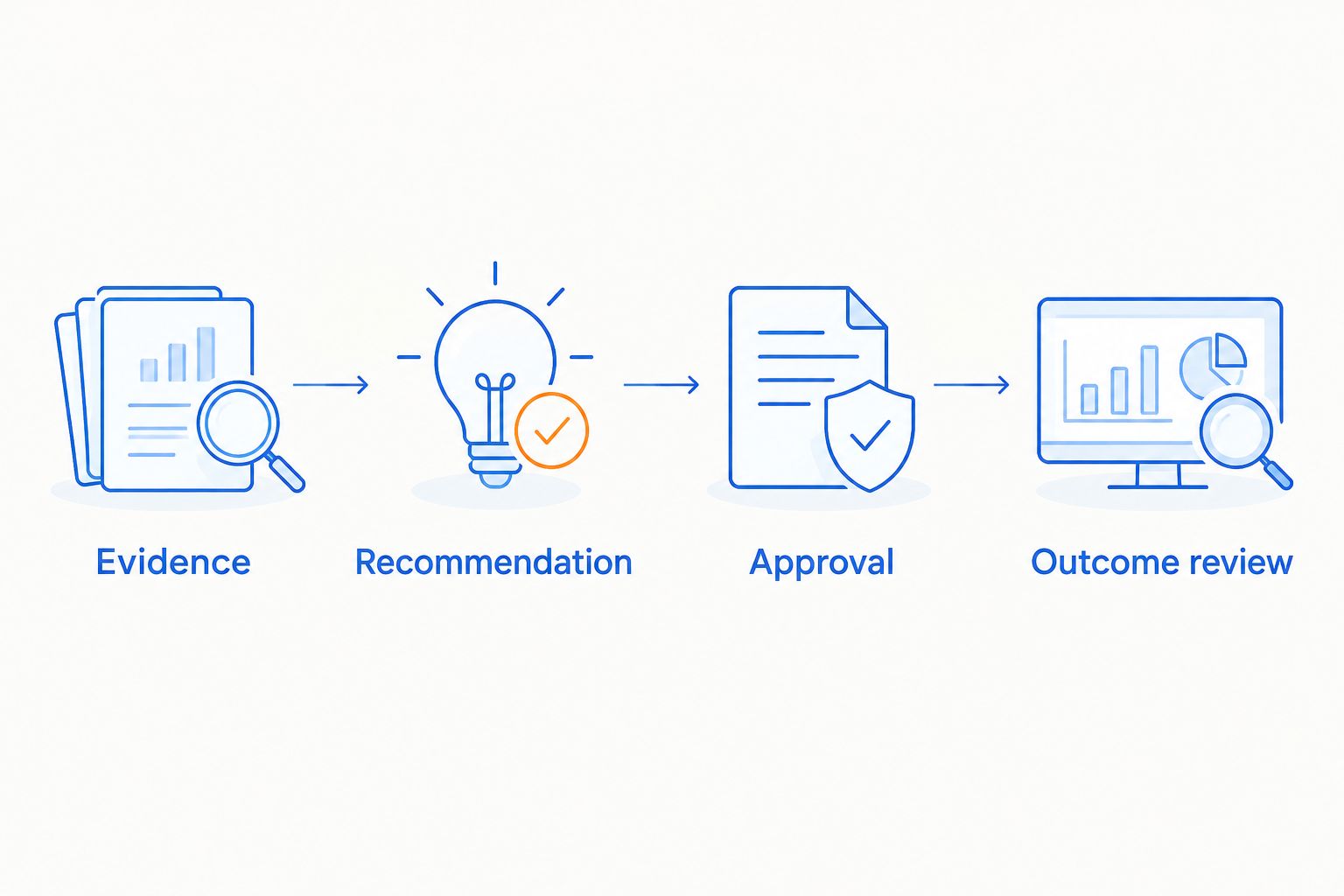
The sequence prevents a common reporting error: counting a recommendation as an achieved improvement. Keep the proposed action, approved action, and observed outcome distinct in client and executive reporting.
Rollout fit depends on the workflow you can validate
The private beta is the appropriate entry point for evaluating the recommendation-led product. Confirm the required connections and workflow before making it part of a client commitment.
The product description names Google Ads, Meta, LinkedIn, Salesforce, HubSpot, and Google Analytics. That list alone does not establish the release status, data coverage, or account-specific suitability of every connection. Confirm which required integrations are live, beta, or coming soon during the application process.
Apply the same discipline to HockeyStack. Demonstrate the actual advertising and CRM combination your team uses. Do not substitute a familiar integration logo for proof that the required fields and outcomes support your analysis.
For a controlled 2026 evaluation, use a proposed test brief rather than an open-ended product tour:
- 30-day spend window: Inspect a defined advertising period with reconciled channel totals.
- 90-day CRM window: Inspect downstream outcomes and identify opportunities still unresolved.
- 7-day review cadence: Review proposed decisions and record approvals, rejections, and reasons.
These windows are suggested evaluation parameters, not vendor requirements or performance benchmarks. Adapt them to your sales cycle. A longer revenue lag needs a longer outcome review, not a more confident interpretation of incomplete data.
Pricing: compare the billing basis and operating burden
Choose commercial terms that match the work you need done, not the most attractive demonstration. Request written terms for the same account scope and required workflow from both vendors.
Evaluate the pricing model through concrete questions:
- What determines the bill: users, accounts, data scope, usage, or another unit?
- What changes when an agency adds a client?
- Which implementation and support responsibilities belong to your team?
- What commitment, renewal, and cancellation terms apply?
- Which required capabilities fall within the proposed agreement?
A fixed commitment favors planning when scope stays stable. A usage-linked model ties the bill to its stated usage unit, which requires monitoring. These are commercial tradeoffs to inspect, not claims about either vendor's current billing structure.
Include the internal work in your decision. For attribution, identify who interprets findings and proposes actions. For recommendations, identify who reviews evidence and implements approved changes. The operating burden belongs in the comparison even when it does not appear on an invoice.
Final verdict for 2026
Choose Paid Lens if you own the budget decision
Best for: agency performance leads and marketing leaders accountable for allocation. Choose the recommendation-led workflow when the recurring question is which budget action to prioritize and how to defend it with revenue evidence.
Apply for the private beta with a specific decision brief. Bring the channels, CRM outcome, approval owner, and unresolved allocation question you need to evaluate. Confirm integration status before promising a rollout.
Choose HockeyStack if you own the attribution explanation
Best for: B2B marketing operations and revenue analytics leaders. Choose the attribution-led evaluation when the immediate requirement is understanding marketing interactions and their relationship to pipeline and revenue.
Ask for a demonstration using your definitions and a representative customer journey. Make the attribution explanation the acceptance test. Evaluate any budget-action workflow separately rather than assuming that reporting and recommendations are the same deliverable.
| Dimension | Winner |
|---|---|
| Defensible budget recommendation as the primary deliverable | Recommendation-led workflow |
| B2B attribution as the primary deliverable | HockeyStack |
| Reliable revenue interpretation | Tie: agreed definitions and sound inputs are prerequisites |
| Explicit read-only recommendation positioning | Recommendation-led workflow |
| Integration and implementation fit | Decide through a scoped demonstration |
| Commercial fit | Decide from written terms and operating responsibilities |
Apply for the private beta
Evaluate evidence-backed budget recommendations against your agency or marketing team's decision workflow.
FAQ
Is Paid Lens better than HockeyStack for budget allocation?
Paid Lens is the closer fit when your primary requirement is ranked, evidence-backed budget reallocation recommendations. HockeyStack is the attribution-led option when understanding marketing interactions and revenue contribution comes first.
Which option should an agency evaluate first?
An agency should evaluate the recommendation-led option first when its main deliverable is a defensible budget change. Start with the attribution-led option when clients first need an explanation of marketing contribution.
Does marketing attribution prove that increasing spend will work?
No. Attribution assigns credit to interactions; it does not by itself establish the incremental effect of additional spending. Treat an allocation recommendation as a separate decision requiring supporting evidence.
Will a read-only recommendation change my advertising budgets?
A read-only recommendation does not execute a budget change. Your team must review the evidence, approve the action, and manage implementation through the appropriate workflow.
Which integrations should I confirm before applying?
Confirm every advertising, CRM, and analytics connection required for your decision. Ask explicitly whether each required integration is live, in beta, or coming soon, and verify the data fields your evaluation needs.
How should I compare commercial terms in 2026?
Compare written terms for the same account scope, required workflow, and implementation responsibilities. Check the billing unit, commitment, support scope, and the internal work needed to turn findings into approved actions.
What should I bring to a product demonstration?
Bring a real budget or attribution question, an agreed revenue definition, and a representative set of advertising and CRM records. Ask the vendor to explain its conclusion, supporting evidence, and limits using that brief.
One last thing
Before a 2026 demonstration, write down the sentence you need to say in the next revenue meeting. If it begins with a proposed budget change, evaluate the recommendation workflow first. If it begins with an explanation of marketing contribution, evaluate attribution first.
The strongest purchase criterion is the decision you can defend afterward. Require the demonstration to produce that deliverable, with its evidence and limits visible.