

Choose Paid Lens if you need ranked, evidence-backed recommendations for reallocating advertising budgets against CRM revenue; choose RedTrack if your immediate job is advertising tracking and conversion attribution. This 2026 comparison separates the decision workflow from the measurement workflow so you can buy for the problem your team actually owns.
- Paid Lens vs RedTrack is primarily a budget decision-intelligence versus advertising attribution comparison.
- Choose Paid Lens for ranked budget recommendations connected to advertising, CRM, analytics, and revenue data.
- Choose RedTrack when advertising tracking and conversion attribution are the immediate requirements.
- Judge both against your own conversion definitions, data permissions, and review process before committing.
Why this matters
A marketing leader asking where to move budget needs a different answer from an analyst asking which campaign received conversion credit. Treating those questions as interchangeable creates a poor software brief. You either buy more measurement when you need a decision, or ask recommendations to compensate for unreliable measurement.
Paid Lens is budget decision-intelligence software for agencies and marketing leaders who must defend reallocations. RedTrack belongs in the evaluation when the central requirement is advertising tracking and attribution. These are different starting points, not evidence that either product replaces the other across every workflow.
Select the workflow first. Then evaluate the software. A useful 2026 shortlist starts with the decision your team cannot make today, not the longest feature list.
At a glance
The verdicts below concern product fit, not measured differences in accuracy, implementation time, or financial results. Use them to shape a demonstration around your actual accounts.
| Dimension | Paid Lens | RedTrack |
|---|---|---|
| Best for | Agencies and leaders defending cross-channel budget decisions | Marketers evaluating advertising tracking and attribution |
| Standout feature | Ranked, evidence-backed budget reallocation recommendations | Advertising tracking and conversion attribution |
| Primary question | What budget change deserves review next? | Which advertising activity receives conversion credit? |
| Revenue assessment | Connects advertising, CRM, analytics, and revenue data for recommendations | Evaluate attribution against your required conversion and revenue definitions |
| Evidence standard | Review recommendation rationale, confidence, and expected business impact | Review attribution rules and the conversion evidence behind reports |
| Human control | Positioned as read-only and built for human review | Verify permissions and execution controls for the proposed configuration |
| Implementation fit | Validate the data needed for the recommendation workflow | Validate the tracking needed for the attribution workflow |
| Pricing model | Confirm the commercial basis and included scope during evaluation | Confirm the commercial basis and included scope during evaluation |
Budget recommendations favor the decision-intelligence workflow
Paid Lens is the better fit when your deliverable is a defensible budget recommendation. Its stated purpose is to combine advertising, CRM, analytics, and revenue data into ranked reallocation recommendations. That puts the proposed action, rather than the dashboard, at the center of the workflow.
For an agency, the practical requirement is an explanation a client can challenge. Which budget should change? What business outcome supports that move? How confident is the recommendation, and what limits should the account lead disclose?
A ranked queue gives those questions an order. Ranking is not permission to execute blindly. Review whether the underlying evidence reflects the client's objective, sales cycle, and conversion definitions before approving a change.
The limitation is equally important: a recommendation does not prove the proposed change will cause the expected outcome. Treat expected impact as a decision input, not a promised result. If your immediate problem is tracking integrity, start with measurement rather than adding a recommendation layer.
Advertising tracking favors RedTrack's product focus
RedTrack is the better starting point when the buying brief centers on advertising tracking and conversion attribution. Its category focus matches the analyst who needs to investigate campaign-level measurement before discussing budget changes.
Bring a real tracking question to the evaluation. Ask how a conversion enters the reporting workflow, how it relates to advertising activity, and how the reported result can be reconciled with the underlying business record. Require the demonstration to follow your conversion definition rather than a generic example.
This is a different job from ranking cross-channel reallocations. A tracking-oriented workflow is useful when the blocker is understanding what happened and how credit was assigned.
The tradeoff is decision ownership. An attribution result still requires someone to decide whether a campaign deserves more budget. Do not interpret a product's tracking focus as proof of any particular recommendation capability, automation feature, or integration status.
Revenue-linked decisions favor a CRM-aware brief
An inexpensive lead and a valuable opportunity are not interchangeable. If your business sells through a CRM, evaluate advertising performance against the revenue stage your leadership actually uses. Otherwise, a budget discussion can reward lead volume while ignoring downstream quality.
The decision-intelligence workflow is explicitly built around connecting advertising and CRM revenue information. For a marketing leader preparing a 2026 budget review, that alignment is more relevant than another view of platform-reported conversions alone.
Check the definitions before judging the recommendation:
- Revenue stage: Specify whether the decision concerns pipeline, won revenue, or another documented outcome.
- Record matching: Inspect how advertising activity relates to CRM records.
- Reporting period: Make sure the comparison respects the time required for leads to mature.
These are 3 checks, not proof of implementation quality. Apply them to either evaluation. A CRM connection is useful only when the joined records support the question you are asking.
For a broader shortlist, compare the decision requirements in this guide to budget allocation tools for paid media.
Attribution investigations favor a measurement-first brief
RedTrack is the more relevant starting point when your team's recurring deliverable is an attribution investigation. Examples include explaining why reported conversions differ between systems or documenting which campaign receives credit under the chosen measurement approach.
Keep that evaluation narrow. Ask the demonstrator to trace an outcome through the reporting process and explain the applicable attribution rules. Then compare the result with the source record your business treats as authoritative.
Winning attribution credit is not the same as proving incremental revenue. Attribution assigns credit under a method; incrementality asks what happened because of the advertising. Neither a favorable attribution report nor a confident budget recommendation removes that distinction.
That boundary matters for both products. If leadership needs a causal claim, specify the evidence required for that claim separately. Do not buy a measurement interface or recommendation queue expecting it to settle a different analytical question automatically.
Both need an auditable evidence chain
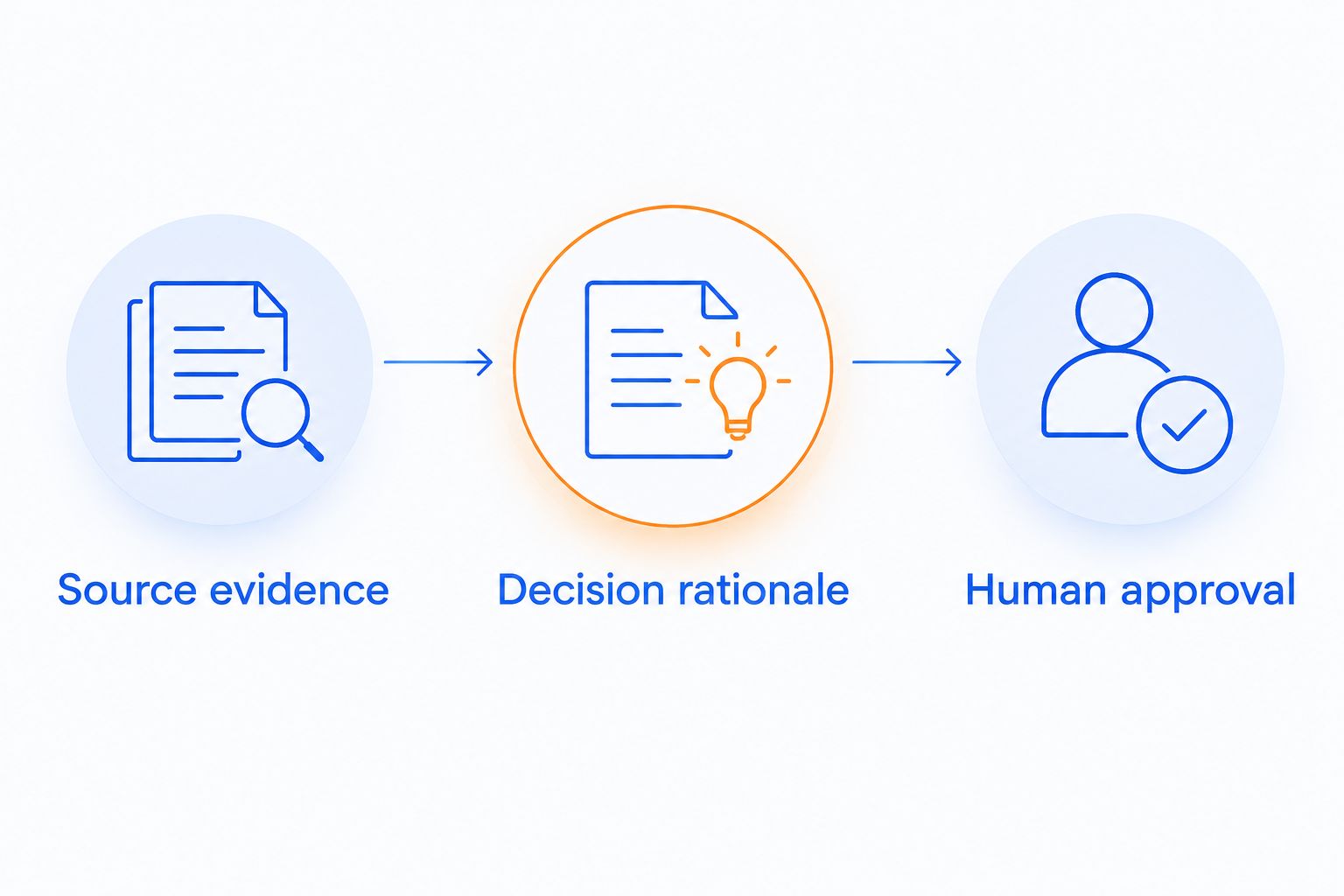
Neither workflow gets an exemption from scrutiny. Your 2026 evaluation should connect the source data, analytical interpretation, and proposed action without forcing the reviewer to accept an unexplained conclusion.
Use the same 3 review stages for both candidates:
- Source evidence: Identify the records and definitions behind the result.
- Decision rationale: Explain why those records support the interpretation or recommendation.
- Human approval: Identify who accepts the conclusion and authorizes any operational change.
A recommendation should expose its rationale and confidence. An attribution report should expose enough measurement context to explain the credit assigned. Those requirements differ in detail, but they share the same standard: a colleague should be able to question the conclusion without restarting the entire analysis.
Do not score confidence language by appearance. Ask what uncertainty means, what evidence supports it, and what would change the conclusion. A clearly bounded answer is more useful than certainty unsupported by the underlying records.
Both require a controlled implementation review
Implementation fit is a tie until your team validates the required connections, permissions, and reporting definitions. A product category does not establish whether a particular account configuration will satisfy your workflow.
The advertised ecosystem includes Google Ads, Meta, LinkedIn, Salesforce, HubSpot, and Google Analytics. Confirm each required connection's current status during evaluation. Distinguish live functionality from beta functionality and coming-soon integrations; do not treat a named platform as confirmation of a production-ready connection.
For the read-only recommendation workflow, inspect the requested permissions and the path from recommendation to human approval. For the tracking workflow, inspect the required data collection and account configuration. These are different implementation questions and deserve separate acceptance criteria.
Use 2 acceptance tests: reproduce a known business outcome and explain a disputed one. The first checks whether the workflow matches an understood case. The second shows whether your team can investigate disagreement without relying on an unexplained output.
Pricing: compare commercial scope, not an assumed model
For a 2026 purchase, request written commercial terms for the exact workflow under evaluation. Do not assume either product uses a particular billing unit or includes every required connection in the proposed scope.
Ask each vendor to define:
- The contractual billing basis and anything that changes it.
- The accounts, workspaces, data connections, and support included.
- Any implementation obligations assigned to your team.
- The terms that apply when your agency adds another client.
A fixed commercial scope supports predictability; a usage-linked scope follows the contracted usage basis. Those are model tradeoffs to inspect in the proposal, not billing claims about either vendor.
Compare total responsibility as well as commercial scope. If one option leaves your analyst responsible for turning reports into recommendations, include that responsibility in the buying decision. If another requires upstream measurement work, include that too. Neither responsibility disappears because it sits outside the interface.
Final verdict: choose for the deliverable you own
Choose Paid Lens if you defend budget decisions
Best for: the agency strategy lead or marketing leader accountable for reallocations. Choose Paid Lens when the deliverable is a ranked recommendation connecting advertising performance with CRM and revenue evidence.
Your acceptance criterion is a recommendation you can explain in a revenue meeting: proposed action, expected impact, confidence, rationale, and limits. Keep human approval explicit. Apply through the private beta process and validate your required connections before planning an operational rollout.
Choose RedTrack if you own advertising attribution
Best for: the performance marketer or analyst accountable for tracking and conversion credit. Choose RedTrack when the immediate deliverable is an advertising measurement workflow rather than a ranked budget decision queue.
Your acceptance criterion is a traceable conversion result under a clearly explained attribution approach. Test the reporting against your business records. Keep the subsequent budget decision separate unless the demonstrated workflow explicitly supports it.
Apply for the private beta
Bring your budget decision workflow and required advertising, CRM, and analytics connections.
One-glance scorecard
| Dimension | Winner |
|---|---|
| Ranked budget recommendations | Paid Lens for the decision-intelligence brief |
| Advertising tracking focus | RedTrack for the measurement brief |
| CRM-linked decision brief | Paid Lens for its stated revenue-connected purpose |
| Attribution investigation brief | RedTrack for its attribution focus |
| Evidence review | Tie: require an auditable explanation |
| Implementation fit | Tie: validate against your configuration |
| Commercial fit | Decide from written scope and terms |
FAQ
Is Paid Lens better than RedTrack for agencies?
Paid Lens is the better fit for agencies seeking ranked, evidence-backed budget reallocation recommendations. RedTrack is the more relevant starting point when the agency's immediate requirement is advertising tracking and attribution.
What's the main difference between decision intelligence and attribution?
Decision intelligence supports choosing an action; attribution assigns conversion credit under a measurement method. A budget recommendation and a credited conversion answer different business questions.
Which option should a marketing leader evaluate for CRM revenue decisions?
Evaluate the CRM-aware decision workflow when your brief is to connect advertising spending with pipeline or revenue outcomes. Validate record matching, revenue definitions, and the reporting period before accepting a recommendation.
Does attribution prove that advertising caused a sale?
No. Attribution assigns credit according to a method; it does not by itself establish what would have happened without the advertising. Evaluate causal claims against separate evidence requirements.
Should an agency automate every recommended budget change?
No. Keep an accountable reviewer between a recommendation and an operational change. Check the supporting evidence, uncertainty, client objective, and permissions before approval.
How should I compare the commercial terms?
Compare written proposals for the same workflow and scope. Confirm the billing basis, included connections, account structure, support, and your team's implementation responsibilities.
Can I assume every named integration is live?
No. Confirm each required integration's current status and distinguish live, beta, and coming-soon functionality. Validate the specific data and permissions your workflow needs.
One last thing
Bring the same disputed conversion to both evaluations. Ask each vendor to explain what the evidence establishes, what remains uncertain, and which action follows. A polished demonstration is less useful than a clear answer to a question your team already struggles to resolve.
For your 2026 decision, write 1 acceptance sentence before scheduling demonstrations: the product must help a named owner produce a named deliverable from named evidence. That sentence prevents a tracking purchase from masquerading as a decision solution—and prevents recommendations from concealing unfinished measurement work.