

Choose Paid Lens if you need ranked, evidence-backed decisions about moving budget across advertising channels; choose WhatConverts if you need to track calls and forms back to the marketing that generated them. The difference is budget decision intelligence versus lead tracking—not two interchangeable reporting tools.
- Paid lens vs whatconverts is a choice between budget recommendations and lead tracking.
- Paid Lens is best for marketing leaders and agencies defending cross-channel budget decisions.
- WhatConverts is best for teams identifying which marketing sources generate calls and forms.
- Neither attribution nor a confidence score proves that additional spending will generate incremental revenue.
Why this matters
A lead-tracking problem and a budget-allocation problem require different answers. Knowing which campaign generated an inquiry helps you explain acquisition. Deciding where the next available budget belongs requires evidence about business outcomes, not just inquiry volume.
For your 2026 evaluation, identify the unresolved question before comparing features. Are you struggling to identify lead sources, or to choose between competing opportunities for spending? Buying a decision tool before fixing incomplete lead data leaves the foundation weak. Buying another tracking tool does not, by itself, produce a defensible reallocation decision.
Paid Lens is budget decision-intelligence software for agencies and marketing leaders who must defend cross-channel spending decisions. WhatConverts addresses an earlier question: where leads came from and which marketing activity produced them.
At a glance
| Dimension | Paid Lens | WhatConverts |
|---|---|---|
| Best for | Agencies and marketing leaders defending budget reallocations | Teams attributing calls and forms to marketing sources |
| Lead-source tracking | Evaluation centers on connected advertising and business-outcome data | Lead tracking is the core use case |
| Budget allocation | Ranked, evidence-backed reallocation recommendations | Lead-source evidence supports your own allocation analysis |
| Revenue context | Connects advertising, CRM, analytics and revenue data | Evaluation centers on lead attribution and lead outcomes |
| Recommendation evidence | Expected impact, confidence and rationale | Lead-source records support investigation |
| Human judgment | Recommendations are built for human review | Tracked leads still require business interpretation |
| Data quality | Depends on reliable connected inputs | Depends on reliable tracking and lead assessment |
| Setup priority | Validate the required data connections and decision workflow | Validate lead capture and source attribution |
| Pricing-model evaluation | Assess commercial terms against decision coverage | Assess commercial terms against lead-tracking coverage |
| Standout feature | Ranked budget recommendation queue | Call and form attribution |
The table compares each product's central job. It does not establish feature parity, integration availability or contractual terms. In a 2026 shortlist, verify those details against the workflow you actually intend to run.
WhatConverts wins when the problem is lead-source visibility
WhatConverts is the better fit when your immediate question is which marketing sources generate calls and forms. That is a lead-tracking question. You need a usable record of the inquiry and its source before arguing about channel performance.
This matters for an agency whose client judges marketing by incoming inquiries. A channel report can show spend and clicks while leaving the actual lead trail unclear. Tracking the inquiry closes a different gap from recommending where to move budget.
The advantage is specificity. You can investigate the acquisition event rather than treating every platform-reported conversion as an equivalent business outcome. The limit is equally clear: knowing the source of a lead does not establish its eventual revenue contribution.
Use 3 questions to evaluate this workflow:
- Can you identify the source of the relevant call or form submission?
- Can your team distinguish a useful inquiry from an irrelevant one?
- Can you connect that inquiry to the business outcome you report?
Choose WhatConverts for lead-source visibility. Do not mistake a clearer lead record for a complete cross-channel budget recommendation.
Paid Lens wins when the problem is deciding where budget moves
Paid Lens budget recommendation software is built around ranked, evidence-backed reallocation recommendations. Its purpose is to connect advertising performance with CRM, analytics and revenue context, then organize the decisions that deserve attention.
That fits a marketing leader who already has reports but still needs to explain a proposed spending change. The question is not simply which campaign recorded more conversions. It is which action deserves priority, what supports it and how confidently the team should act.
The product's stated decision workflow includes a prioritized queue, expected business impact, confidence scoring and pipeline-aware recommendations. Those are recommendation features, not a promise that every suggested change will succeed. Treat expected impact as a decision input, not as realized customer revenue.
The tradeoff is dependency on usable evidence. A ranked queue cannot repair inconsistent opportunity stages or make unrelated conversion definitions comparable. Your review still needs to test whether the underlying records support the proposed action.
Choose the recommendation workflow when allocation is the bottleneck. If your team cannot reliably identify the leads entering that workflow, fix the measurement problem first.
Paid Lens is the closer fit for CRM-to-budget decisions
A budget decision becomes more defensible when acquisition data connects to downstream outcomes. The platform's stated scope joins advertising, CRM, analytics and revenue data to support those decisions. That matches a revenue meeting more directly than a lead-source question alone.
Consider the decision structure without assuming a result. One campaign generates inquiries; another generates opportunities that progress through your sales process. Before changing their budgets, you need consistent definitions, comparable reporting periods and an explanation of what happened after acquisition.
WhatConverts is useful when the missing piece is the lead's source. Its lead-tracking focus is not the same as the stated cross-channel recommendation workflow. That distinction identifies the closer fit; it does not prove that either product captures every outcome in your business.
For a 2026 evaluation, take a recent budget decision and trace it backward. Ask which advertising record, lead record, opportunity stage and revenue outcome would support it. Then establish whether the proposed implementation can preserve those connections.
The practical limit is attribution. A connected revenue record explains an observed relationship under your measurement approach. It does not establish what would have happened without the advertising.
The recommendation queue wins on explicit decision rationale
A useful recommendation needs more than an instruction to increase or decrease spending. It needs evidence you can inspect, an expected outcome and a reason to trust—or challenge—the conclusion.
The stated recommendation workflow includes confidence scoring and rationale. That gives a marketing leader a defined review target: the proposed action and the evidence behind it. WhatConverts serves a different review target: the tracked lead and its attributed source.
Use 5 fields when reviewing any proposed budget change:
- Action: What spending decision is being proposed?
- Evidence: Which records and comparisons support it?
- Expected impact: What business outcome is the recommendation intended to improve?
- Confidence: How strongly does the evidence support acting?
- Limits: Which gaps or assumptions weaken the conclusion?
These fields are an evaluation checklist, not a claim that both products expose identical controls. Request a demonstration using a decision you recognize. Inspect the explanation before accepting the recommendation.
A confidence score supports review; it does not replace proof. Ask what the score represents and which missing inputs affect it. A precise-looking result without an inspectable basis is not a defensible spending decision.
Both require human judgment before a spending change
Neither lead attribution nor a ranked recommendation removes the need to interpret business context. A sales-process change, an inconsistent qualification rule or an incomplete revenue record can change how you read performance.
The recommendation platform is described as read-only, controlled and built for human review. Keep that distinction clear: receiving a recommendation is not the same as automatically executing a budget change. Evaluate the proposed decision before taking action in your advertising accounts.
With WhatConverts, the same principle applies at the lead level. A recorded inquiry is evidence of an event, not proof of commercial value. Your team must decide what qualifies as a meaningful outcome.
Give each part of the review an explicit owner. Marketing should explain campaign context; sales or revenue operations should confirm outcome definitions; the budget owner should approve the spending decision. This is a governance recommendation, not a claim about either product's permissions.
Both workflows need accountable interpretation. The honest tie is human review, not identical functionality.
Both depend on consistent data definitions
Data quality is another tie. The tools address different questions, but neither makes inconsistent inputs comparable by definition.
If one team counts every inquiry as a lead and another counts only qualified inquiries, channel comparisons become difficult to defend. If opportunity stages change without a clear reporting rule, pipeline trends become harder to interpret. Resolve those definitions before judging a recommendation or attribution report.
Apply 4 checks before your 2026 pilot:
- Lead definitions: Agree on what enters the report.
- Source coverage: Identify the acquisition paths that need tracking.
- Revenue mapping: Define how leads connect to downstream outcomes.
- Review ownership: Name who approves the interpretation and action.
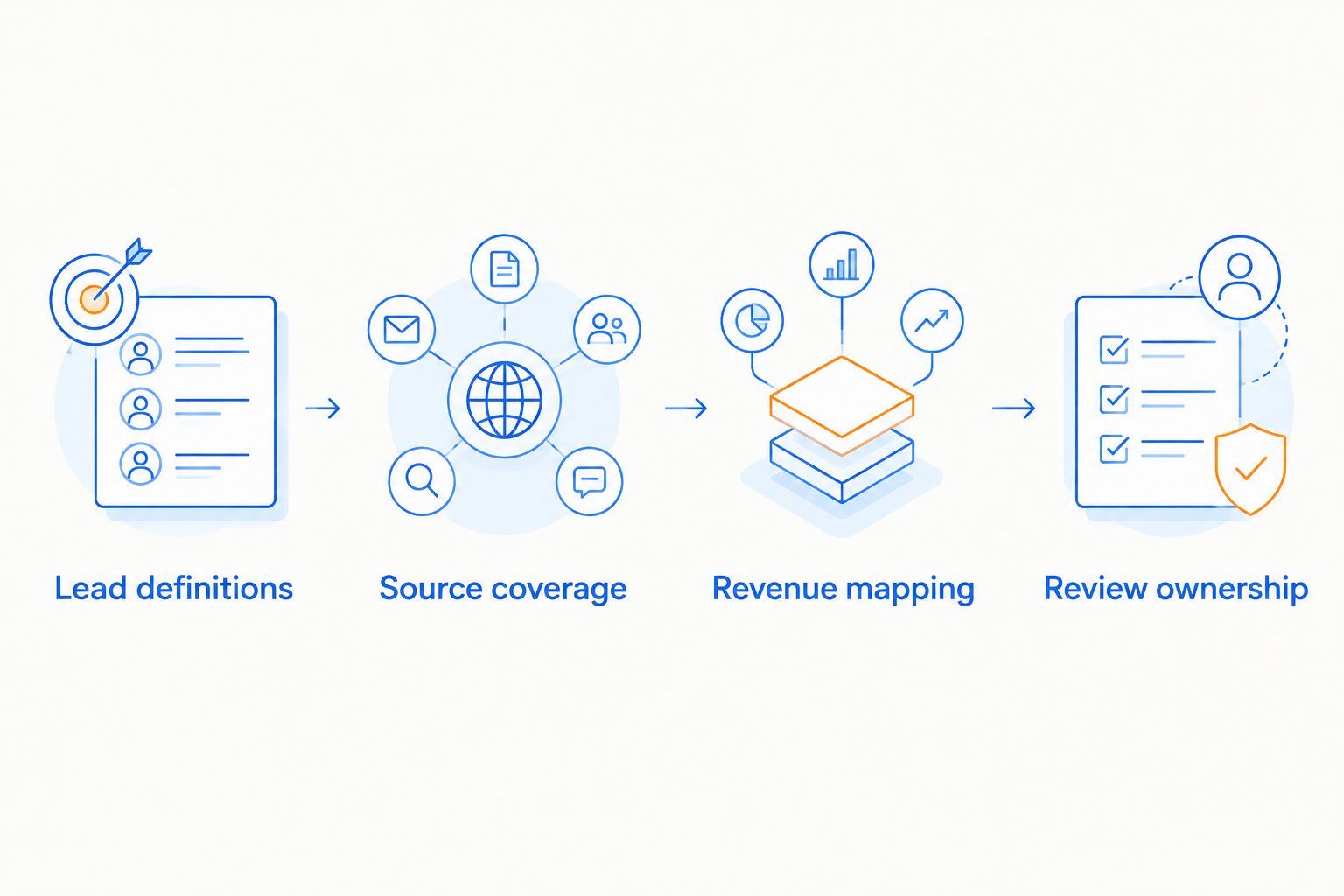
These checks prevent a misleading comparison. If your lead records are incomplete, evaluate capture first. If your records are consistent but your team cannot prioritize budget changes, evaluate the decision workflow. Measure the tool against the unresolved problem, not the number of screens it presents.
WhatConverts fits a lead-tracking pilot; Paid Lens fits a decision pilot
Setup should follow the outcome you need to verify. A lead-tracking pilot should demonstrate that relevant calls and forms receive useful source information. A decision-intelligence pilot should demonstrate that a proposed allocation change has an inspectable business rationale.
For the tracking pilot, follow an inquiry from acquisition through qualification. Confirm that the source record means what your reporting team thinks it means. Then inspect how that evidence supports the client report.
For the decision pilot, select a real allocation question. Ask the platform to explain the proposed action, expected impact, confidence and limitations. Bring the explanation to the person who would approve the change.
Do not infer connector readiness from a list of advertising or CRM platforms. Confirm each required integration's current status, including whether it is live, beta or coming soon. A named connection is not sufficient evidence that your intended workflow is available.
Judge setup by the completed task, not a generic ease-of-use claim. No comparable implementation evidence here establishes a faster setup winner.
Pricing: compare the commercial model against the job
A pricing comparison needs more than a headline subscription figure. Confirm what the subscription covers, what changes the bill and which capabilities belong to the proposed agreement.
For a budget recommendation workflow, assess coverage against the advertising and business-outcome data needed for the decision. For a lead-tracking workflow, assess coverage against the calls, forms and client reporting requirements you need to support. These are purchasing questions, not assertions about either vendor's billing units.
Ask both vendors how the commercial arrangement changes when you add clients, expand the measurement scope or change the required integrations. Establish which commitments are fixed and which vary with usage or scope. Predictability and flexibility only become comparable once those terms are explicit.
For your 2026 procurement decision, request terms for the same intended scope. Neither product has an established pricing winner in this comparison. Select the workflow first, then evaluate the agreement that delivers it.
Final verdict: choose the unresolved job
Choose Paid Lens if you defend cross-channel budgets
Best for: an agency strategy lead or marketing leader accountable for allocation decisions. Choose Paid Lens when you need ranked recommendations connected to advertising, CRM and revenue evidence. Your acceptance test is whether the rationale survives questions from the budget owner.
Apply to the private beta through the product site and verify the required workflow before committing. Keep live capabilities, beta access and future integration plans separate in the evaluation.
Evaluate your budget decision workflow
Apply to the private beta and confirm fit for your advertising, CRM and revenue decision process.
Choose WhatConverts if you need a reliable lead-source record
Best for: an agency account lead or marketing manager reporting on incoming calls and forms. Choose WhatConverts when lead attribution is the unresolved problem. Your acceptance test is whether the team can identify relevant inquiries, explain their sources and connect them to meaningful outcomes.
Do not force a choice between functions your business needs separately. First establish reliable acquisition evidence. Then evaluate how that evidence supports the spending decision.
| Dimension | Winner |
|---|---|
| Lead-source visibility | WhatConverts |
| Ranked budget recommendations | Paid Lens |
| CRM-to-budget decision fit | Paid Lens |
| Explicit recommendation rationale | Paid Lens |
| Need for human judgment | Tie |
| Dependence on consistent definitions | Tie |
| Setup | Task-specific; no speed winner established |
| Pricing | No winner established |
FAQ
Is Paid Lens better than WhatConverts?
Paid Lens is the closer fit for ranked cross-channel budget recommendations; WhatConverts is the closer fit for call and form attribution. Choose according to whether your unresolved problem is allocation or lead-source visibility.
Which tool is better for an agency managing multiple clients?
The better tool depends on the client deliverable. Choose a budget recommendation workflow for allocation decisions and a lead-tracking workflow for explaining incoming inquiries and their sources.
Does WhatConverts tell me where to move advertising budget?
WhatConverts provides lead-tracking evidence that can inform your budget analysis. That is different from the ranked, evidence-backed reallocation workflow described for Paid Lens.
Does a confidence score prove a budget recommendation will work?
No, a confidence score does not prove a future outcome. Inspect the underlying evidence, assumptions and limitations before approving a spending change.
Can I replace lead tracking with budget recommendation software?
Do not assume budget recommendation software replaces lead capture and source attribution. Verify those requirements separately from the recommendation workflow.
What should I ask about integrations before applying to the beta?
Ask which required connections are live, beta or coming soon. Confirm that the current implementation supports your specific advertising, CRM and revenue workflow.
How should I compare subscription costs?
Compare commercial terms for the same intended scope and required capabilities. Ask what changes the bill and distinguish fixed commitments from variable charges before selecting a plan.
One last thing
Bring a rejected budget recommendation to your evaluation, not just an approved one. Ask what evidence would change the decision and what uncertainty would stop you from acting. A tool that helps explain why you should hold budget steady can be as useful as one that recommends moving it.