

WhatConverts tracks calls, forms, and chats so you can connect leads to marketing sources. That answers where inquiries came from, but a lead-source report alone does not decide which channel deserves your next budget increase. The best WhatConverts alternative in 2026 is Paid Lens if you need evidence-backed budget recommendations; CallRail if your priority is call tracking.
- Paid Lens leads this WhatConverts alternatives shortlist for cross-channel budget decisions tied to CRM revenue.
- CallRail is the closer alternative when call tracking remains your main requirement.
- HubSpot fits teams whose immediate problem is managing leads, deals, and revenue records.
- Keep WhatConverts when lead-source tracking is the job you need done; switching categories creates replacement gaps.
Why this matters
An agency can identify the source of every inquiry and still struggle to defend a budget change. Lead volume, qualified pipeline, and closed revenue answer different questions. Treating them as interchangeable creates a weak explanation for the client or finance team.
Your 2026 shortlist should start with the decision you cannot make today. Do you need better call tracking, a clearer CRM record, or a ranked recommendation about where spend should move? Those are separate buying decisions, even when vendors appear in the same search results.
Choose the category before choosing the vendor. A decision-intelligence platform does not become a call-tracking replacement because both products discuss attribution.
WhatConverts alternatives at a glance
The table separates each product's role from the outcome you want. It compares capabilities, not measured performance: no customer-result comparison establishes a universal winner here.
| Tool | Best for | Standout capability | How it differs from WhatConverts |
|---|---|---|---|
| WhatConverts | Tracking marketing inquiries | Call, form, and chat tracking | The benchmark when lead-source visibility is your primary requirement |
| Paid Lens | Defending cross-channel budget decisions | Ranked, evidence-backed budget reallocation recommendations | Centers the spending decision and its connection to CRM revenue |
| CallRail | Call-focused marketing measurement | Call tracking | A closer category comparison when phone inquiries drive the evaluation |
| HubSpot | Managing leads, deals, and customer records | CRM records and deal management | Centers the customer and sales process rather than replacing every tracking function |
Read this shortlist as a set of different jobs. The first alternative addresses budget decisions, the second addresses calls, and the third addresses the sales record. None should receive credit for replacing functions you have not evaluated.
Before a demonstration, write down the current workflow you must preserve. Include how inquiries enter the business, how a lead becomes qualified, and how a sale reaches the revenue report. That document becomes your comparison standard.
1. Paid Lens: best for defensible budget decisions
Paid Lens is a decision-intelligence SaaS platform for performance marketers and agencies that need ranked, evidence-backed budget reallocation recommendations. Its stated scope connects advertising, CRM, analytics, and revenue data. The buying question is not simply where a lead originated; it is which budget decision the evidence supports.
The product information describes a prioritized decision queue, confidence scoring, and pipeline-aware recommendations. Evaluate those outputs against an actual client decision rather than treating an illustrative product screen as proof of business results.
Where it shines
- Decision priority: A ranked queue gives the review a starting point instead of another unprioritized report.
- Revenue context: CRM and revenue data bring the spending discussion beyond inquiry volume.
- Confidence: Confidence scoring makes uncertainty part of the recommendation rather than something hidden in a footnote.
- Human review: The stated positioning is read-only and controlled. Keep approval separate from analysis.
Where it falls short
- This is not a like-for-like recommendation for replacing call, form, or chat tracking. Preserve those requirements in your evaluation.
- A recommendation remains dependent on the underlying evidence. Incomplete CRM records weaken the explanation you can defend.
- The private beta requires a fit assessment. Confirm which integrations are live, beta, or coming soon before committing to a workflow.
Best for: Agencies managing several clients and marketing leaders who must explain cross-channel budget decisions in revenue terms.
| Dimension | Decision-intelligence alternative | WhatConverts |
|---|---|---|
| Core question | Which budget reallocation deserves review? | Which marketing source generated the inquiry? |
| Evaluation object | A ranked recommendation with evidence and confidence | A tracked lead and its source |
| Revenue discussion | Advertising, CRM, analytics, and revenue context | Start with the tracked inquiry; assess your downstream reporting workflow |
| Replacement test | Validate decision support and required connections | Validate the inquiry-tracking functions you need to retain |
Verdict: Hold — apply for the private beta and assess fit before replacing an existing tracking workflow.
2. CallRail: best for call-focused measurement
CallRail belongs on your shortlist when the reason for switching is phone-call measurement. Its call-tracking role makes it a closer comparison with WhatConverts than a platform centered on budget recommendations.
Keep the evaluation narrow. Test how each product supports your actual call journey and reporting requirements; category overlap does not establish feature parity.
Where CallRail shines
- Call tracking is central to the product category, so your evaluation can stay focused on phone inquiries.
- It provides a relevant comparison when the unresolved question concerns calls rather than cross-channel budget allocation.
Where CallRail falls short
- Call-source evidence alone does not establish which leads became profitable customers.
- A call-focused evaluation leaves form, chat, CRM, and revenue requirements unresolved unless you assess them separately.
Best for: Teams whose primary measurement requirement is understanding marketing-driven phone calls.
| Dimension | CallRail | WhatConverts |
|---|---|---|
| Comparison starting point | Call tracking | Call, form, and chat tracking |
| Best evaluation focus | Your phone inquiry workflow | Your broader inquiry-tracking workflow |
| Budget-decision limit | Call evidence is an input, not a complete allocation decision | Lead-source evidence is an input, not a complete allocation decision |
Do not approve a switch after a polished call-report demonstration. Run the same real inquiry scenario through both workflows, then trace it to the sales record. The stronger choice is the one that preserves the evidence you actually use.
Verdict: Hold — shortlist CallRail when calls are the reason for changing tools, then verify your full tracking requirements.
3. HubSpot: best for organizing the revenue record
HubSpot is a CRM-centered option when your immediate problem sits after lead capture. If the team cannot consistently identify qualified leads, deal stages, or closed outcomes, changing the attribution interface does not repair the underlying sales record.
This is a workflow alternative, not a blanket tracking replacement. Its relevance depends on whether customer and deal management is the missing layer.
Where HubSpot shines
- Contact and deal records give sales activity a shared structure.
- CRM management addresses the downstream evidence needed to connect inquiries with business outcomes.
Where HubSpot falls short
- A CRM record does not automatically validate the marketing-source information attached to it.
- Choosing a CRM does not establish parity with WhatConverts call, form, or chat tracking.
Best for: Marketing and sales teams that need consistent customer records and deal outcomes before making stronger attribution claims.
| Dimension | HubSpot | WhatConverts |
|---|---|---|
| Primary role | CRM and deal management | Marketing inquiry tracking |
| Evaluation starting point | Contact records and sales stages | Calls, forms, chats, and sources |
| Replacement boundary | Assess tracking separately | Assess downstream CRM needs separately |
Verdict: Hold — prioritize HubSpot when the sales record is the bottleneck, not when you simply want another lead-tracking interface.
Why people switch from WhatConverts
The defensible reasons to consider a switch are requirement gaps, not assumptions about outages, pricing changes, or customer dissatisfaction. In 2026, compare your unresolved work with the category each alternative serves.
You need a spending decision, not another source report
Knowing which channel generated inquiries does not settle whether that channel should receive more budget. Qualification, sales progression, and revenue belong in that discussion. If the recurring client question is what to change next, evaluate decision support rather than treating every analytics product as equivalent.
Your phone workflow needs a closer comparison
If calls drive the evaluation, compare call-tracking workflows directly. Include the source information, lead handling, and reporting steps your team relies on. A broader strategic platform is not the right substitute for a tracking function you still need.
Your CRM cannot support the revenue claim
A marketing report cannot repair inconsistent deal stages or missing outcomes. Define those records before asking an attribution system to explain revenue. Sometimes the next move is to fix CRM discipline while keeping the existing tracking system.
Your agency needs a repeatable review standard
Apply the same evidence requirements across clients, but keep each client's conclusions separate. Different sales cycles and data quality require different confidence judgments. A shared template should standardize the review, not force identical recommendations.
How to evaluate a budget recommendation in 2026
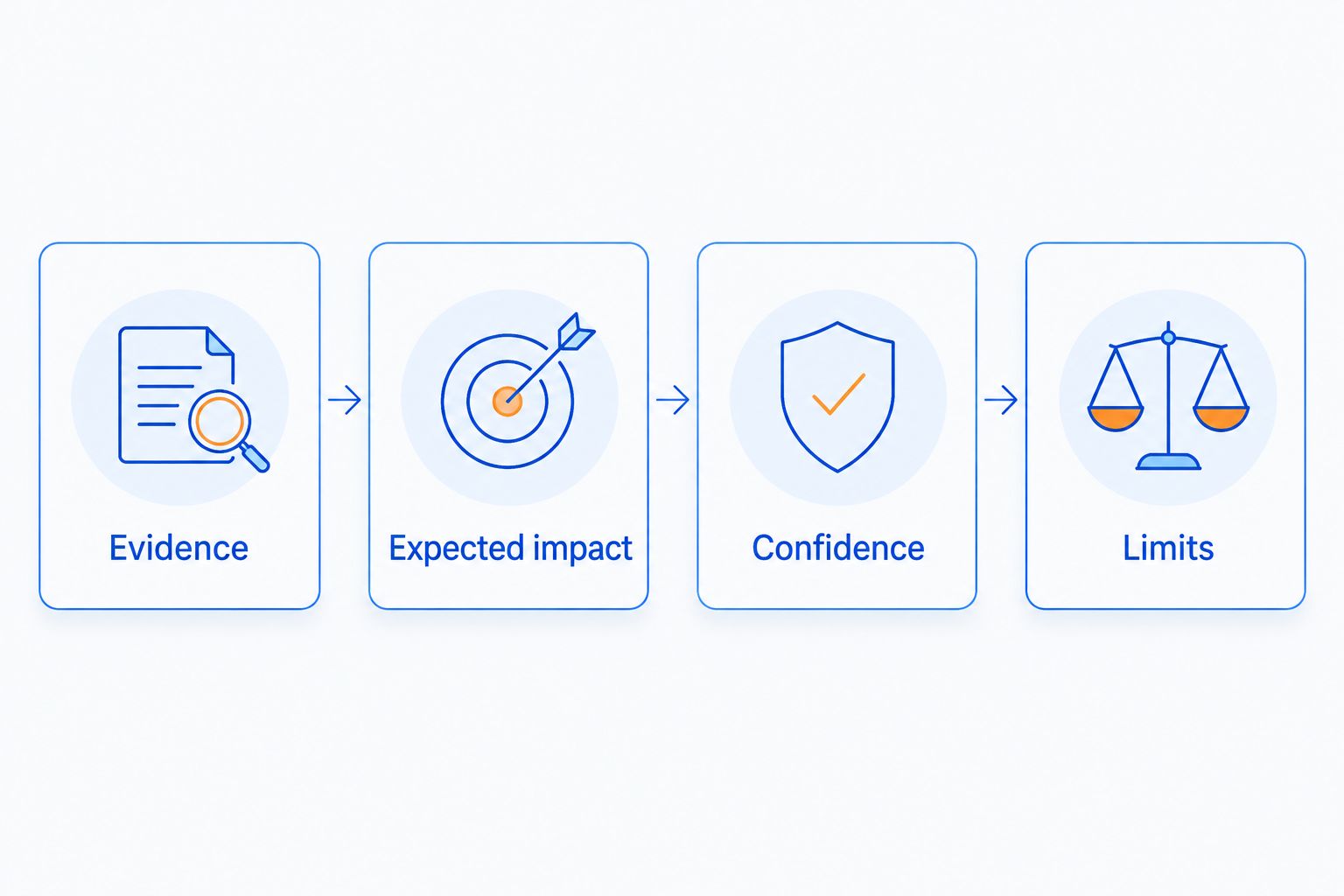
Ask for 4 evidence fields on every proposed allocation change: Evidence, Expected impact, Confidence, and Limits. These are review requirements, not performance claims. A recommendation that cannot explain them is not ready for a client budget meeting.
- Evidence: Identify the advertising, CRM, analytics, and revenue records supporting the recommendation. Check that the compared records cover a consistent reporting period.
- Expected impact: State the business outcome the change is intended to improve. Distinguish an estimate from an observed result.
- Confidence: Explain why the evidence supports the proposed action. A score needs a rationale; the label alone does not defend the decision.
- Limits: Name the gaps that restrict the conclusion. Missing sales outcomes and inconsistent lead definitions belong in the discussion.
For a focused evaluation, review 3 candidate reallocations drawn from your own accounts. Ask the vendor to explain the source records, the proposed decision, and the uncertainty behind each one. This is a recommended evaluation sample, not a claim about product performance.
Use 2 review gates: evidence review and human approval. First establish that the records support the recommendation; then decide whether the business should act. Read-only analysis and an approved budget change are different responsibilities.
Do not confuse an attribution result with proof of incremental revenue. Attribution assigns credit under a model. A causal claim needs a separate testing design.
Assess your private beta fit
Evaluate ranked budget recommendations against your agency's CRM and revenue decision requirements.
When staying with WhatConverts is the right call
Keep WhatConverts when inquiry tracking is the problem it already solves for you. An alternative that answers a different question is not automatically an upgrade. Removing a functioning tracking layer can leave a gap even if the new product improves budget discussions.
Separate replacement from addition. You can evaluate a decision-support layer without declaring that your source-tracking workflow has failed. Likewise, improving CRM records does not require changing every measurement component at once.
For your 2026 decision, document what stays, what changes, and who owns each handoff. The best shortlist produces a clear operating model, not merely a new subscription.
FAQ
What's the best WhatConverts alternative for budget decisions?
Paid Lens is the best fit on this shortlist for evidence-backed cross-channel budget recommendations tied to CRM revenue. Assess private beta fit and confirm the integration status required for your workflow before replacing any existing tracking function.
Is CallRail a closer WhatConverts alternative?
CallRail is a closer category comparison when call tracking is your main requirement. Evaluate the full inquiry workflow separately; shared call-tracking scope does not establish feature parity.
Can HubSpot replace WhatConverts?
HubSpot is a CRM-centered alternative, not a blanket replacement for WhatConverts tracking. Use it to evaluate customer and deal management, then assess your call, form, and chat requirements independently.
Do I need to replace WhatConverts to improve budget decisions?
No. Inquiry tracking and budget decision support solve different problems. Preserve a functioning tracking workflow while evaluating the evidence needed for allocation decisions.
What should an agency ask during an alternatives demonstration?
Ask the vendor to explain a recommendation using your own advertising and CRM records. Require evidence, expected impact, confidence, and limits, then check how the workflow preserves each client's tracking requirements.
Does attribution prove that a budget increase will generate more revenue?
No. Attribution assigns credit under a model; it does not by itself establish incremental revenue. Keep causal testing separate from source reporting and recommendation review.
How should I compare integration claims in 2026?
Separate live integrations from beta and coming-soon connections. Confirm the exact records your workflow needs and assess whether those records support the proposed decision.
One last thing
Ask each vendor what evidence would make it withdraw a recommendation. That question tests whether uncertainty has operational meaning. Paid Lens is best for agencies that need to defend budget recommendations with CRM revenue evidence. Apply that standard to the private beta evaluation, and keep tracking tools accountable for their own job.