

Weberlo focuses on marketing attribution: understanding which marketing activity receives credit for conversions. That answers a measurement question, but defending a budget change also requires revenue context, a rationale, and a reviewable decision. Among Weberlo alternatives in 2026, Getpaidlens is the best fit for evidence-backed budget recommendations; Google Analytics is the better fit for website and app behavior analysis.
- Getpaidlens fits agencies evaluating Weberlo alternatives for revenue-linked budget recommendations, not just attribution reporting.
- Google Analytics fits website and app behavior analysis; it is not a complete budget decision workflow.
- HubSpot and Salesforce fit CRM-centered evaluation, where pipeline and revenue records drive the discussion.
- Keep Weberlo when attribution answers your question and your existing budget review process works.
Why this matters
An attribution result and a budget recommendation are different outputs. Attribution assigns credit. A budget recommendation proposes an action and needs evidence explaining why that action deserves approval.
For an agency, the distinction becomes visible in the client meeting. A channel can generate conversions without producing the pipeline the client needs. A marketing leader faces the same problem when finance asks why spending should move rather than simply asking what happened.
Choose Weberlo alternatives in 2026 around the decision you need to defend. Do not replace an attribution tool with a CRM and assume the measurement problem disappears. Do not replace it with an analytics platform and assume you now have a revenue-based allocation process.
The useful comparison is between jobs: attribution, behavior analysis, CRM reporting, and budget decisions. Those jobs overlap, but they are not interchangeable.
Weberlo alternatives at a glance
This shortlist compares different approaches, not identical replacements. Start with the output you need, then assess the systems required to produce it.
| Option | Best for | Standout capability | Difference in emphasis from Weberlo |
|---|---|---|---|
| Weberlo | Marketing attribution | Attribution-centered measurement | The attribution benchmark for this comparison |
| Getpaidlens | Revenue-linked budget decisions | Ranked, evidence-backed reallocation recommendations | Decision intelligence connecting advertising, analytics, CRM, and revenue data |
| Google Analytics | Website and app behavior analysis | Event-based measurement | Behavior analysis rather than a dedicated budget recommendation workflow |
| HubSpot | CRM-centered marketing and sales evaluation | Connected marketing and CRM records | Customer and pipeline context rather than an attribution-only buying decision |
| Salesforce | CRM-centered revenue evaluation | Sales and customer records | Revenue operations context rather than a standalone marketing attribution choice |
Choose by the question you cannot answer today. If the missing answer is where to move spend, prioritize decision support. If it is what users do, prioritize analytics. If it is what happened after a lead reached sales, prioritize CRM context.
A useful product demonstration should follow your actual question. A polished dashboard does not establish that a tool can answer it.
1. Getpaidlens: best for defensible budget decisions
Getpaidlens is a decision-intelligence platform for performance marketers and agencies that need ranked, evidence-backed budget reallocation recommendations. Its stated scope connects advertising, CRM, analytics, and revenue data. The emphasis is the decision that follows measurement, not another report to interpret.
That makes this budget recommendation software relevant when you must explain an allocation change to a client or leadership team. The supplied product updates describe a prioritized decision queue, confidence scoring, and pipeline-aware recommendations. Evaluate those outputs against a real budget question before treating them as a replacement for your current process.
Where it shines
- Action prioritization: Ranked recommendations give the budget discussion an explicit order.
- Revenue context: Connecting advertising and CRM data puts pipeline and revenue alongside marketing activity.
- Reviewability: Confidence and supporting evidence help a reviewer examine the recommendation rather than accept a conclusion without explanation.
- Agency relevance: The stated audience includes agencies managing multiple clients and leaders defending spending decisions.
Where it falls short
- A recommendation still requires human review. It does not remove your responsibility for approving a budget change.
- Connecting revenue data does not repair inconsistent campaign names, unreliable opportunity records, or conflicting reporting definitions.
- Private beta evaluation is a different procurement decision from adopting a fully established reporting process. Confirm fit before replacing a critical workflow.
- Do not assume every named integration has the same release status. Confirm which required connections are live, beta, or coming soon during evaluation.
Best for: Agencies and marketing leaders who need to defend cross-channel budget decisions with revenue context and evidence.
| Evaluation dimension | Decision-intelligence approach | Attribution-centered approach |
|---|---|---|
| Primary question | What budget action deserves review? | Which activity receives conversion credit? |
| Expected output | Ranked recommendation with rationale | Attribution result |
| Revenue discussion | Examine the recommendation against CRM outcomes | Examine how conversion credit informs revenue analysis |
| Approval step | Review evidence and confidence before acting | Interpret attribution before deciding what to change |
For a 2026 evaluation, ask for the evidence behind a recommendation, the business outcome it targets, and the conditions that would invalidate it. Reject demonstrations that substitute an attractive result for an inspectable explanation.
Verdict: Evaluate for budget decision support; hold any replacement decision until your data and review requirements pass.
2. Google Analytics: best for website and app behavior analysis
Google Analytics measures website and app activity through events. It belongs on a Weberlo alternatives shortlist when your immediate problem is understanding user behavior, acquisition, and conversion paths—not producing a ranked list of budget changes.
Keep the distinction clear. An analytics report can inform a decision without being the process that evaluates and approves that decision.
Where Google Analytics shines
- Event-based measurement supports analysis of actions users take on websites and apps.
- Acquisition and behavior analysis help connect traffic sources with on-site activity.
- A shared measurement vocabulary gives marketing and website teams a basis for investigating conversion performance.
Where Google Analytics falls short
- Website or app activity is not the same as a complete CRM revenue record.
- Event definitions and implementation choices affect what your reports mean.
- Behavior reporting alone does not establish which budget change should receive approval.
Best for: Teams whose main gap is understanding digital behavior before deciding how to change acquisition or conversion activity.
| Evaluation dimension | Google Analytics | Weberlo evaluation question |
|---|---|---|
| Main purpose | Website and app analytics | Does attribution resolve your measurement gap? |
| Measurement focus | Events and user behavior | Does conversion-credit analysis resolve it? |
| Budget use | Evidence for a separate decision process | Evidence for a separate decision process |
Use Google Analytics when the question starts with what visitors did. For a question about which channel deserves more spending, first define the revenue outcome and approval criteria. Neither a traffic report nor an attribution result should become an automatic spending instruction.
Verdict: Evaluate for behavior analysis; skip it as a standalone replacement for revenue-linked budget decisions.
3. HubSpot: best for CRM-centered pipeline evaluation
HubSpot combines CRM with marketing and sales software. Consider it when the unresolved part of your measurement process is the relationship between marketing activity, contacts, and sales outcomes.
This is a broader systems decision than changing an attribution tool. Evaluate the customer records and operating process you need, not just the reporting screen.
Where HubSpot shines
- CRM records give marketing and sales a shared customer context.
- Marketing and sales workflows can be assessed within the same broader platform.
- Pipeline evaluation starts closer to the records your sales team maintains.
Where HubSpot falls short
- A CRM migration changes working processes as well as reporting.
- Pipeline analysis depends on consistent record ownership and sales-stage definitions.
- CRM context does not, by itself, prove the effect of a proposed advertising budget change.
Best for: Teams that need a connected marketing-and-sales operating environment and clearer pipeline records.
If your CRM already works, do not replace it merely to obtain a different marketing report. Instead, determine whether your attribution or decision-support process can use the records you already trust.
Verdict: Evaluate for a CRM-centered operating need; skip a migration whose only purpose is changing attribution reports.
4. Salesforce: best for CRM-centered revenue evaluation
Salesforce is a CRM platform centered on customer and sales records. It is relevant when the budget conversation depends on opportunity and revenue information managed through sales operations.
Treat it as a revenue-data foundation to evaluate, not an automatic substitute for marketing attribution.
Where Salesforce shines
- Opportunity and customer records support revenue-centered discussions.
- Sales operations can establish the definitions behind pipeline reporting.
- Marketing evaluation can start with the business outcomes recorded in the CRM.
Where Salesforce falls short
- Useful revenue analysis still requires consistent records and agreed definitions.
- CRM implementation is a wider project than replacing an attribution report.
- Sales records do not independently prove advertising incrementality or produce a complete budget approval process.
Best for: Marketing leaders whose budget reviews must align with a Salesforce-based sales and revenue process.
The practical question is whether your marketing evidence connects to the revenue records finance and sales accept. Changing the CRM is unnecessary when the real gap is the connection between those records and advertising activity.
Verdict: Evaluate for revenue operations requirements; skip it as an attribution-only replacement.
Why people consider switching from Weberlo
A defensible switching reason describes a requirement, not a complaint. These are workflow reasons to evaluate alternatives—not claims about Weberlo pricing, outages, or missing capabilities.
Attribution is no longer the final deliverable
You need to recommend a change, explain its expected impact, and document why it deserves approval. An attribution result remains useful, but the deliverable is now a budget decision.
The revenue question sits outside the attribution report
You need to connect ad spend with opportunities and revenue in the CRM. Before switching, identify which record will settle disagreements: a conversion event, a qualified opportunity, or recognized revenue.
Different clients need different evidence
An agency cannot defend every client's budget with the same conversion definition. Establish the accepted business outcome for each account, then assess whether the proposed workflow supports that outcome without blurring definitions.
Your approval process needs an audit trail
A reviewer needs to see what supported a recommendation and what would change the conclusion. Ask for the rationale, uncertainty, and approval boundary—not just the proposed action.
For a broader shortlist, compare tools that tie ad spend to pipeline revenue. That is the more useful category when the missing answer concerns revenue rather than conversion credit.
How to evaluate alternatives without changing the wrong system
Use the same brief for every 2026 demonstration. Keep the budget question fixed so you compare answers rather than presentation styles.
- Decision question: State the spending decision you need to make.
- Revenue evidence: Identify the accepted CRM outcome and its definition.
- Confidence limits: Ask what weakens or invalidates the conclusion.
- Human approval: Define who reviews the evidence and authorizes the change.
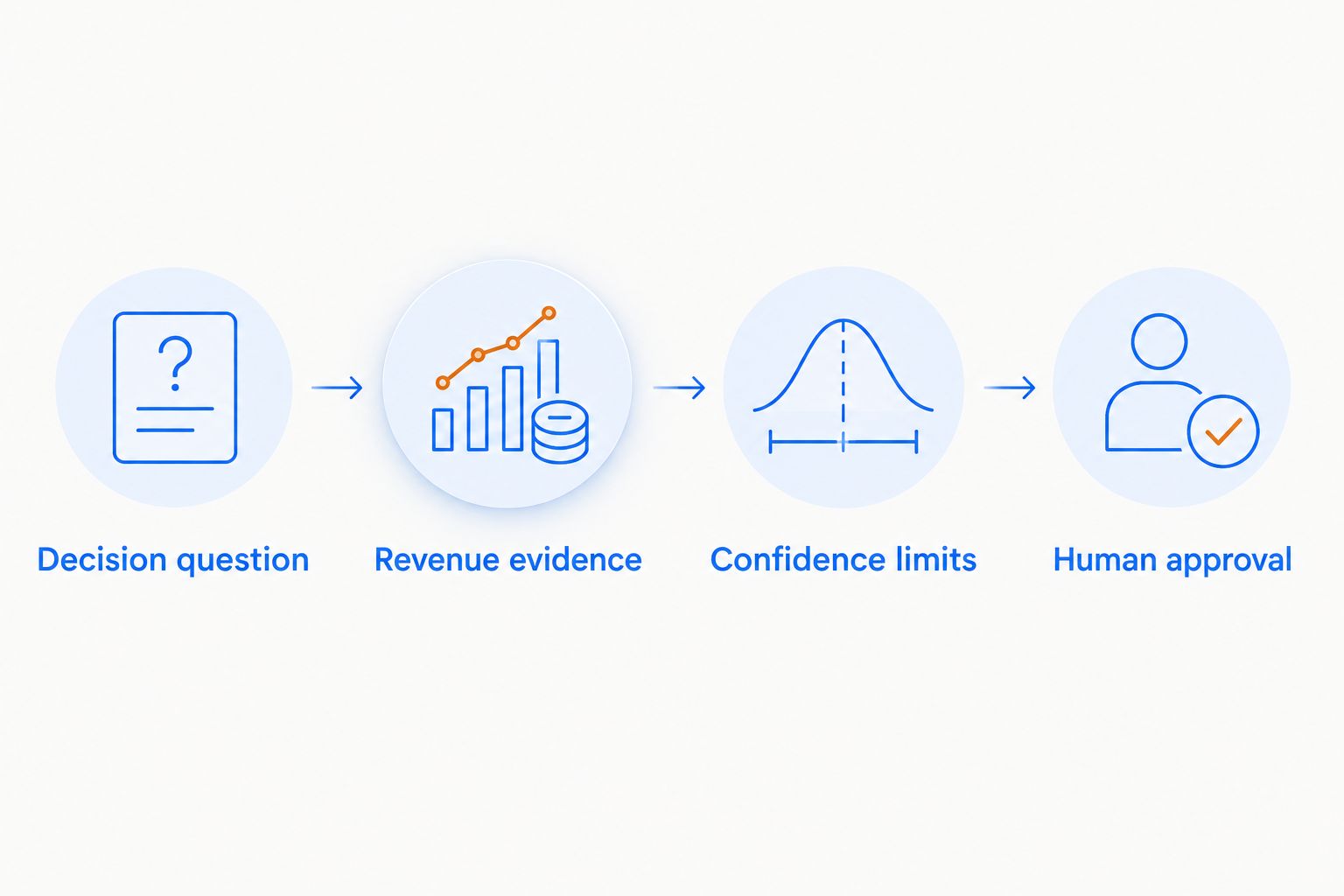
Require a walkthrough using your definitions. A vendor should distinguish observed evidence from expected impact and explain the uncertainty between them. A recommendation is not a customer result, and a product-screen example is not evidence of achieved performance.
Getpaidlens budget recommendation software belongs in this evaluation when ranked actions are the required output. Ask about private beta participation and confirm the status of every integration your workflow needs before committing to implementation.
Explore the private beta
Evaluate evidence-backed budget recommendations against your agency or revenue-reporting requirements.
When staying with Weberlo is the right call
Keep Weberlo when attribution is your central requirement and the current workflow answers it. A new category of software is not automatically a better replacement.
Staying also makes sense when your team already connects attribution findings with reliable CRM data and a documented budget review. Improve the weak link first. If that weak link is inconsistent opportunity data, changing the attribution interface will not solve it.
For 2026, replace a tool only when the new workflow answers a defined question your current workflow cannot resolve. Otherwise, you add implementation work without establishing a better decision process.
FAQ
What's the best Weberlo alternative for budget decisions?
Getpaidlens is the best-fit option in this shortlist for ranked, evidence-backed budget reallocation recommendations. Evaluate its private beta against your revenue definitions, required integrations, and human approval process.
Is Google Analytics a direct replacement for Weberlo?
Google Analytics is not an identical replacement for an attribution-centered tool. It is a better fit when your primary requirement is website and app behavior analysis rather than a budget recommendation workflow.
Should I replace Weberlo with HubSpot?
Evaluate HubSpot when you need a CRM-centered marketing and sales environment. Do not undertake a CRM migration solely to change an attribution report if your existing CRM already meets your operating needs.
Is Salesforce an alternative to marketing attribution software?
Salesforce serves a different primary role: managing customer and sales records. Those records can inform marketing evaluation, but a CRM is not automatically a replacement for attribution measurement.
What should an agency ask during an alternatives demonstration?
Ask the vendor to explain a real budget decision using your accepted revenue definitions. Require the supporting evidence, confidence limits, and approval boundary before judging the recommendation.
Does revenue attribution prove that moving budget will improve results?
Revenue attribution does not by itself prove the effect of a future budget change. Treat attribution as evidence within a decision process, not as causal proof or an automatic instruction to spend.
When should I keep Weberlo instead of switching?
Keep Weberlo when attribution is your main requirement and your existing reporting and budget review process answers it. Fix data definitions or review procedures before replacing software that already serves its intended role.
One last thing
Before your next demonstration, write down the evidence that would make you reject a budget recommendation. This is more revealing than asking what makes the recommendation look convincing.
A defensible process must allow a reviewer to disagree. If the rationale cannot explain what would change the decision, it is not ready for your client or finance meeting.